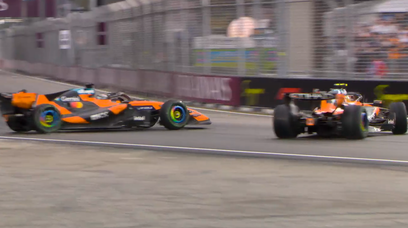
McLaren demonstrated once again at the Bahrain Grand Prix that it has a car operating on a higher plane than its F1 rivals. In truth, qualifying had represented perhaps the least-evident data of this reality, as the MCL39 was even more dominant in every free practice session in Sakhir, and then again at the hands of Oscar Piastri in the race. The Woking-based team managed to find optimal balance for car from the outset of the campaign, something that has guaranteed the performance shown so far on a range of different tracks. Importantly for the papaya squad, whilst the FIA has tightened the rules on the controlled flexibility of rear wings (with similar changes pertaining to front wings postponed until the Spanish Grand Prix), it has been clear from the start of the season that some top teams, namely McLaren and Ferrari, have not experienced a tangible loss of performance, despite the governing body's focus on compliance with the tightened regulations.
Learning tricks from Red Bull
The MCL39 has proved to be very efficient on the straight, whilst maintaining a vertical load through corners that does not penalise the dynamic behaviour of the car - and its wings are absolutely legal as they have passed all the static tests regarding controlled elasticity of the differing elements. The FIA carefully monitors micro-flexing of the rear wing through adhesive stickers positioned to detect if the designed deformation exceeded allowable limits and therefore illegal. In reality, the MCL39's competitiveness does not depend solely on the deformation of the wings. Interestingly, however, its technical director, Rob Marshall - who joined McLaren from Red Bull at the start of 2024 - was the mind behind a similar approach at the Milton Keynes squad. It is a characteristic the six-times constructors' champion has progressively lost after the exit of Marshall, who, as a pragmatic engineer, always had enviable task of making Adrian Newey's theoretical visions feasible. It therefore logical that McLaren found itself in a position to perfect that work in adherence to the regulations, despite the aerodynamic concept of the MCL39 being decidedly extreme.
Most read


Never miss a thing from the Formula 1 season! Add the 2026 F1 schedule to your calendar at the touch of a button. Subscribe below and put the dates and times of every race directly on your PC or smartphone, so you don't miss a second from the new season.
Download the F1 calendar Download the F1 calendar
A variant with just the race and qualifying is also available.
Click here to download it..