

Ferrari
- Nationality
-
 Italian
- Leader
-
 Frederic Vasseur
- Active
- 1950 - present
- Standings
- 2th (358 pts)
Drivers 2026


Lewis Hamilton and Charles Leclerc are determined to lead Scuderia Ferrari back to Formula 1 glory in 2026 with the new SF-26 following a disappointing 2025 season.
Ferrari profile
- Name
- Ferrari
- Nationality
-
Italian
- Debut race
-
 Monaco Grand Prix 1950
- Last race
-
 Spanish Grand Prix 2026
Career of Ferrari
-
F1 years
- 77
- Best race result
- 1
- Number of Grands Prix won
- 1138
- Number of sprint races
- 29
- Sprint wins
- 1 / 29
- 3.4%
- WC points
- 11315
-
Victories
- 250
- 22.0%
- Wins from pole
- 105 / 257
- 40.9%
- Hat-tricks
- 18
- Grand Slams
- 4
- Most wins in a season
- 15
- Win streak
- 13
-
Podium finishes
- 847
- 74.4%
- P1 finishes
- 250 / 847
- 29.5%
- P2 finishes
- 296 / 847
- 34.9%
- P3 finishes
- 301 / 847
- 35.5%
- Most podiums in a season
- 29
- Podium streak
- 53
Ferrari foundations and early history
Ferrari have a long and storied history in F1, being the sport's oldest and most successful team.
Founded in 1929 by Enzo Ferrari, the team was initially created with the intention of entering amateur drivers in various races. The idea came to life on 16 November 1929, when Ferrari asked for financial help from textile heirs Augusto and Alfredo Caniato, along with wealthy amateur racer Mario Tadini, during a dinner in Bologna.
He then gathered a group that included over 40 drivers, most of whom competed in various Alfa Romeo 8C cars, while Ferrari himself continued racing until the birth of his son, Dino, in 1932. The Prancing Horse emblem made its first appearance at the 1932 Spa 24 Hours on a two-car team of Alfa Romeo 8C 2300 Spiders, which finished first and second.
With Alfa Romeo experiencing economic hardship, the outfit withdrew from in-house racing, making Scuderia Ferrari the acting team when the factory released the Monoposto Tipo B racers to the Scuderia.
The first car to wear the Ferrari badge came in 1925, when Enzo and Luigi Bazzi built the Alfa Romeo Bimotore. After managing numerous drivers, Alfa Romeo made Enzo the manager of the factory racing division, Alfa Corse, in 1938.
However, after a disagreement, Enzo left, founding the Auto Avio Costruizioni Ferrari, which also manufactured machine tools. He was allowed to exit Alfa on the condition that the Ferrari name would not appear on cars for four years.
Ferrari started working on his own race car, the Tipo 815, in 1939-40, making it the first true Ferrari car. However, World War II put a temporary hold on all racing. While Ferrari continued to manufacture machine tools, the headquarters were moved to Maranello in 1943, only to be bombed the following year.
After rebuilding the venue, the 12-cylinder, 1.5 L Tipo 125 was created, and it went on to compete at several non-championship grands prix. Making its debut at the 1948 Italian Grand Prix with Raymond Sommer, the team's first win came at the Circuit di Garda with Giuseppe Farina.
Once the four-year restriction expired, the road car company Ferrari S.p.A was born, while the name SEFAC (Società Per Azioni Escercizio Fabbriche Automobili e Corse) was used for the racing division.
F1 championship begins with Ferrari
The first F1 world championship was established in 1950, with Scuderia Ferrari taking part from the beginning. To this day, the Italian outfit is the only team to have competed in every season since its inception.
However, Ferrari did not take part in the first race of the championship, the British Grand Prix, due to a dispute over money paid to entrants. As a result, the squad debuted at the Monaco Grand Prix with the 125 F1, which featured a supercharged version of the 125 F12.
The trio of Alberto Ascari, Raymond Sommer and Gigi Villoresi were unable to stop Alfa Romeo's dominance, as they won all 11 events [six world championship races and five non-championship]. However, Ferrari ended that run in 1951 when Jose Froilan Gonzalez took the British Grand Prix, ahead of Juan Manuel Fangio in the Alfa Romeo.
With Alfa Romeo withdrawing from the sport after the 1951 season, Ferrari went on to win almost every race in 1952 with the 2.0 L 4-cylinder Ferrari Tipo 500, with Ascari clinching the championship after winning six consecutive races. Ascari took the title again the following year.
The final grand prix of the season saw Fangio win in a Maserati, and it was a sign of things to come as the Argentine claimed the title in the subsequent season, too. Ferrari was unable to keep up with its Italian competitors and Mercedes, resulting in just two victories in 1954.
Ferrari continued to win races in the years that followed, though it was not until 1958 that it took another drivers' championship. Mike Hawthorn won in the Ferrari 246 F1 with a V6 engine named after Enzo Ferrari's recently deceased son. Hawthorn announced his retirement after the triumph. Tragically, he passed away just three months later following a road accident.
1960s success with Graham Hill and John Surtees
After Phil Hill gave Ferrari its only win in 1960, the American battled it out with team-mate Wolfgang von Trips for the title during the following year in the Ferrari 156, which was based on the Formula 2 car that had dominated the series the year before.
Giancarlo Baghetti joined the team mid-season and became the first driver to win his debut race at the French Grand Prix. However, the season ended on a tragic note as von Trips crashed at the Italian GP and was killed, along with over a dozen spectators. As a result, Hill won his only title, with Ferrari opting not to compete at the season finale at Watkins Glen in New York.
John Surtees and Lorenzo Bandini were joined by Pedro Rodriguez in 1964. Whilst the Ferrari was slower than Jim Clark's Lotus, its superior reliability made the difference. Surtees took the title after claiming two victories, while Bandini added a third victory and finished fourth in the standings.
From there, Ferrari entered into a decline as the likes of Lotus, Brabham and Matra claimed titles to close out the decade.
1970s and return to glory with Niki Lauda
The 1970s started with Jacky Ickx, who rejoined the team for a second stint, battling it out with Lotus' Jochen Rindt for the title. Ickx won three races, while Clay Regazzoni added a fourth in Italy.
In the end, Ickx had to settle for second in the championship as he was unable to overtake Rindt, who passed away with four races remaining during practice for the Italian Grand Prix. He became the only driver to be posthumously awarded the drivers' championship. Ferrari driver Pedro Rodriguez was also killed at an Interserie sports car race in Nuremberg.
The following three years saw Ferrari struggle, with the team failing to attend two races - the Dutch and German Grands Prix - in 1973, the first time the team had done so since starting in F1.
Niki Lauda was signed in 1974, with Luca di Montezemolo appointed team principal, and the Scuderia's fortunes turned around. It won races in Spain, the Netherlands and Germany, but ultimately Regazzoni lost the world championship to Emerson Fittipaldi at the final race of the season in the USA.
Mauro Forghieri designed the Ferrari 312T used in 1975, and it proved to be a success. The team returned to its winning ways, with Lauda calling it "the unbelievable year". No other car in the field was a match, with Lauda winning five races and Regazzoni adding a sixth victory. However, it was Lauda who took the drivers' championship with ease over Fittipaldi in the McLaren.
Lauda was comfortably leading the championship in 1976 when disaster struck at the German Grand Prix at the Nürburgring. The Austrian crashed his Ferrari and was enveloped in flames before being hit by two further cars. Lauda suffered serious burns and was rushed to hospital, where he fought for his life over the next few days.
While Ferrari hired Carlos Reutemann as a replacement, the team fielded three cars at the Italian Grand Prix as Lauda returned just six weeks after his accident. While the Austrian scored points at two races following his return, he voluntarily withdrew from the season-ending Japanese GP at Fuji due to heavy rain, opening the door for James Hunt to win the title by one point, though Ferrari won the constructors' championship for a second year running.
There was no stopping Lauda in 1977, as he won three races to take his second title ahead of Jody Scheckter and Mario Andretti. However, his relationship with Ferrari deteriorated from there, and Lauda left for Brabham at the end of the season.
Scheckter replaced Reutemann in 1979 and partnered Gilles Villeneuve. The two drivers scored a total of six victories from 15 events, including a one-two finish at the Italian Grand Prix, but Scheckter ultimately came out on top by four points. It would prove to be Ferrari's last drivers' championship for 21 years.
Early 1980s success followed by decline
Scheckter's title defence in 1980 was one to forget as Ferrari fell behind their rivals, with the squad scoring just eight points all season. This prompted the South African to retire at the end of the campaign.
The team bounced back in 1982 with Villeneuve and Didier Pironi, with Ferrari proving to be the best package in terms of speed and reliability for much of the year. However, tragedy struck twice, as Villeneuve was killed during qualifying for the Belgian GP, while Pironi suffered career-ending injuries before the German GP. Ferrari still managed to win the constructors' championship.
Another constructors' title followed in 1983, but from there the team failed to mount a serious challenge for the drivers' crown following Michele Alboreto's efforts in 1985.
Enzo Ferrari passed away in August 1988 at the age of 90, increasing Fiat's shares in the company to 90 per cent. Gerhard Berger and Alboreto completed a famous one-two at the Italian GP less than a month after Enzo's passing, with the Austrian dedicating the win - the only one by a team other than McLaren in 1988 - to the late founder.
Ferrari brought reigning champion Alain Prost in to partner Nigel Mansell for the 1990 season, and the Frenchman entered the penultimate round of the season in Japan nine points behind rival and former McLaren team-mate Ayrton Senna. A controversial collision on the first lap ended Ferrari's hopes for a world title, with Prost forced to settle for second.
Jean Alesi replaced Mansell in 1991, and Prost failed to see out the season after he was fired before the Australian Grand Prix due to a falling out with the team. Ferrari failed to win a race in 1991, a trend that continued in 1992 and 1993.
Berger became Alesi's team-mate in 1993, while Jean Todt was hired as team principal, the first of several moves that would lead to the team's renaissance. Berger won the 1994 German Grand Prix, while Alesi took victory at the 1995 Canadian Grand Prix, though the squad was never in championship contention in either season.
Schumacher joins and writes Ferrari history
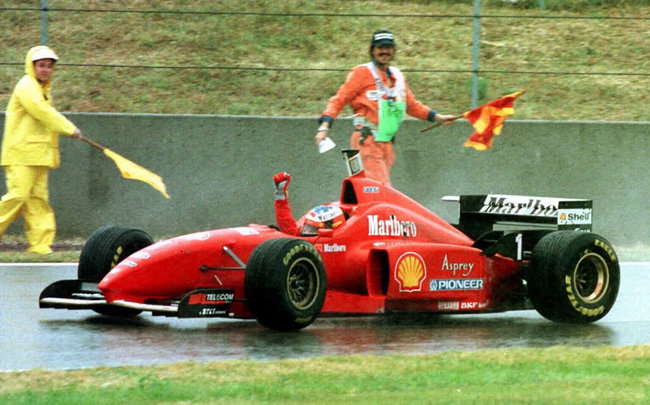
The 1996 season saw Ferrari overhaul its driver line-up, with two-time defending champion Michael Schumacher joining alongside Eddie Irvine. The German, who won both titles while with Benetton, brought with him several of the team's technical staff, including technical director Ross Brawn and chief designer Rory Byrne.
While the Ferrari F310 was not great in terms of reliability, Schumacher managed to claim three victories in Spain, Belgium and Italy, marking the Scuderia's first win at Monza since 1988.
The increased reliability of the F310B in 1997 helped Ferrari to push for its first drivers' championship since Scheckter in 1979. Schumacher tallied five wins and eight podium finishes, and went into the final race with a one-point lead on Jacques Villeneuve.
However, a collision between the two, as the Canadian tried to take the lead, saw Schumacher retire. Villeneuve carried on and claimed the title with a third-place finish. Initially deemed a racing incident, Schumacher was disqualified from the championship for unsportsmanlike behaviour.
Schumacher battled it out with Mika Hakkinen for the 1998 title, winning six races, but there was no fairytale ending. At the season finale in Japan, Schumacher started on the front row but suffered a puncture mid-race, ending his bid for the championship.
In 1999, Ferrari took victory at three of the opening four races, with Eddie Irvine claiming his first career win in Australia. However, things started to go wrong in Canada when Schumacher crashed into the Wall of Champions while leading the race.
The German's bid for the championship ended on the first lap of the British Grand Prix, when a rear brake failure sent him crashing heavily at Stowe. Schumacher broke his lower right leg as a result, missing the next six races. Mika Salo stepped in as replacement.
As a result, Irvine took on Ferrari's push for the title and won the next two races in Austria and Germany. Schumacher returned for the final two grands prix of the season, helping Irvine to win the inaugural Malaysian Grand Prix.
Irvine led Hakkinen by four points in the championship heading into the final round, but his bid for the title fell short as Hakkinen won the race and the title by two points. Ferrari did win the constructors' championship, though, for the first time since 1983.
End of title drought kicks off historic Ferrari run
Rubens Barrichello replaced Irvine for the 2000 F1 season. The campaign started well, with Schumacher winning the opening three races to lead the championship by 21 points. A mid-season slump saw him retire in four of five grands prix, reducing his lead to two points.
However, finishing the year with four consecutive wins ensured he became the Scuderia's first drivers' champion since Scheckter in 1979. Barrichello finished fourth in the standings, helping Ferrari to claim its second consecutive constructors' championship.
It was the start of one of the most dominant eras in F1, as Schumacher embarked on a run of five consecutive drivers' titles, and Ferrari extended its streak to six successive constructors' crowns.
The triumph kickstarted a historic run for the Scuderia, with Schumacher taking the 2001 title after a dominant season in which he earned nine victories and clinched the championship with four races remaining.
Along the way, Ferrari won 15 out of the 17 races in 2002, matching McLaren's record number of wins set in 1988. Schumacher clinched 11 victories, though his win in Austria was controversial, with Barrichello being asked to let him through on the final lap, resulting in team orders being banned ahead of the 2003 season.
In 2004, Schumacher won 13 of the 18 races, including 12 of the first 13 of the season, taking his championship tally to seven, but that is where the success ended as Schumacher and Ferrari managed only one victory in 2005, and that was controversial, given the Michelin runners at the United States GP withdrew over safety fears, leaving just the six Bridgestone-shod cars to compete.
Barrichello departed at the end of the year, with Felipe Massa coming in as his replacement for 2006, a year in which Schumacher challenged Fernando Alonso for the title. Despite equalling the Spanish driver with seven wins, he fell 13 points shy.
Schumacher, who had announced his retirement from F1 at the Italian GP, was replaced by Kimi Raikkonen for the 2007 season.
Raikkonen adds to Ferrari's success
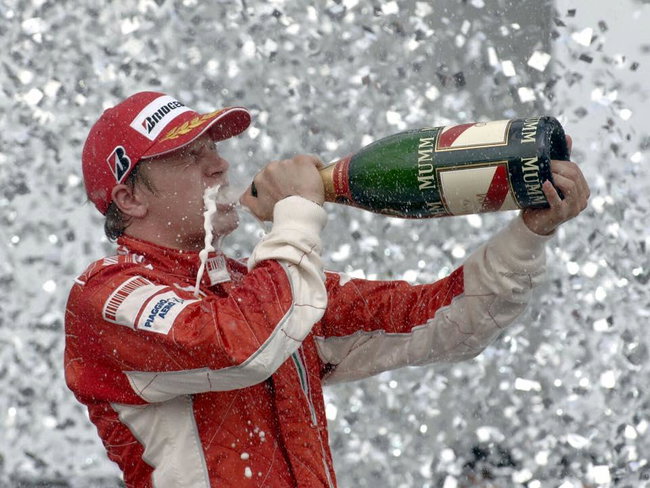
Raikkonen won his first race for the team in Australia, becoming the first Ferrari driver to win on his debut since Mansell in 1989. Despite entering the final race of the season trailing McLaren duo Alonso and Lewis Hamilton in the championship standings, the Finn defied the odds to take victory, clinching the title by just one point.
Raikkonen ended the campaign with six victories, whilst Massa's three wins helped the team win the constructors' championship, albeit after McLaren was disqualified following the 'spygate' saga.
In 2008, whilst Raikkonen led the championship early on, it was ultimately Massa who battled it out with Hamilton for the crown.
The Brazilian entered the season finale in his home country with a chance to clinch the title. Although he won the race, it was Hamilton who became champion after passing Timo Glock on the final corner of the last lap. Despite the disappointment, the Scuderia added another constructors' title to its tally.
In 2009, Ferrari suffered its worst start to a season since 1981 after failing to score a point in the first three grands prx. Massa then missed the second half of the year after suffering severe head injuries during qualifying for the Hungarian GP after being struck by a spring from the rear suspension of Barrichello's Brawn. He was replaced by Luca Badoer and then Giancarlo Fisichella. The team registered only one win, in Belgium, thanks to Raikkonen.
Close calls with Alonso and Vettel
Raikkonen was replaced by Fernando Alonso for 2010, despite the Finn having a year remaining on his contract. The Spaniard started the season strongly, leading a Ferrari one-two in Bahrain, and then winning in Germany, Italy, Singapore and Korea.
Alonso entered the final race of the year needing to finish in the top two to win the title. However, a strategy error resulted in him finishing seventh, handing the championship to Sebastian Vettel.
Ferrari was not competitive in 2011 and won just one race, but the team returned to form in 2012. Victories in Malaysia, Valencia and Germany helped Alonso build a 40-point lead in the standings, yet two DNFs and no wins in the final 10 races helped Vettel reclaim his crown.
Vettel dominated the 2013 season with Red Bull, with Alonso again settling for second in the standings. While the Ferrari driver registered two wins, his relationship with the team began to sour. That feeling carried over to 2014, as Mercedes burst onto the scene and Ferrari went without a win.
Considerable change followed in 2015, with Vettel replacing Alonso, while Sergio Marchionne and Maurizio Arrivabene took over as Ferrari president and team principal, respectively. The team ended a run of 34 races without a win by taking the chequered flag in Malaysia thanks to Vettel, who also claimed victory in Hungary and Singapore.
The Scuderia took a step back the following year and failed to win a race, but bounced back in 2017, with Vettel winning the season opener in Australia. As a result, the German became the first Ferrari driver to lead the championship since the 2012 Japanese GP, along with being the first non-Mercedes driver to do so since he had previously led at the end of the 2013 season.
A one-two result came in Monaco, Ferrari's first since 2010. A second followed in Hungary, but a slump in the latter half of the year saw reliability issues dent Vettel's championship hopes.
Ferrari and Vettel mounted another push for the title in 2018. However, a mistake at the German GP at Turn 13 caused the four-time champion to crash into a wall. From there, Hamilton did not look back, taking his fifth title by 88 points.
While Ferrari replaced Raikkonen with Charles Leclerc before the 2019 season, the team was never in the running for the title. Leclerc finished the campaign with two wins compared to Vettel's one, as Hamilton and Mercedes again dominated.
Vettel and Leclerc returned for the Covid-hit 2020 season. Before the start, though, it was announced that the German would be replaced by Carlos Sainz at the end of the campaign.
It was a year to forget for the Scuderia as they finished sixth in the constructors' championship, its worst result since 1980. A lone bright spot came at the Tuscan Grand Prix, which marked Ferrari's 1,000th GP start as a constructor.
A lean decade so far
Despite Ferrari starting 2021 with its youngest driver line-up in over 50 years, with Leclerc and Sainz, the campaign was a tough one that yielded no wins and just five podiums, with four for the Spaniard, and the team a distant third in the constructors'.
At least the team, and Leclerc especially, started 2022 strongly, with the Monégasque winning two of the first three races, and second in the other, to take an early lead in the championship.
But it proved to be a false dawn as strategic errors, team mistakes, and gaffes from Leclerc saw his title hopes fizzle out, whilst Ferrari finished over 200 points behind Red Bull in the constructors'. One of the few bright spots was Sainz's first F1 win, taking the flag at Silverstone for his country's first victory for a decade since Alonso in 2013.
At the end of the year, Ferrari confirmed Alfa Romeo team principal Fred Vasseur would replace Mattia Binotto. But like every other team and driver in 2023, Ferrari, Vasseur, Leclerc and Sainz were merely bit-part players in a staggering season for Red Bull and Verstappen, who won 19 of 22 races.
The one highlight for Ferrari was Sainz's win in Singapore, whilst Leclerc was runner-up in the final two races, a portent of what was to follow in 2024, which started with a major bombshell, however, as it was announced on February 1 that Hamilton would be joining the team for 2025, replacing Sainz.
He still gave his all, winning two races to Leclerc's three, and along with an additional 17 podiums between them, the team went into the final race in with a shout of the constructors' title, only to fall 14 points shy of McLaren.
With Hamilton on board in 2025, there was no follow-through. Instead, the seven-time champion finished the year without a podium for the first time in his 19-season career. Leclerc managed seven top-three finishes - no wins - but Ferrari slumped to fourth in the constructors', a staggering 400 points behind McLaren.
With new regulations for 2026, it is hoped Ferrari, Hamilton and Leclerc can finally conjure a title challenge.
Get the latest F1 news from RacingNews365 directly in your Google feed! Click on the link below and you’ll see your favourite F1 website appearing even more often. That way, you’ll never miss any news, analyses, interviews, or exclusives.
Follow RacingNews365 on GoogleFerrari foundations and early history
Ferrari have a long and storied history in F1, being the sport's oldest and most successful team.
Founded in 1929 by Enzo Ferrari, the team was initially created with the intention of entering amateur drivers in various races. The idea came to life on 16 November 1929, when Ferrari asked for financial help from textile heirs Augusto and Alfredo Caniato, along with wealthy amateur racer Mario Tadini, during a dinner in Bologna.
He then gathered a group that included over 40 drivers, most of whom competed in various Alfa Romeo 8C cars, while Ferrari himself continued racing until the birth of his son, Dino, in 1932. The Prancing Horse emblem made its first appearance at the 1932 Spa 24 Hours on a two-car team of Alfa Romeo 8C 2300 Spiders, which finished first and second.
With Alfa Romeo experiencing economic hardship, the outfit withdrew from in-house racing, making Scuderia Ferrari the acting team when the factory released the Monoposto Tipo B racers to the Scuderia.
The first car to wear the Ferrari badge came in 1925, when Enzo and Luigi Bazzi built the Alfa Romeo Bimotore. After managing numerous drivers, Alfa Romeo made Enzo the manager of the factory racing division, Alfa Corse, in 1938.
However, after a disagreement, Enzo left, founding the Auto Avio Costruizioni Ferrari, which also manufactured machine tools. He was allowed to exit Alfa on the condition that the Ferrari name would not appear on cars for four years.
Ferrari started working on his own race car, the Tipo 815, in 1939-40, making it the first true Ferrari car. However, World War II put a temporary hold on all racing. While Ferrari continued to manufacture machine tools, the headquarters were moved to Maranello in 1943, only to be bombed the following year.
After rebuilding the venue, the 12-cylinder, 1.5 L Tipo 125 was created, and it went on to compete at several non-championship grands prix. Making its debut at the 1948 Italian Grand Prix with Raymond Sommer, the team's first win came at the Circuit di Garda with Giuseppe Farina.
Once the four-year restriction expired, the road car company Ferrari S.p.A was born, while the name SEFAC (Società Per Azioni Escercizio Fabbriche Automobili e Corse) was used for the racing division.
F1 championship begins with Ferrari
The first F1 world championship was established in 1950, with Scuderia Ferrari taking part from the beginning. To this day, the Italian outfit is the only team to have competed in every season since its inception.
However, Ferrari did not take part in the first race of the championship, the British Grand Prix, due to a dispute over money paid to entrants. As a result, the squad debuted at the Monaco Grand Prix with the 125 F1, which featured a supercharged version of the 125 F12.
The trio of Alberto Ascari, Raymond Sommer and Gigi Villoresi were unable to stop Alfa Romeo's dominance, as they won all 11 events [six world championship races and five non-championship]. However, Ferrari ended that run in 1951 when Jose Froilan Gonzalez took the British Grand Prix, ahead of Juan Manuel Fangio in the Alfa Romeo.
With Alfa Romeo withdrawing from the sport after the 1951 season, Ferrari went on to win almost every race in 1952 with the 2.0 L 4-cylinder Ferrari Tipo 500, with Ascari clinching the championship after winning six consecutive races. Ascari took the title again the following year.
The final grand prix of the season saw Fangio win in a Maserati, and it was a sign of things to come as the Argentine claimed the title in the subsequent season, too. Ferrari was unable to keep up with its Italian competitors and Mercedes, resulting in just two victories in 1954.
Ferrari continued to win races in the years that followed, though it was not until 1958 that it took another drivers' championship. Mike Hawthorn won in the Ferrari 246 F1 with a V6 engine named after Enzo Ferrari's recently deceased son. Hawthorn announced his retirement after the triumph. Tragically, he passed away just three months later following a road accident.
1960s success with Graham Hill and John Surtees
After Phil Hill gave Ferrari its only win in 1960, the American battled it out with team-mate Wolfgang von Trips for the title during the following year in the Ferrari 156, which was based on the Formula 2 car that had dominated the series the year before.
Giancarlo Baghetti joined the team mid-season and became the first driver to win his debut race at the French Grand Prix. However, the season ended on a tragic note as von Trips crashed at the Italian GP and was killed, along with over a dozen spectators. As a result, Hill won his only title, with Ferrari opting not to compete at the season finale at Watkins Glen in New York.
John Surtees and Lorenzo Bandini were joined by Pedro Rodriguez in 1964. Whilst the Ferrari was slower than Jim Clark's Lotus, its superior reliability made the difference. Surtees took the title after claiming two victories, while Bandini added a third victory and finished fourth in the standings.
From there, Ferrari entered into a decline as the likes of Lotus, Brabham and Matra claimed titles to close out the decade.
1970s and return to glory with Niki Lauda
The 1970s started with Jacky Ickx, who rejoined the team for a second stint, battling it out with Lotus' Jochen Rindt for the title. Ickx won three races, while Clay Regazzoni added a fourth in Italy.
In the end, Ickx had to settle for second in the championship as he was unable to overtake Rindt, who passed away with four races remaining during practice for the Italian Grand Prix. He became the only driver to be posthumously awarded the drivers' championship. Ferrari driver Pedro Rodriguez was also killed at an Interserie sports car race in Nuremberg.
The following three years saw Ferrari struggle, with the team failing to attend two races - the Dutch and German Grands Prix - in 1973, the first time the team had done so since starting in F1.
Niki Lauda was signed in 1974, with Luca di Montezemolo appointed team principal, and the Scuderia's fortunes turned around. It won races in Spain, the Netherlands and Germany, but ultimately Regazzoni lost the world championship to Emerson Fittipaldi at the final race of the season in the USA.
Mauro Forghieri designed the Ferrari 312T used in 1975, and it proved to be a success. The team returned to its winning ways, with Lauda calling it "the unbelievable year". No other car in the field was a match, with Lauda winning five races and Regazzoni adding a sixth victory. However, it was Lauda who took the drivers' championship with ease over Fittipaldi in the McLaren.
Lauda was comfortably leading the championship in 1976 when disaster struck at the German Grand Prix at the Nürburgring. The Austrian crashed his Ferrari and was enveloped in flames before being hit by two further cars. Lauda suffered serious burns and was rushed to hospital, where he fought for his life over the next few days.
While Ferrari hired Carlos Reutemann as a replacement, the team fielded three cars at the Italian Grand Prix as Lauda returned just six weeks after his accident. While the Austrian scored points at two races following his return, he voluntarily withdrew from the season-ending Japanese GP at Fuji due to heavy rain, opening the door for James Hunt to win the title by one point, though Ferrari won the constructors' championship for a second year running.
There was no stopping Lauda in 1977, as he won three races to take his second title ahead of Jody Scheckter and Mario Andretti. However, his relationship with Ferrari deteriorated from there, and Lauda left for Brabham at the end of the season.
Scheckter replaced Reutemann in 1979 and partnered Gilles Villeneuve. The two drivers scored a total of six victories from 15 events, including a one-two finish at the Italian Grand Prix, but Scheckter ultimately came out on top by four points. It would prove to be Ferrari's last drivers' championship for 21 years.
Early 1980s success followed by decline
Scheckter's title defence in 1980 was one to forget as Ferrari fell behind their rivals, with the squad scoring just eight points all season. This prompted the South African to retire at the end of the campaign.
The team bounced back in 1982 with Villeneuve and Didier Pironi, with Ferrari proving to be the best package in terms of speed and reliability for much of the year. However, tragedy struck twice, as Villeneuve was killed during qualifying for the Belgian GP, while Pironi suffered career-ending injuries before the German GP. Ferrari still managed to win the constructors' championship.
Another constructors' title followed in 1983, but from there the team failed to mount a serious challenge for the drivers' crown following Michele Alboreto's efforts in 1985.
Enzo Ferrari passed away in August 1988 at the age of 90, increasing Fiat's shares in the company to 90 per cent. Gerhard Berger and Alboreto completed a famous one-two at the Italian GP less than a month after Enzo's passing, with the Austrian dedicating the win - the only one by a team other than McLaren in 1988 - to the late founder.
Ferrari brought reigning champion Alain Prost in to partner Nigel Mansell for the 1990 season, and the Frenchman entered the penultimate round of the season in Japan nine points behind rival and former McLaren team-mate Ayrton Senna. A controversial collision on the first lap ended Ferrari's hopes for a world title, with Prost forced to settle for second.
Jean Alesi replaced Mansell in 1991, and Prost failed to see out the season after he was fired before the Australian Grand Prix due to a falling out with the team. Ferrari failed to win a race in 1991, a trend that continued in 1992 and 1993.
Berger became Alesi's team-mate in 1993, while Jean Todt was hired as team principal, the first of several moves that would lead to the team's renaissance. Berger won the 1994 German Grand Prix, while Alesi took victory at the 1995 Canadian Grand Prix, though the squad was never in championship contention in either season.
Schumacher joins and writes Ferrari history
The 1996 season saw Ferrari overhaul its driver line-up, with two-time defending champion Michael Schumacher joining alongside Eddie Irvine. The German, who won both titles while with Benetton, brought with him several of the team's technical staff, including technical director Ross Brawn and chief designer Rory Byrne.
While the Ferrari F310 was not great in terms of reliability, Schumacher managed to claim three victories in Spain, Belgium and Italy, marking the Scuderia's first win at Monza since 1988.
The increased reliability of the F310B in 1997 helped Ferrari to push for its first drivers' championship since Scheckter in 1979. Schumacher tallied five wins and eight podium finishes, and went into the final race with a one-point lead on Jacques Villeneuve.
However, a collision between the two, as the Canadian tried to take the lead, saw Schumacher retire. Villeneuve carried on and claimed the title with a third-place finish. Initially deemed a racing incident, Schumacher was disqualified from the championship for unsportsmanlike behaviour.
Schumacher battled it out with Mika Hakkinen for the 1998 title, winning six races, but there was no fairytale ending. At the season finale in Japan, Schumacher started on the front row but suffered a puncture mid-race, ending his bid for the championship.
In 1999, Ferrari took victory at three of the opening four races, with Eddie Irvine claiming his first career win in Australia. However, things started to go wrong in Canada when Schumacher crashed into the Wall of Champions while leading the race.
The German's bid for the championship ended on the first lap of the British Grand Prix, when a rear brake failure sent him crashing heavily at Stowe. Schumacher broke his lower right leg as a result, missing the next six races. Mika Salo stepped in as replacement.
As a result, Irvine took on Ferrari's push for the title and won the next two races in Austria and Germany. Schumacher returned for the final two grands prix of the season, helping Irvine to win the inaugural Malaysian Grand Prix.
Irvine led Hakkinen by four points in the championship heading into the final round, but his bid for the title fell short as Hakkinen won the race and the title by two points. Ferrari did win the constructors' championship, though, for the first time since 1983.
End of title drought kicks off historic Ferrari run
Rubens Barrichello replaced Irvine for the 2000 F1 season. The campaign started well, with Schumacher winning the opening three races to lead the championship by 21 points. A mid-season slump saw him retire in four of five grands prix, reducing his lead to two points.
However, finishing the year with four consecutive wins ensured he became the Scuderia's first drivers' champion since Scheckter in 1979. Barrichello finished fourth in the standings, helping Ferrari to claim its second consecutive constructors' championship.
It was the start of one of the most dominant eras in F1, as Schumacher embarked on a run of five consecutive drivers' titles, and Ferrari extended its streak to six successive constructors' crowns.
The triumph kickstarted a historic run for the Scuderia, with Schumacher taking the 2001 title after a dominant season in which he earned nine victories and clinched the championship with four races remaining.
Along the way, Ferrari won 15 out of the 17 races in 2002, matching McLaren's record number of wins set in 1988. Schumacher clinched 11 victories, though his win in Austria was controversial, with Barrichello being asked to let him through on the final lap, resulting in team orders being banned ahead of the 2003 season.
In 2004, Schumacher won 13 of the 18 races, including 12 of the first 13 of the season, taking his championship tally to seven, but that is where the success ended as Schumacher and Ferrari managed only one victory in 2005, and that was controversial, given the Michelin runners at the United States GP withdrew over safety fears, leaving just the six Bridgestone-shod cars to compete.
Barrichello departed at the end of the year, with Felipe Massa coming in as his replacement for 2006, a year in which Schumacher challenged Fernando Alonso for the title. Despite equalling the Spanish driver with seven wins, he fell 13 points shy.
Schumacher, who had announced his retirement from F1 at the Italian GP, was replaced by Kimi Raikkonen for the 2007 season.
Raikkonen adds to Ferrari's success
Raikkonen won his first race for the team in Australia, becoming the first Ferrari driver to win on his debut since Mansell in 1989. Despite entering the final race of the season trailing McLaren duo Alonso and Lewis Hamilton in the championship standings, the Finn defied the odds to take victory, clinching the title by just one point.
Raikkonen ended the campaign with six victories, whilst Massa's three wins helped the team win the constructors' championship, albeit after McLaren was disqualified following the 'spygate' saga.
In 2008, whilst Raikkonen led the championship early on, it was ultimately Massa who battled it out with Hamilton for the crown.
The Brazilian entered the season finale in his home country with a chance to clinch the title. Although he won the race, it was Hamilton who became champion after passing Timo Glock on the final corner of the last lap. Despite the disappointment, the Scuderia added another constructors' title to its tally.
In 2009, Ferrari suffered its worst start to a season since 1981 after failing to score a point in the first three grands prx. Massa then missed the second half of the year after suffering severe head injuries during qualifying for the Hungarian GP after being struck by a spring from the rear suspension of Barrichello's Brawn. He was replaced by Luca Badoer and then Giancarlo Fisichella. The team registered only one win, in Belgium, thanks to Raikkonen.
Close calls with Alonso and Vettel
Raikkonen was replaced by Fernando Alonso for 2010, despite the Finn having a year remaining on his contract. The Spaniard started the season strongly, leading a Ferrari one-two in Bahrain, and then winning in Germany, Italy, Singapore and Korea.
Alonso entered the final race of the year needing to finish in the top two to win the title. However, a strategy error resulted in him finishing seventh, handing the championship to Sebastian Vettel.
Ferrari was not competitive in 2011 and won just one race, but the team returned to form in 2012. Victories in Malaysia, Valencia and Germany helped Alonso build a 40-point lead in the standings, yet two DNFs and no wins in the final 10 races helped Vettel reclaim his crown.
Vettel dominated the 2013 season with Red Bull, with Alonso again settling for second in the standings. While the Ferrari driver registered two wins, his relationship with the team began to sour. That feeling carried over to 2014, as Mercedes burst onto the scene and Ferrari went without a win.
Considerable change followed in 2015, with Vettel replacing Alonso, while Sergio Marchionne and Maurizio Arrivabene took over as Ferrari president and team principal, respectively. The team ended a run of 34 races without a win by taking the chequered flag in Malaysia thanks to Vettel, who also claimed victory in Hungary and Singapore.
The Scuderia took a step back the following year and failed to win a race, but bounced back in 2017, with Vettel winning the season opener in Australia. As a result, the German became the first Ferrari driver to lead the championship since the 2012 Japanese GP, along with being the first non-Mercedes driver to do so since he had previously led at the end of the 2013 season.
A one-two result came in Monaco, Ferrari's first since 2010. A second followed in Hungary, but a slump in the latter half of the year saw reliability issues dent Vettel's championship hopes.
Ferrari and Vettel mounted another push for the title in 2018. However, a mistake at the German GP at Turn 13 caused the four-time champion to crash into a wall. From there, Hamilton did not look back, taking his fifth title by 88 points.
While Ferrari replaced Raikkonen with Charles Leclerc before the 2019 season, the team was never in the running for the title. Leclerc finished the campaign with two wins compared to Vettel's one, as Hamilton and Mercedes again dominated.
Vettel and Leclerc returned for the Covid-hit 2020 season. Before the start, though, it was announced that the German would be replaced by Carlos Sainz at the end of the campaign.
It was a year to forget for the Scuderia as they finished sixth in the constructors' championship, its worst result since 1980. A lone bright spot came at the Tuscan Grand Prix, which marked Ferrari's 1,000th GP start as a constructor.
A lean decade so far
Despite Ferrari starting 2021 with its youngest driver line-up in over 50 years, with Leclerc and Sainz, the campaign was a tough one that yielded no wins and just five podiums, with four for the Spaniard, and the team a distant third in the constructors'.
At least the team, and Leclerc especially, started 2022 strongly, with the Monégasque winning two of the first three races, and second in the other, to take an early lead in the championship.
But it proved to be a false dawn as strategic errors, team mistakes, and gaffes from Leclerc saw his title hopes fizzle out, whilst Ferrari finished over 200 points behind Red Bull in the constructors'. One of the few bright spots was Sainz's first F1 win, taking the flag at Silverstone for his country's first victory for a decade since Alonso in 2013.
At the end of the year, Ferrari confirmed Alfa Romeo team principal Fred Vasseur would replace Mattia Binotto. But like every other team and driver in 2023, Ferrari, Vasseur, Leclerc and Sainz were merely bit-part players in a staggering season for Red Bull and Verstappen, who won 19 of 22 races.
The one highlight for Ferrari was Sainz's win in Singapore, whilst Leclerc was runner-up in the final two races, a portent of what was to follow in 2024, which started with a major bombshell, however, as it was announced on February 1 that Hamilton would be joining the team for 2025, replacing Sainz.
He still gave his all, winning two races to Leclerc's three, and along with an additional 17 podiums between them, the team went into the final race in with a shout of the constructors' title, only to fall 14 points shy of McLaren.
With Hamilton on board in 2025, there was no follow-through. Instead, the seven-time champion finished the year without a podium for the first time in his 19-season career. Leclerc managed seven top-three finishes - no wins - but Ferrari slumped to fourth in the constructors', a staggering 400 points behind McLaren.
With new regulations for 2026, it is hoped Ferrari, Hamilton and Leclerc can finally conjure a title challenge.
Get the latest F1 news from RacingNews365 directly in your Google feed! Click on the link below and you’ll see your favourite F1 website appearing even more often. That way, you’ll never miss any news, analyses, interviews, or exclusives.
Follow RacingNews365 on Google-
Lando Norris makes major car swap as Max Verstappen title requirement revealed - RacingNews365
-
Liam Lawson and Arvid Lindblad 'riot act' approach explained
-
Major split revealed over possible F1 regulation change
-
Kimi Antonelli labelled 'phenomenon' as 'luck' claim ridiculed
-
Max Verstappen urged to fight back in controversial Madrid decision verdict
-
Toto Wolff reveals Max Verstappen need for 2027 F1 title tilt
-
Charles Leclerc cousin takes major step en route to F1
-
Madring handed stark money warning after F1 slating
-
Kimi Antonelli closing in on F1 history as rivals start to run out of road
-
McLaren announce new 'high performance' multi-year partnership
| Race | Date |
|---|---|
 Azerbaijan GP
|
26 Sep 2026 |
 Bahrain GP
|
04 Oct 2026 |
 Singapore GP
|
11 Oct 2026 |
 United States GP
|
25 Oct 2026 |
 Mexico City GP
|
01 Nov 2026 |
 Brazilian GP
|
08 Nov 2026 |