

Red Bull
- Nationality
-
 Austrian
- Leader
-
 Laurant Mekkies
- Active
- 2005 - present
- Standings
- 4th (230 pts)
Drivers 2026


Max Verstappen targets his fifth Formula 1 world championship in 2026 with Red Bull Racing. The Dutch driver enters a new era as Red Bull Powertrains delivers its first fully in-house developed engine, marking a major milestone for the team. Verstappen will be joined by new team-mate Isack Hadjar, who faces the challenge of staying close to the reigning champion in the RB22 as Red Bull aims to remain at the front of the grid.
Red Bull profile
- Name
- Red Bull
- Nationality
-
Austrian
- Debut race
-
 Australian Grand Prix 2005
- Last race
-
 Spanish Grand Prix 2026
Career of Red Bull
-
F1 years
- 22
- Best race result
- 1
- Number of Grands Prix won
- 432
- Number of sprint races
- 29
- Sprint wins
- 14 / 29
- 48.3%
- WC points
- 8518
-
Victories
- 130
- 30.1%
- Wins from pole
- 69 / 111
- 62.2%
- Hat-tricks
- 22
- Grand Slams
- 10
- Most wins in a season
- 21
- Win streak
- 15
-
Podium finishes
- 304
- 70.4%
- P1 finishes
- 130 / 304
- 42.8%
- P2 finishes
- 91 / 304
- 29.9%
- P3 finishes
- 83 / 304
- 27.3%
- Most podiums in a season
- 30
- Podium streak
- 19
Origins and Sauber sponsorship
Although Red Bull debuted in F1 as a team in 2005, its origins date back to the Stewart Grand Prix outfit that took to the grid in 1997.
Owner and three-time F1 world champion, Sir Jackie Stewart, sold the operation to Ford after two seasons, but the rebrand to Jaguar Racing yielded little success. It was put up for sale in September 2004, with reports noting that Ford asked bidders for a symbolic $1 US fee, along with a commitment to invest $400 million into the team over three seasons.
Before the sale, Red Bull had been involved in F1 as one of Sauber's sponsors from 1995 to 2004. However, once Jaguar Racing was purchased, the long-term partnership was brought to an end.
F1 start with Cosworth engines
Christian Horner was named team boss of Red Bull's new F1 entry, with David Coulthard and Christian Klien selected as its first driver pairing. The initial plans called for Klien, retained from Jaguar, and 2004 International Formula 3000 champion Vitantonio Liuzzi to swap every four races, but come the end of the season, the Italian had only appeared at four events.
Red Bull named its first chassis the RB1 and used Cosworth engines – a deal inherited from Jaguar. The car's best result was a fourth-place finish on debut in Australia, and a few months later at the Nürburgring, with both results achieved by Coulthard.
Compared to Jaguar's limited success, Red Bull was a massive hit in its first season. It held sixth in the constructors' standings for much of the season, only for BAR-Honda to overtake it later in the year.
By the end of the 2005 campaign, Red Bull finished with more points - 34- than Jaguar had scored in 2003 and 2004 combined.
Ferrari power and Newey signing
After just one year with Cosworth, Red Bull struck a deal that saw it use customer Ferrari engines in 2006. The move came after a rule change that mandated the use of V8 engines.
Perhaps more importantly, the team managed to secure the signing of Adrian Newey in November 2005. The British engineer was a key figure at Williams and later McLaren in the 1990s and 2000s, and would prove crucial in turning Red Bull into a dominant force in F1.
That success was not immediate, however, as Red Bull took a step back with the RB2 in 2006. Cooling and overheating issues plagued the car during early tests, and continued reliability problems in the first part of the season led to several retirements.
Nevertheless, Coulthard secured Red Bull's first podium with a third-place finish in Monaco. Horner had stated before the race that if one of his cars finished on the podium, he would jump into a swimming pool at the track naked. He ended up taking the plunge wearing just a red cape.
Red Bull finished the season with 16 points. Coulthard accounted for 14 of those points compared to Klien's two. Robert Doornbos replaced the Austrian for the final three races.
2007 and 2008 seasons
The Newey-designed RB3 took to the grid in 2007, with Red Bull making the switch from Ferrari to Renault engines. The team's contract with the Scuderia was passed along to junior team Toro Rosso.
Red Bull's driver line-up was also changed, with Mark Webber brought in to race alongside Coulthard. Both drivers started the season slowly as they suffered eight retirements between them across the first seven races, though Coulthard did score the team's first points with a fifth-place finish in Spain.
A season highlight involved Webber claiming his second career podium at the unpredictable European GP, while Coulthard finished fifth despite starting back in 20th after the team kept him in the pits too long during qualifying.
Webber came close to victory at the Japanese GP but crashed with Toro Rosso youngster Sebastian Vettel, leaving the latter in tears. In the end, the team finished fifth in the constructors' standings with 24 points.
The same driver line-up returned in 2008 with Webber scoring points in five straight races after retiring from the season-opener. Coulthard started at a slower pace but bounced back with a podium finish in Canada, helping Red Bull reach the same number of points it achieved in 2007 by the halfway point of the season.
However, from there, the team's form dipped, scoring just five points in the final 10 races. Its performance was made worse by the fact that Red Bull 'B team' Toro Rosso became the first Red Bull-owned outfit to win a race with Vettel's victory at the rain-hit Italian Grand Prix. The result helped Toro Rosso finish the season with more points – 39 to 29 – than Red Bull.
Vettel joins and Red Bull grow stronger
Coulthard retired at the end of the 2008 season, allowing Red Bull to promote Vettel after a season with Toro Rosso.
The German showed he meant business immediately, running second during the Australian GP before retiring following a clash with Robert Kubica. Vettel scored Red Bull's first pole position at the Chinese GP, while Webber started third. The following day, in rain-soaked conditions, Red Bull took its first win thanks to Vettel, with Webber rounding out a one-two finish.
Vettel grabbed a second victory at the British GP after starting from pole, while Webber took his first win in Germany. Red Bull ended the year in style with another one-two finish at the Abu Dhabi GP.
Vettel led the way and ended the year just 11 points adrift of world champion Jenson Button. Red Bull also finished second in the constructors' championship, 18.5 points behind champions Brawn GP.
Vettel and Red Bull's breakthrough world titles
What followed were four years of dominance from Red Bull, and Vettel, as the constructors' and drivers' championship doubles were achieved from 2010 to 2013.
In the 2010 constructors', a Vettel-led one-two in the Brazilian GP saw Red Bull become the first Austrian team to win the title. In the drivers', it all boiled down to the final.
Vettel entered it third in the standings, behind Fernando Alonso and Webber, yet he poached the title by winning the race, whilst his rivals finished outside the top six. All in all, Red Bull finished the year with nine wins, five by Vettel.
In 2011, Red Bull continued with the Vettel-Webber pairing. Unlike the previous season, there was no surprise ending as Vettel cruised to his second championship, becoming the ninth F1 driver to defend his title, winning 11 of the 19 races, and claiming 15 pole positions to beat Nigel Mansell's record from 1992.
Success continued in 2012 as Vettel took his third consecutive title, becoming the youngest triple champion. There were some bumps along the way, as his first win only came in Bahrain, four races into the season. In fact, he found himself trailing Alonso by 39 points after retiring from the Italian GP.
However, Vettel won four successive races to assert his authority. Further podiums in Abu Dhabi and the United States put him in a strong position for the showdown in Brazil, where he needed some wiggle room following a first-lap collision with Bruno Senna. After dropping to the back of the field, Vettel recovered to sixth place to secure the title by three points over Alonso, who came home second.
Red Bull fielded an unchanged line-up in 2013, with Vettel winning two of the opening four races. The first of those wins came amid some controversy in Malaysia. Running behind his team-mate, Vettel disobeyed team orders and overtook Webber late in the race, much to the Australian's anger. Vettel subsequently apologised to the team, but not for winning.
After retiring at the British GP, Vettel won 10 of the final 11 races to secure the championship by 155 points over Alonso. His efforts saw him named 'Sportsman of the Year' at the Laureus World Sports Awards, becoming the second driver to receive that honour.
Webber retirement and Vettel departure
Webber announced his retirement from F1 at the end of 2013, with Red Bull promoting Daniel Ricciardo from Toro Rosso.
However, it was clear during pre-season testing that the Renault-powered teams would struggle in 2014 as they were down on power compared to Mercedes and Ferrari following the introduction of the new hybrid power units.
Red Bull managed to win three races and finish second in the standings, though they ended the year 296 points adrift of Mercedes. All the wins came via Ricciardo, who took the chequered flag for the first time in Canada.
The 2014 campaign proved to be Vettel's last with the team as he moved to Ferrari, with Daniil Kvyat replacing him. While Red Bull harboured hopes of closing the gap to Mercedes in 2015, thanks to the progress made by Renault, that was not the case as reliability and power issues plagued the team all season.
Red Bull ended it without a win for the first time since 2008, with its best finish in Hungary, where Ricciardo and Kvyat finished second and third. While the team tried to end its partnership with Renault, no deal was reached. As a result, it ran Renault engines that were rebadged as TAG Heuer.
Improvement and emergence of Max Verstappen
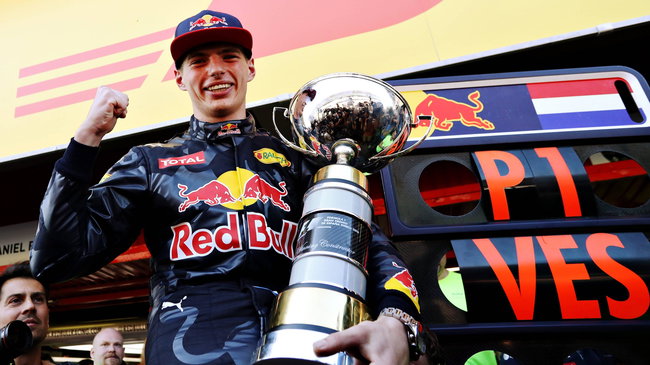
In 2016, Kvyat was ditched after just four races, despite finishing third in the third of those in China, promoting a certain rising star in Max Verstappen. The move was a stroke of genius as he won the Spanish GP on his debut for the team, becoming the youngest victor, podium finisher and driver to lead a lap at the age of 18 years and 228 days.
The team achieved several podiums, while Ricciardo took his fourth career win in Malaysia after an engine failure for Hamilton. Red Bull finished the season second in the constructors' championship, with Ricciardo third in the drivers' standings.
Verstappen and Ricciardo returned in 2017, but they started the season slowly, with both drivers suffering retirements, notably the former with five in the first nine races. Ricciardo at least took the chequered flag in Azerbaijan.
In Malaysia, later in the season, Verstappen finally netted win number two - 31 races after his debut triumph - and followed that up with another win in Mexico a few races later, although he still finished 32 points behind Ricciardo, as Red Bull were third in the constructors'.
In 2018, after Ricciardo won in the third race in China, the duo dramatically crashed into one another in the following grand prix in Azerbaijan. Ricciardo at least bounced back with a victory in Monaco, but that would to be his last for the team as he opted to leave at the end of the season and join Renault for 2019.
Whilst Ricciardo suffered six retirements in his final 13 grands prix, Verstappen finished the year with five consecutive podiums, including a win in Mexico, to add to an earlier triumph in Austria.
A major talking point throughout the season was the deteriorating relationship between Red Bull and Renault. The Milton Keynes-based outfit announced at the French GP that it would be switching to Honda power following its impressive display for sister team Toro Rosso.
Moving to Honda engines
With Renault and Ricciardo gone, Honda and Pierre Gasly were brought in for the 2019 season.
The Frenchman failed to make much of an impression over the course of the opening 12 races, in stark contrast to Verstappen, who won in Australia and Germany, to go along with three other podium finishes. As a result, Red Bull again made another driver swap mid-season, promoting Alex Albon and sending Gasly back to Toro Rosso.
By the end of the year, Verstappen had finished on the podium another three times, and won in Brazil, to claim third in the standings, while Albon's best result was fourth in Japan, as Red Bull again finished behind Mercedes and Ferrari.
The Covid-hit 2020 campaign saw Red Bull climb to second in the constructors' championship. Verstappen won the 70th Anniversary GP at Silverstone to go along with a dominant display at the season-ending Abu Dhabi GP, while Albon recorded his first career podium at the Tuscan GP.
Albon would not stay at Red Bull for much longer than Gasly, however, having been outscored by Verstappen 214 points to 105 over the course of the season, prompting the team to look outside of their own talent pool and replace the Thai-British driver with Sergio Perez for 2021.
Red Bull vs Mercedes, Verstappen vs Hamilton
In 2021, new rear downforce regulations that appeared to hurt high-rake concept cars like the Mercedes – and solid improvements from the Red Bull-Honda camp – led to the first multi-team battle since the turbo-hybrid era began.
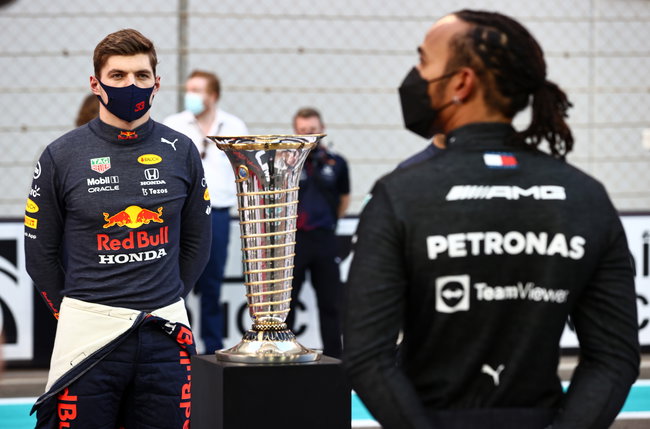
What followed was an explosive season as Red Bull and Mercedes, and Verstappen and Hamilton, went all out for title glory.
There were crashes between Verstappen and Hamilton in Silverstone and Monza before a climactic ending to the campaign in Abu Dhabi, where Hamilton was on the brink of becoming a record-setting eight-time drivers' champion.
A late safety car, following a crash involving Williams' Nicolas Latifi, changed everything. Then-FIA race director Michael Masi made a fundamental error in the handling of the safety car, during which Verstappen had pitted for new soft tyres.
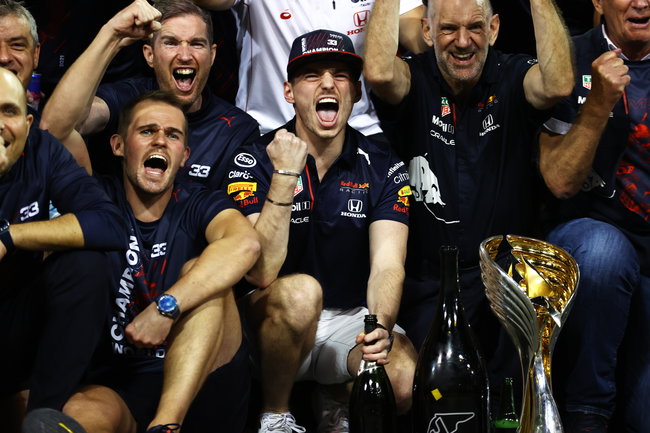
When the race restarted with a lap remaining, on old, hard tyres, Hamilton was a sitting duck. Verstappen passed with ease to claim his maiden championship.
Defending his crown in 2022 proved to be relatively straightforward for Verstappen, who won 15 of 22 races. En route, Red Bull won its first constructors' title since 2013.
Off track, there was controversy. In October that year, it was confirmed the team would be punished for breaching the 2021 cost cap. It was fined $7 million, whilst it also forfeited 10% of its aerodynamic development allowance.
The 2023 season was what then-team principal Christian Horner described as "a unicorn year". Verstappen won 19 of the 22 races, setting several records in the process, including a points haul of 575. Red Bull comfortably retained its constructors' title.
Red Bull struggles in 2024 and 2025, and Christian Horner drama
Although Verstappen won his fourth consecutive drivers' championship in 2024, it was far from straightforward as the performance of the car was not at the level of previous seasons, and there was a backdrop of discord and discontent within the team.
That was based on allegations of impropriety made against Horner by a female employee, which were resolved, to a certain extent, during the year, but a level of damage had been done. Notably, key figures Adrian Newey and sporting director Jonathan Wheatley announced their departures.
On track, Verstappen managed to keep McLaren's Lando Norris at arm's length to retain his crown, but Red Bull was unable to keep hold of its constructors' championship, which went the way of McLaren.
At the end of the year, the team decided to part ways with Sergio Perez due to a string of disappointing performances, promoting Liam Lawson, although the New Zealander lasted just two races in 2025 before trading places with Yuki Tsunoda.
For a considerable period of the season, Verstappen looked on as Norris and team-mate Oscar Piastri went head-to-head for the drivers' title, and in early July, a major bombshell was dropped when the team parted ways with Horner after 20 years at the helm.
Laurent Mekies was promoted from Racing Bulls to become the new team principal, leading to an upturn in form after the summer break as Verstappen embarked on a run of 10 consecutive podiums, including six wins, albeit finishing just two points shy of a fifth drivers' crown.
Red Bull demoted Tsunoda to the role of reserve at the end of the year for 2026, promoting Isack Hadjar following a strong rookie year with Racing Bulls in 2025.
Get the latest F1 news from RacingNews365 directly in your Google feed! Click on the link below and you’ll see your favourite F1 website appearing even more often. That way, you’ll never miss any news, analyses, interviews, or exclusives.
Follow RacingNews365 on GoogleOrigins and Sauber sponsorship
Although Red Bull debuted in F1 as a team in 2005, its origins date back to the Stewart Grand Prix outfit that took to the grid in 1997.
Owner and three-time F1 world champion, Sir Jackie Stewart, sold the operation to Ford after two seasons, but the rebrand to Jaguar Racing yielded little success. It was put up for sale in September 2004, with reports noting that Ford asked bidders for a symbolic $1 US fee, along with a commitment to invest $400 million into the team over three seasons.
Before the sale, Red Bull had been involved in F1 as one of Sauber's sponsors from 1995 to 2004. However, once Jaguar Racing was purchased, the long-term partnership was brought to an end.
F1 start with Cosworth engines
Christian Horner was named team boss of Red Bull's new F1 entry, with David Coulthard and Christian Klien selected as its first driver pairing. The initial plans called for Klien, retained from Jaguar, and 2004 International Formula 3000 champion Vitantonio Liuzzi to swap every four races, but come the end of the season, the Italian had only appeared at four events.
Red Bull named its first chassis the RB1 and used Cosworth engines – a deal inherited from Jaguar. The car's best result was a fourth-place finish on debut in Australia, and a few months later at the Nürburgring, with both results achieved by Coulthard.
Compared to Jaguar's limited success, Red Bull was a massive hit in its first season. It held sixth in the constructors' standings for much of the season, only for BAR-Honda to overtake it later in the year.
By the end of the 2005 campaign, Red Bull finished with more points - 34- than Jaguar had scored in 2003 and 2004 combined.
Ferrari power and Newey signing
After just one year with Cosworth, Red Bull struck a deal that saw it use customer Ferrari engines in 2006. The move came after a rule change that mandated the use of V8 engines.
Perhaps more importantly, the team managed to secure the signing of Adrian Newey in November 2005. The British engineer was a key figure at Williams and later McLaren in the 1990s and 2000s, and would prove crucial in turning Red Bull into a dominant force in F1.
That success was not immediate, however, as Red Bull took a step back with the RB2 in 2006. Cooling and overheating issues plagued the car during early tests, and continued reliability problems in the first part of the season led to several retirements.
Nevertheless, Coulthard secured Red Bull's first podium with a third-place finish in Monaco. Horner had stated before the race that if one of his cars finished on the podium, he would jump into a swimming pool at the track naked. He ended up taking the plunge wearing just a red cape.
Red Bull finished the season with 16 points. Coulthard accounted for 14 of those points compared to Klien's two. Robert Doornbos replaced the Austrian for the final three races.
2007 and 2008 seasons
The Newey-designed RB3 took to the grid in 2007, with Red Bull making the switch from Ferrari to Renault engines. The team's contract with the Scuderia was passed along to junior team Toro Rosso.
Red Bull's driver line-up was also changed, with Mark Webber brought in to race alongside Coulthard. Both drivers started the season slowly as they suffered eight retirements between them across the first seven races, though Coulthard did score the team's first points with a fifth-place finish in Spain.
A season highlight involved Webber claiming his second career podium at the unpredictable European GP, while Coulthard finished fifth despite starting back in 20th after the team kept him in the pits too long during qualifying.
Webber came close to victory at the Japanese GP but crashed with Toro Rosso youngster Sebastian Vettel, leaving the latter in tears. In the end, the team finished fifth in the constructors' standings with 24 points.
The same driver line-up returned in 2008 with Webber scoring points in five straight races after retiring from the season-opener. Coulthard started at a slower pace but bounced back with a podium finish in Canada, helping Red Bull reach the same number of points it achieved in 2007 by the halfway point of the season.
However, from there, the team's form dipped, scoring just five points in the final 10 races. Its performance was made worse by the fact that Red Bull 'B team' Toro Rosso became the first Red Bull-owned outfit to win a race with Vettel's victory at the rain-hit Italian Grand Prix. The result helped Toro Rosso finish the season with more points – 39 to 29 – than Red Bull.
Vettel joins and Red Bull grow stronger
Coulthard retired at the end of the 2008 season, allowing Red Bull to promote Vettel after a season with Toro Rosso.
The German showed he meant business immediately, running second during the Australian GP before retiring following a clash with Robert Kubica. Vettel scored Red Bull's first pole position at the Chinese GP, while Webber started third. The following day, in rain-soaked conditions, Red Bull took its first win thanks to Vettel, with Webber rounding out a one-two finish.
Vettel grabbed a second victory at the British GP after starting from pole, while Webber took his first win in Germany. Red Bull ended the year in style with another one-two finish at the Abu Dhabi GP.
Vettel led the way and ended the year just 11 points adrift of world champion Jenson Button. Red Bull also finished second in the constructors' championship, 18.5 points behind champions Brawn GP.
Vettel and Red Bull's breakthrough world titles
What followed were four years of dominance from Red Bull, and Vettel, as the constructors' and drivers' championship doubles were achieved from 2010 to 2013.
In the 2010 constructors', a Vettel-led one-two in the Brazilian GP saw Red Bull become the first Austrian team to win the title. In the drivers', it all boiled down to the final.
Vettel entered it third in the standings, behind Fernando Alonso and Webber, yet he poached the title by winning the race, whilst his rivals finished outside the top six. All in all, Red Bull finished the year with nine wins, five by Vettel.
In 2011, Red Bull continued with the Vettel-Webber pairing. Unlike the previous season, there was no surprise ending as Vettel cruised to his second championship, becoming the ninth F1 driver to defend his title, winning 11 of the 19 races, and claiming 15 pole positions to beat Nigel Mansell's record from 1992.
Success continued in 2012 as Vettel took his third consecutive title, becoming the youngest triple champion. There were some bumps along the way, as his first win only came in Bahrain, four races into the season. In fact, he found himself trailing Alonso by 39 points after retiring from the Italian GP.
However, Vettel won four successive races to assert his authority. Further podiums in Abu Dhabi and the United States put him in a strong position for the showdown in Brazil, where he needed some wiggle room following a first-lap collision with Bruno Senna. After dropping to the back of the field, Vettel recovered to sixth place to secure the title by three points over Alonso, who came home second.
Red Bull fielded an unchanged line-up in 2013, with Vettel winning two of the opening four races. The first of those wins came amid some controversy in Malaysia. Running behind his team-mate, Vettel disobeyed team orders and overtook Webber late in the race, much to the Australian's anger. Vettel subsequently apologised to the team, but not for winning.
After retiring at the British GP, Vettel won 10 of the final 11 races to secure the championship by 155 points over Alonso. His efforts saw him named 'Sportsman of the Year' at the Laureus World Sports Awards, becoming the second driver to receive that honour.
Webber retirement and Vettel departure
Webber announced his retirement from F1 at the end of 2013, with Red Bull promoting Daniel Ricciardo from Toro Rosso.
However, it was clear during pre-season testing that the Renault-powered teams would struggle in 2014 as they were down on power compared to Mercedes and Ferrari following the introduction of the new hybrid power units.
Red Bull managed to win three races and finish second in the standings, though they ended the year 296 points adrift of Mercedes. All the wins came via Ricciardo, who took the chequered flag for the first time in Canada.
The 2014 campaign proved to be Vettel's last with the team as he moved to Ferrari, with Daniil Kvyat replacing him. While Red Bull harboured hopes of closing the gap to Mercedes in 2015, thanks to the progress made by Renault, that was not the case as reliability and power issues plagued the team all season.
Red Bull ended it without a win for the first time since 2008, with its best finish in Hungary, where Ricciardo and Kvyat finished second and third. While the team tried to end its partnership with Renault, no deal was reached. As a result, it ran Renault engines that were rebadged as TAG Heuer.
Improvement and emergence of Max Verstappen
In 2016, Kvyat was ditched after just four races, despite finishing third in the third of those in China, promoting a certain rising star in Max Verstappen. The move was a stroke of genius as he won the Spanish GP on his debut for the team, becoming the youngest victor, podium finisher and driver to lead a lap at the age of 18 years and 228 days.
The team achieved several podiums, while Ricciardo took his fourth career win in Malaysia after an engine failure for Hamilton. Red Bull finished the season second in the constructors' championship, with Ricciardo third in the drivers' standings.
Verstappen and Ricciardo returned in 2017, but they started the season slowly, with both drivers suffering retirements, notably the former with five in the first nine races. Ricciardo at least took the chequered flag in Azerbaijan.
In Malaysia, later in the season, Verstappen finally netted win number two - 31 races after his debut triumph - and followed that up with another win in Mexico a few races later, although he still finished 32 points behind Ricciardo, as Red Bull were third in the constructors'.
In 2018, after Ricciardo won in the third race in China, the duo dramatically crashed into one another in the following grand prix in Azerbaijan. Ricciardo at least bounced back with a victory in Monaco, but that would to be his last for the team as he opted to leave at the end of the season and join Renault for 2019.
Whilst Ricciardo suffered six retirements in his final 13 grands prix, Verstappen finished the year with five consecutive podiums, including a win in Mexico, to add to an earlier triumph in Austria.
A major talking point throughout the season was the deteriorating relationship between Red Bull and Renault. The Milton Keynes-based outfit announced at the French GP that it would be switching to Honda power following its impressive display for sister team Toro Rosso.
Moving to Honda engines
With Renault and Ricciardo gone, Honda and Pierre Gasly were brought in for the 2019 season.
The Frenchman failed to make much of an impression over the course of the opening 12 races, in stark contrast to Verstappen, who won in Australia and Germany, to go along with three other podium finishes. As a result, Red Bull again made another driver swap mid-season, promoting Alex Albon and sending Gasly back to Toro Rosso.
By the end of the year, Verstappen had finished on the podium another three times, and won in Brazil, to claim third in the standings, while Albon's best result was fourth in Japan, as Red Bull again finished behind Mercedes and Ferrari.
The Covid-hit 2020 campaign saw Red Bull climb to second in the constructors' championship. Verstappen won the 70th Anniversary GP at Silverstone to go along with a dominant display at the season-ending Abu Dhabi GP, while Albon recorded his first career podium at the Tuscan GP.
Albon would not stay at Red Bull for much longer than Gasly, however, having been outscored by Verstappen 214 points to 105 over the course of the season, prompting the team to look outside of their own talent pool and replace the Thai-British driver with Sergio Perez for 2021.
Red Bull vs Mercedes, Verstappen vs Hamilton
In 2021, new rear downforce regulations that appeared to hurt high-rake concept cars like the Mercedes – and solid improvements from the Red Bull-Honda camp – led to the first multi-team battle since the turbo-hybrid era began.
What followed was an explosive season as Red Bull and Mercedes, and Verstappen and Hamilton, went all out for title glory.
There were crashes between Verstappen and Hamilton in Silverstone and Monza before a climactic ending to the campaign in Abu Dhabi, where Hamilton was on the brink of becoming a record-setting eight-time drivers' champion.
A late safety car, following a crash involving Williams' Nicolas Latifi, changed everything. Then-FIA race director Michael Masi made a fundamental error in the handling of the safety car, during which Verstappen had pitted for new soft tyres.
When the race restarted with a lap remaining, on old, hard tyres, Hamilton was a sitting duck. Verstappen passed with ease to claim his maiden championship.
Defending his crown in 2022 proved to be relatively straightforward for Verstappen, who won 15 of 22 races. En route, Red Bull won its first constructors' title since 2013.
Off track, there was controversy. In October that year, it was confirmed the team would be punished for breaching the 2021 cost cap. It was fined $7 million, whilst it also forfeited 10% of its aerodynamic development allowance.
The 2023 season was what then-team principal Christian Horner described as "a unicorn year". Verstappen won 19 of the 22 races, setting several records in the process, including a points haul of 575. Red Bull comfortably retained its constructors' title.
Red Bull struggles in 2024 and 2025, and Christian Horner drama
Although Verstappen won his fourth consecutive drivers' championship in 2024, it was far from straightforward as the performance of the car was not at the level of previous seasons, and there was a backdrop of discord and discontent within the team.
That was based on allegations of impropriety made against Horner by a female employee, which were resolved, to a certain extent, during the year, but a level of damage had been done. Notably, key figures Adrian Newey and sporting director Jonathan Wheatley announced their departures.
On track, Verstappen managed to keep McLaren's Lando Norris at arm's length to retain his crown, but Red Bull was unable to keep hold of its constructors' championship, which went the way of McLaren.
At the end of the year, the team decided to part ways with Sergio Perez due to a string of disappointing performances, promoting Liam Lawson, although the New Zealander lasted just two races in 2025 before trading places with Yuki Tsunoda.
For a considerable period of the season, Verstappen looked on as Norris and team-mate Oscar Piastri went head-to-head for the drivers' title, and in early July, a major bombshell was dropped when the team parted ways with Horner after 20 years at the helm.
Laurent Mekies was promoted from Racing Bulls to become the new team principal, leading to an upturn in form after the summer break as Verstappen embarked on a run of 10 consecutive podiums, including six wins, albeit finishing just two points shy of a fifth drivers' crown.
Red Bull demoted Tsunoda to the role of reserve at the end of the year for 2026, promoting Isack Hadjar following a strong rookie year with Racing Bulls in 2025.
Get the latest F1 news from RacingNews365 directly in your Google feed! Click on the link below and you’ll see your favourite F1 website appearing even more often. That way, you’ll never miss any news, analyses, interviews, or exclusives.
Follow RacingNews365 on Google-
Lando Norris makes major car swap as Max Verstappen title requirement revealed - RacingNews365
-
Liam Lawson and Arvid Lindblad 'riot act' approach explained
-
Major split revealed over possible F1 regulation change
-
Kimi Antonelli labelled 'phenomenon' as 'luck' claim ridiculed
-
Max Verstappen urged to fight back in controversial Madrid decision verdict
-
Toto Wolff reveals Max Verstappen need for 2027 F1 title tilt
-
Charles Leclerc cousin takes major step en route to F1
-
Madring handed stark money warning after F1 slating
-
Kimi Antonelli closing in on F1 history as rivals start to run out of road
-
McLaren announce new 'high performance' multi-year partnership
| Race | Date |
|---|---|
 Azerbaijan GP
|
26 Sep 2026 |
 Bahrain GP
|
04 Oct 2026 |
 Singapore GP
|
11 Oct 2026 |
 United States GP
|
25 Oct 2026 |
 Mexico City GP
|
01 Nov 2026 |
 Brazilian GP
|
08 Nov 2026 |