


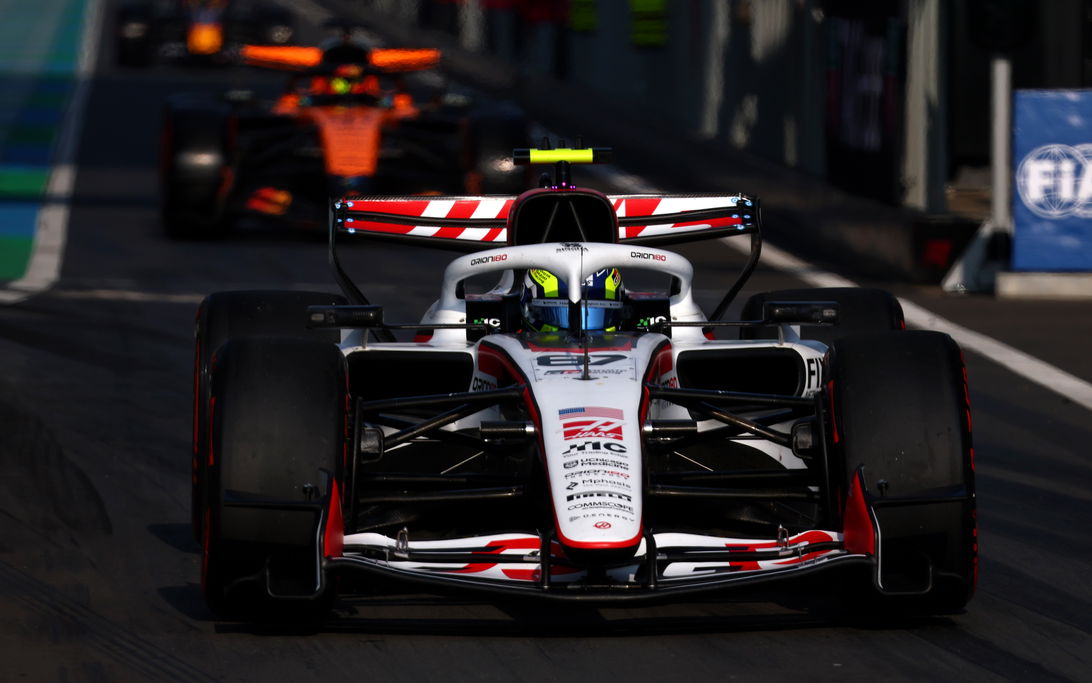
The FIA has drawn up a package of rule changes following a series of meetings with teams, drivers and engine manufacturers.
The changes will be implemented starting from the Miami Grand Prix, with the exception of a countermeasure to prevent some cars from getting away too slowly at the start after releasing the clutch. That measure will be tested at the next round to gather additional data before it is introduced.
Energy recovery was at the centre of the discussions during the talks, and as was witnessed during the opening rounds, qualifying was the part of the weekend most affected by energy management.
In practice, this made it impossible to drive fast laps without the driver having to prioritise energy management rather than driving at the car's limit.
In Japan, the maximum recharge limit was lowered from 9 MJ to 8 MJ during qualifying, but this did not provide a clear advantage. Still, the FIA believes that a further reduction to 7 MJ may be the right move, as it could encourage more driving at the limit.
Influence of superclipping
This follows the same philosophy as the earlier reduction in Japan. Because only a maximum of 7 MJ can be recovered per lap, it is no longer necessary to recharge the battery at multiple points on the track, including on straights.
In fact, the phase in which energy is used is extended, albeit at a lower level, reducing the time required for recovery.
The goal is to reduce the impact of superclipping to about 2 to 4 seconds per lap. At the same time, the maximum power that can be recovered via superclipping has been increased to 350 kW, equal to that of lift and coast.
Where superclipping previously produced 250 kW, this equalisation makes strategic lifting of the throttle less useful. This should lead to a more natural driving style, with drivers releasing gas only when braking and no longer on straights.
In addition, the higher recovery power means that superclipping needs to be shorter. The performance degradation remains, but lasts for less time.
So in theory, Miami could see a more powerful but shorter phase of superclipping, for example on the long straight toward Turn 17 or in the second sector toward Turn 11.
For the race, the focus is on reducing the feeling of artificial overtaking, and the matter of drivers immediately being overtaken again. Therefore, the maximum boost has been reduced to an increase of 150 kW (or the actual power of the car if higher), limiting sudden differences in performance.
The goal is a more linear power profile: an increase that does not form a brief spike followed by an immediate rebound.
With less boost, there remains a performance difference between cars, but the advantage to the overtaking car becomes less volatile. As a result, it is less likely to overtake again immediately.
Fewer speed differences
The new regulation for the MGU-K has safety as its main goal. The power remains 350 kW in important acceleration zones (from exits of corners to the braking point and overtaking zones), but is limited to 250 kW on other parts of the track.
This should reduce speed differences between cars and prevent incidents, such as the one between Oliver Bearman and Franco Colapinto at Suzuka, while maintaining overtaking opportunities without affecting performance.
Before the start phase, a system is being tested in Miami that detects under-acceleration after releasing the clutch. In this case, the MGU-K is automatically activated to ensure minimum acceleration and reduce the risk of collision, without providing sporting advantage.
This system can be seen as a kind of virtual MGU-H, as it performs a similar function as this component used to: reducing turbo lag at the start.
Whereas until 2025 this was done via a direct increase in turbine speed, now it is done via additional power delivery that prevents the car from slowing down due to the lack of turbo pressure.
All in all, there is no fundamental revision of the 2026 rules, something that would not be feasible in five weeks.
The FIA, together with all stakeholders, has tried to correct the application of rules that proved too optimistic and were based on conflicting technical objectives.
The combination of lighter cars (with smaller batteries) and a tripling of electric power to the level of the internal combustion engine is at the root of the problems that became apparent in the first three races. It is now up to practice to confirm whether these modifications will be effective.
Also interesting:
Join RacingNews365's Nick Golding and Sam Coop as they dissect the biggest storylines looking ahead to the rest of the 2026 F1 season, and why so much depends on what changes are made to the F1 regulations by the FIA.
Rather watch the podcast? Then click here!


Most read





In this article
Never miss a thing from the Formula 1 season! Add the 2026 F1 schedule to your calendar at the touch of a button. Subscribe below and put the dates and times of every race directly on your PC or smartphone, so you don't miss a second from the new season.
Download the F1 calendar Download the F1 calendar
A variant with just the race and qualifying is also available.
Click here to download it..






Join the conversation!