


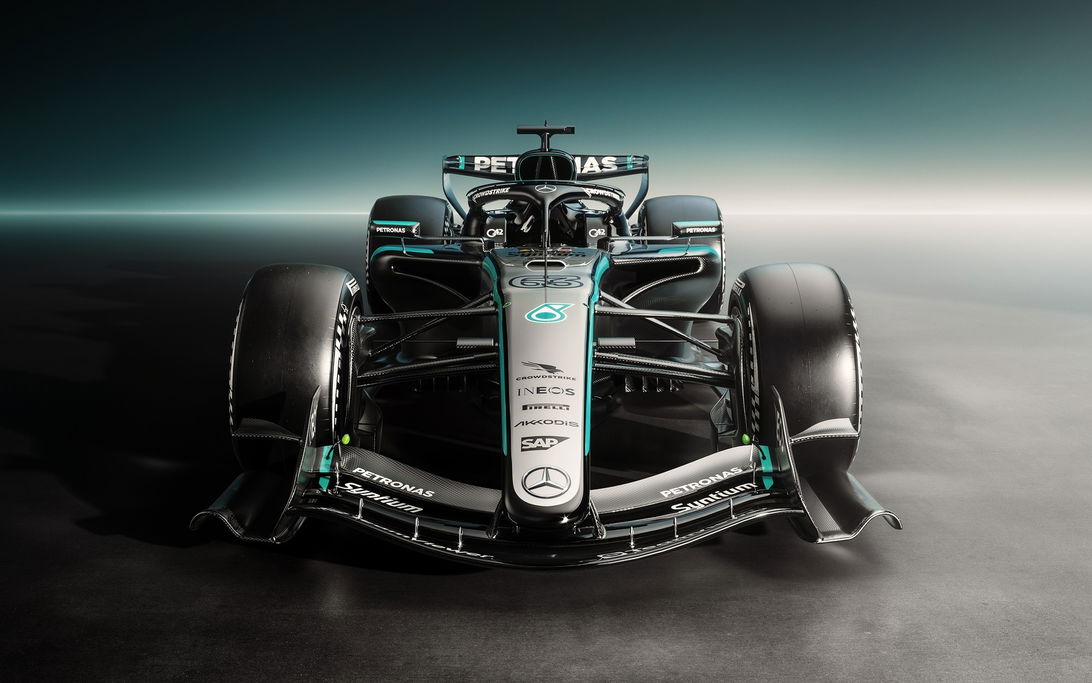
The 2026 campaign edges closer to reality with pre-season testing at Circuit de Barcelona-Catalunya scheduled for next week, yet Mercedes' first public showing of the W17 this morning has raised more questions than it has answered.
What emerged from the shakedown was a machine that appeared almost deliberately conventional, featuring solutions so textbook in nature that they bordered on the rudimentary. The overall impression was of a show car masquerading as a race-ready contender.
The front wing immediately caught attention for all the wrong reasons. Its overly simplified design, particularly around the flap profiles, made identifying the active aerodynamics actuation system a challenge.
Two short pillars connect the nose to the wing assembly, with the nose itself featuring a lower section recess that flows towards the chassis splitter.
Yet this entire area felt provisional, almost artificial in its presentation. The elements appeared specifically chosen for public consumption rather than representing genuine aerodynamic intent.
The bargeboards, featuring two basic slots, reinforced this impression. Rather than the complex, finely-tuned surfaces expected from a team of Mercedes' calibre, what appeared was a rudimentary interpretation of what will surely become a heavily developed area.
Viewed by others:

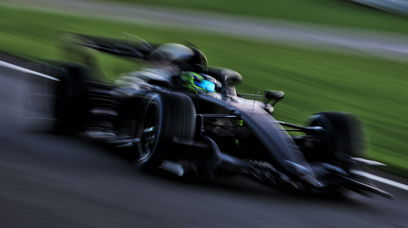
Sidepods and floor development questions persist
The sidepods retained familiar W16 styling cues whilst incorporating a deeper undercut along the upper profile towards the rear section. However, even these modifications felt tentative, lacking the precision typically associated with Mercedes' aerodynamic philosophy.
Perhaps most tellingly, the floor appeared decidedly unfinished. Its lateral profile remained disappointingly simple, with only hints of the slots positioned ahead of the rear wheels. For a regulation area that has dominated aerodynamic development since 2022, such basic execution seemed incongruous.
The push-rod suspension layout featured at both ends, with the genuinely notable aspect being the pronounced inclination of the upper wishbones. This configuration targets effective anti-dive characteristics at the front and anti-squat properties at the rear.
The power unit air intake retained its oval configuration divided into three sections, a characteristic shared across all cars revealed thus far, albeit with varying frontal section approaches. The engine cover featured a prominent shark fin yet appeared poorly defined, particularly regarding the rear hot air outlet configuration and the volume height at the engine hood's base.
The W17's presentation immediately evoked memories of Mercedes' dual aerodynamic specification strategy during the 2019 Barcelona tests. On that occasion, the team fielded a conventional, almost academic machine during the first session, only to replace it with a radically revised car featuring complex aerodynamic solutions the following week.
That approach allowed Mercedes to conceal their true development direction whilst satisfying pre-season testing obligations. The W17's deliberately basic appearance suggests a similar strategy may be at play, with the real machine potentially remaining hidden until testing begins in earnest.
With George Russell and Italian newcomer Kimi Antonelli preparing for their first season together, Mercedes faces the challenge of integrating a 19-year-old rookie whilst potentially deploying one of their most sophisticated deception campaigns yet.
Also interesting:
The 2026 F1 Cars Revealed: Everything You Need to Know!
Discover how the 2026 F1 regulations will revolutionise the sport, with a shift to movable wings instead of traditional DRS, to the increased electrical power in the hybrid systems, and the introduction of 100% sustainable fuel.
Most read





Never miss a thing from the Formula 1 season! Add the 2026 F1 schedule to your calendar at the touch of a button. Subscribe below and put the dates and times of every race directly on your PC or smartphone, so you don't miss a second from the new season.
Download the F1 calendar Download the F1 calendar
A variant with just the race and qualifying is also available.
Click here to download it..





Join the conversation!