


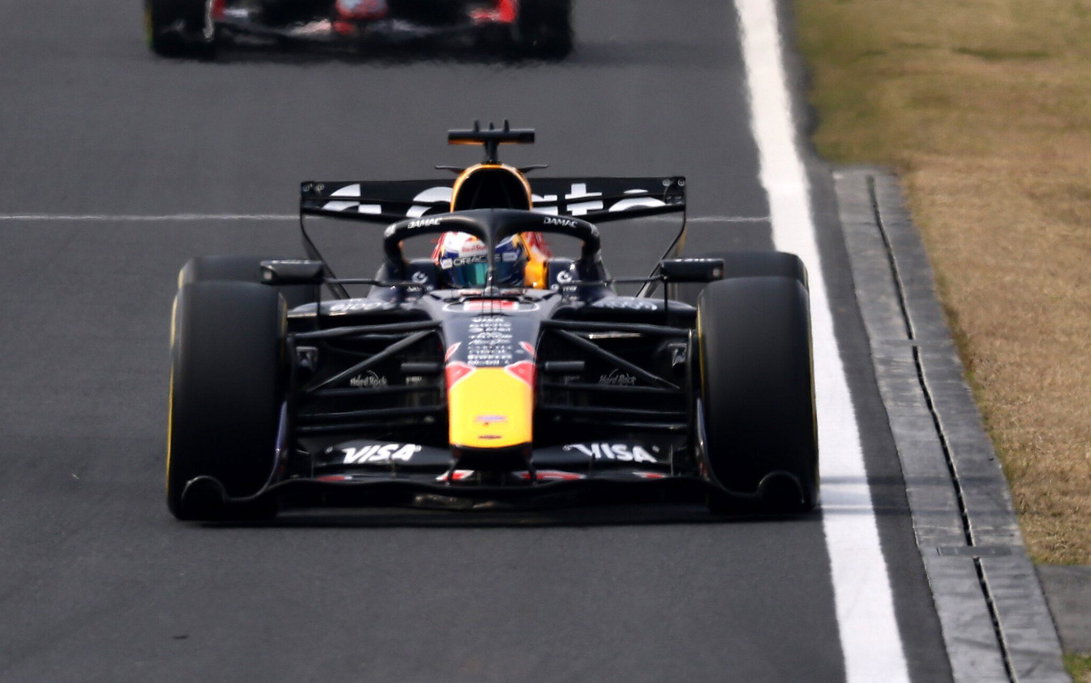
Red Bull pulled the covers off a dramatically modified RB22 during its filming day at Silverstone, revealing aerodynamic changes that span the entire length of the car and showcase the team's own interpretation of Ferrari's revolutionary "Macarena" wing concept.
The Milton Keynes-based team's latest creation features fresh winglets mounted on the front wing endplates, while the sidepod profile has undergone a radical transformation.
The revised bodywork now sports a different rearward ramp that extends the upper surface of the sidepods towards the rear wheels, fundamentally altering the car's aerodynamic philosophy.
However, the most eye-catching modification centres on the rear wing, where Red Bull has implemented a fully rotating system that represents their take on Ferrari's groundbreaking design.
The flap rotates to invert itself, positioning the concave side downwards and the convex side upwards, effectively mimicking an aircraft wing configuration to generate lift rather than downforce.
Article continues below the 3D simulation...
Red Bull differences to Ferrari rear wing
While the concept mirrors Ferrari's innovative "Macarena" wing, Red Bull's execution reveals a more conservative engineering approach.
The team has retained the central vertical actuator as the primary rotation mechanism, modifying only the attachment points between the flap and endplates through the addition of straight extensions relative to the flap's pivot.
This design choice enables reverse rotation whilst avoiding the complexity of Ferrari's more ambitious system. Where the SF-26's wing achieves complete rotation exceeding 200 degrees through dual actuators concealed within the endplates, Red Bull's solution delivers approximately 110-120 degrees of unidirectional movement.
The strategic difference reflects Red Bull's preference for reduced mechanical complexity and accelerated development timelines. By maintaining the central actuator and limiting rotation angles, the team has sidestepped the need for extensive structural reinforcement or comprehensive redesign of the endplate pivot mechanisms.
Ferrari's approach, by contrast, has necessitated a more extensive design and validation programme, evidenced by their prolonged testing schedule. The replacement of the single central actuator with twin units hidden within the endplates has undoubtedly required significant engineering resources and development time.
Red Bull's philosophy prioritises rapid implementation over maximum aerodynamic potential, though questions remain over whether the partial rotation can match the benefits delivered by Ferrari's full-range system. The retention of the central actuator inevitably introduces additional drag and turbulence that Ferrari's design eliminates.
The divergent approaches also highlight how aerodynamic concepts developed for one car may not translate directly to another, given the fundamental differences in overall design philosophy between the two machines.
The cross-pollination between teams suggests the rotating wing concept will likely spread throughout the grid, with McLaren among those expected to introduce their own interpretation of the "Macarena" wing in future developments.
Also interesting:
Join RacingNews365's Nick Golding and Sam Coop as they dissect the biggest storylines looking ahead to the rest of the 2026 F1 season, and why so much depends on what changes are made to the F1 regulations by the FIA.
Rather watch the podcast? Then click here!


Most read





In this article
Never miss a thing from the Formula 1 season! Add the 2026 F1 schedule to your calendar at the touch of a button. Subscribe below and put the dates and times of every race directly on your PC or smartphone, so you don't miss a second from the new season.
Download the F1 calendar Download the F1 calendar
A variant with just the race and qualifying is also available.
Click here to download it..






Join the conversation!