


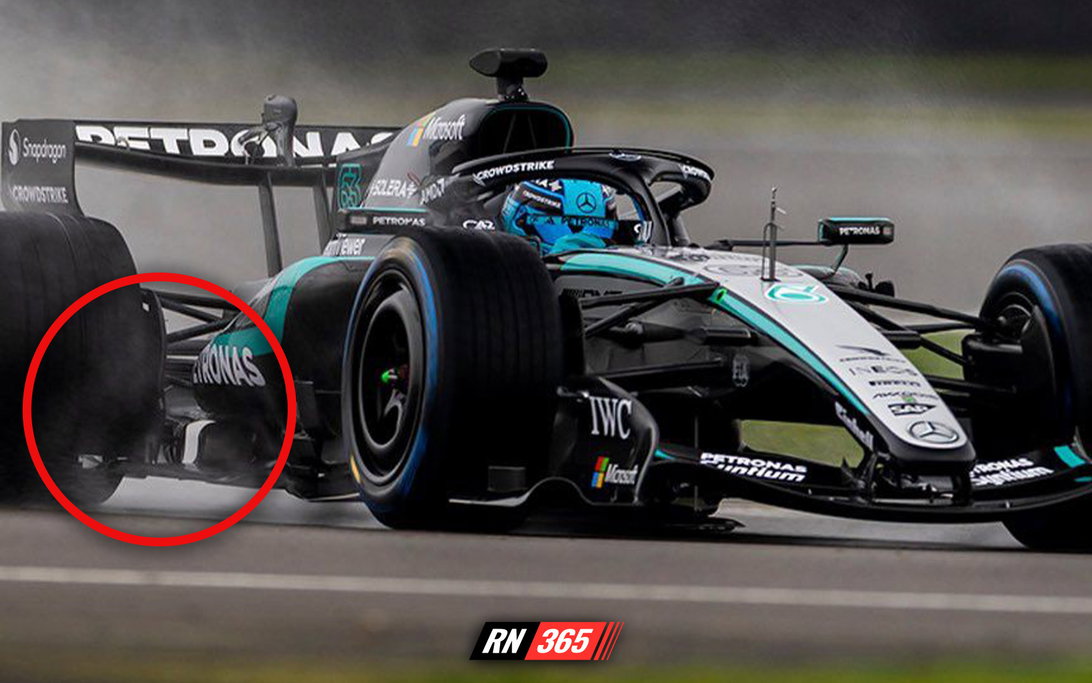
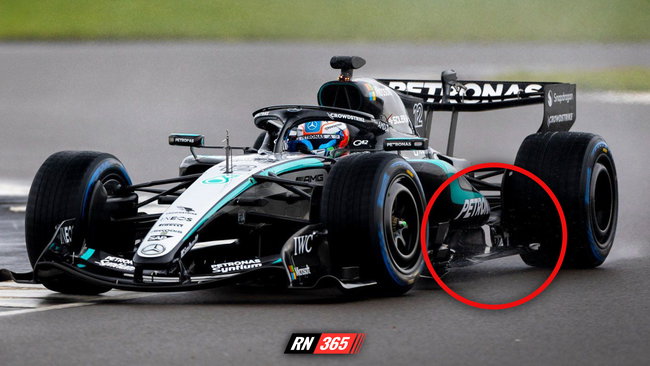
There has been a heated debate since the unveiling of the 2026 Mercedes W17 about whether a large vertical slot at the rear, near the diffuser, is legal or not.
It is worth noting that looking at the 2025 generation of car, slots were present in more or less a similar position on all cars, with the function being to channel the airflow passing centrally through the diffuser, speeding it up and increasing the downforce produced by the floor.
The need for this is made all the more important in 2026 owing to the return of the rake, where the rear of the floor is higher than the front, with the requirement for this made redundant in the ground effects era, where downforce was produced by having the entire floor run as low as possible to the track.
Article 3.5 of the technical regulations deals specifically with the floor bodywork.
Paragraphs 3.5.1-3.5.4 refer to the areas where the floor must be located, and that it must be lie fully within the RV-Floor-Body, and that there must be no holes in it when viewed from below to fully obscure the RS-Floor-Body, RV-PU-ICE, and the RV-DIFF.
If it is visible from below, it must lie exactly on RV-Floor-Body, if directly below the RS-Floor-REF and RS-Floor-Step, whilst also having two sections visible in any Z-lane and be fully visible from above or below.
If we exclude, for a moment, the rather cryptic requirements that only indicate which sections of the floor are visible, it is very important to note the requirement which, when viewed from below, the floor must be dark, or essentially an element without holes.
Applying this to the Mercedes, it is quite clear that when viewed from below, the floor would simply represent a curvature, a bend in the edge of the diffuser and not a hole passing through its vertical axis.
It is therefore clear that any hole passing through the surface of the floor would be prohibited when viewed from above, but that the Mercedes design is almost a narrowing of the diffuser channel, and thus entirely legal.
Also interesting:
The 2026 F1 Cars Revealed: Everything You Need to Know!
Discover how the 2026 F1 regulations will revolutionise the sport, with a shift to movable wings instead of traditional DRS, to the increased electrical power in the hybrid systems, and the introduction of 100% sustainable fuel.
Most read







Never miss a thing from the Formula 1 season! Add the 2026 F1 schedule to your calendar at the touch of a button. Subscribe below and put the dates and times of every race directly on your PC or smartphone, so you don't miss a second from the new season.
Download the F1 calendar Download the F1 calendar
A variant with just the race and qualifying is also available.
Click here to download it..





Join the conversation!