


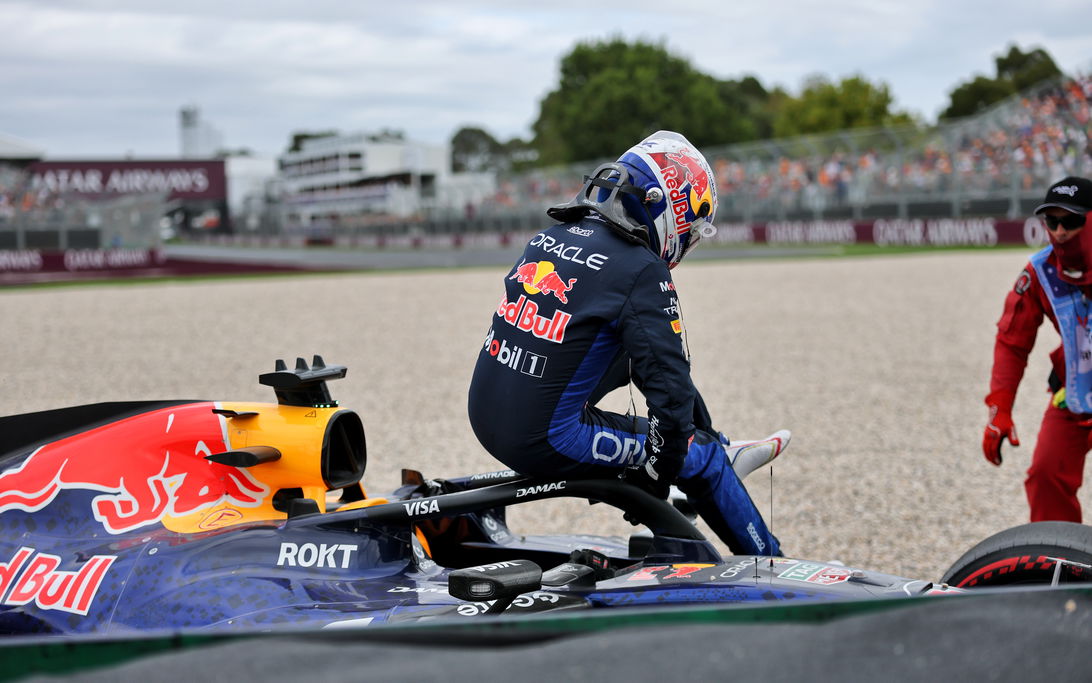
Max Verstappen endured a dramatic end to his opening qualifying session of F1's new regulatory era.
On his first flying lap in Q1 ahead of the Australian Grand Prix at Melbourne's Albert Park, Verstappen was sent hurtling into a barrier at Turn 1 after his Red Bull locked up at the rear on entry to the fast right-hander at the end of the start-finish straight.
Team principal Laurent Mekies described what he witnessed as "very brutal", with the team to investigate what unfolded. What was initially evident was that Verstappen was downshifting when the car violently spun out of his control.
At first, your initial suspicion would turn to a mechanical problem, such as a gearbox failure, that had caused the locking. In reality, the problem was related to energy recovery. The software began to glitch when reading the engine speed and the motion transmitted to the rear axle during downshifting.
Essentially, in combating an abnormal number of revolutions, the system went into safe mode. This caused the engine brake to intervene, in turn immediately causing the rear axle to lock.
As is well known, braking on the rear axle is controlled by the brake-by-wire system. In this instance, however, that system was not responsible for the crash. It was due to modes in the ERS system that immediately locked the system, leaving Verstappen with no way to regain control of the car.
This is a clear example of how current Formula 1 power unit energy recovery technology is still in its early stages of development, where teething problems can even lead to a driver being eliminated prematurely in qualifying, as was the case with Verstappen.
Looking ahead to the race, Fred Vasseur's prediction also seems quite realistic. According to the Ferrari team boss, Sunday's race could be particularly chaotic, precisely because of the great importance of energy management, both strategically and in terms of reliability.



Also interesting:
Most read

In this article
Never miss a thing from the Formula 1 season! Add the 2026 F1 schedule to your calendar at the touch of a button. Subscribe below and put the dates and times of every race directly on your PC or smartphone, so you don't miss a second from the new season.
Download the F1 calendar Download the F1 calendar
A variant with just the race and qualifying is also available.
Click here to download it..





Join the conversation!