


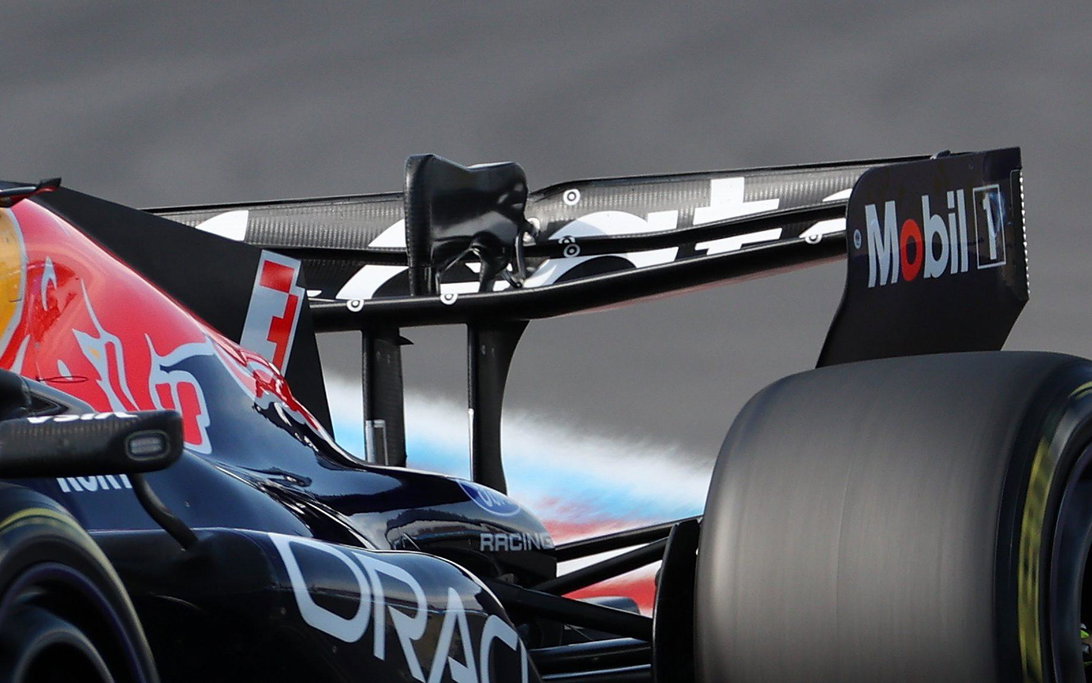
One of the most discussed technical stories to emerge from the British Grand Prix at Silverstone concerns the rear wing fault on the RB22, the very issue that forced Max Verstappen into retirement last Sunday.
The problem is not entirely new, either. A week prior in Austria, the same malfunction sent the four-time world champion off the circuit, raising serious questions about Red Bull's ability to guarantee reliability in a system that, on paper, should be straightforward.
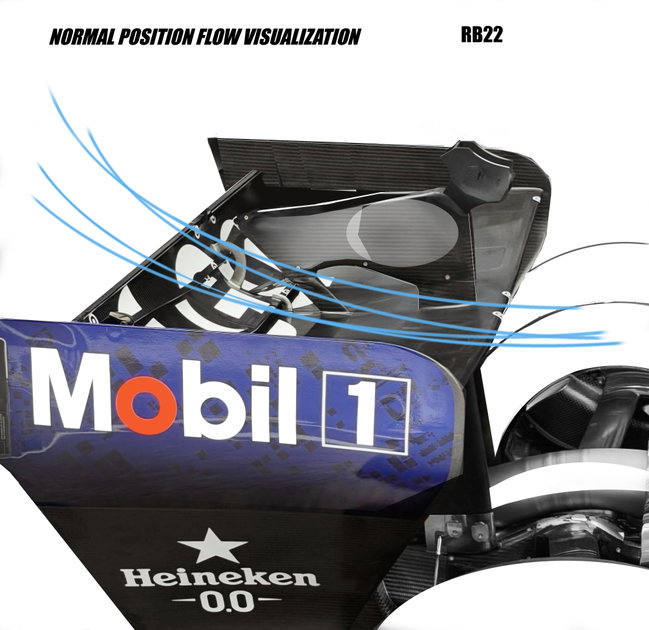
At the heart of the issue is the opening and closing mechanism of the RB22's rear wing. Red Bull have opted for a single central actuator to operate the flap, a design that works by pulling the upper edge of the flap towards the actuator via an upper linkage when the rear wing opens, whilst simultaneously pushing the lower edge rearwards through a lower linkage.
It is a simple pivoting arrangement and, precisely because of its simplicity, it ought to offer a high degree of reliability. In practice, that has not been the case.
Compare this with the approach taken by Ferrari on the SF-26, which houses twin actuators within the rear wing endplates, and it becomes clear that Red Bull's single-actuator solution is, as yet, not capable of guaranteeing a consistently effective closing action.
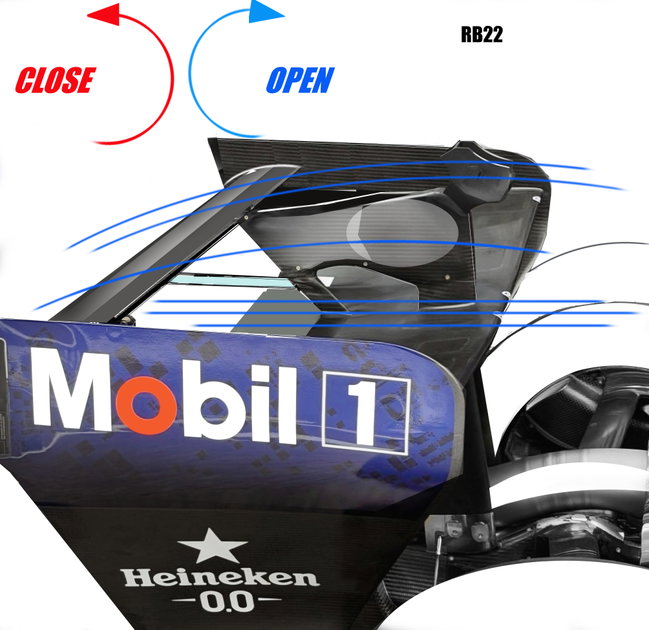
See below the air flow change when the RB22's rear wing is both closed and open.
Why the Closing Phase Is the Problem
The root of the issue lies not just in the choice of a single actuator, but in the direction of movement during the closing phase. When the rear wing opens, the trailing edge of the flap is pulled towards the actuator whilst the leading edge is pushed rearwards. So far, so manageable. The difficulty emerges once the system attempts to close.
During closing, the trailing edge must be pushed backwards and the leading edge pulled forwards. As the lower edge moves forward, the flap angle increases significantly, eventually reaching its maximum angle of incidence relative to the horizontal.
At that point, aerodynamic resistance in the lower section of the flap becomes extremely high, and it is precisely that section which must continue moving forwards to complete the closing process. The mechanics of the system are, in effect, working against themselves.
Should the wing fail to close completely, even by a small margin, two damaging consequences follow. The upper edge of the flap remains at a greater angle of incidence than intended, generating additional drag and turbulence. At the same time, the lower edge fails to fully overlap with the main wing profile, resulting in a loss of aerodynamic downforce.
On the straights, those effects are relatively limited from the driver's perspective in terms of rear axle grip. Through corners, however, the picture changes dramatically. The lateral acceleration generated by cornering makes rear grip considerably more critical, and any shortfall in downforce is far more keenly felt.
The underlying physics are worth understanding. It is not the turbulence from the partially open wing that destabilises the car. Rather, at certain speeds and corner radii, the lateral component of the car's velocity generates a force that directly opposes the centripetal force produced by the steering input.
The tyres are then subjected not only to longitudinal acceleration but also to lateral forces pushing the car towards the outside of the corner. Once those lateral forces exceed the available tyre grip, the rear of the car snaps, and the car is sent along the tangent to the corner and into the run-off.
That is precisely the sequence of events that befell Verstappen at both the Austrian GP and again at Silverstone.
Also interesting:
Join RacingNews365's Nick Golding and Samuel Coop as they look back on last weekend's British Grand Prix! They discuss whether the title fight has been blown wide open, if Ferrari is a genuine contender and Max Verstappen's major criticism of the RB22.


Get the latest F1 news from RacingNews365 directly in your Google feed! Click on the link below and you’ll see your favourite F1 website appearing even more often. That way, you’ll never miss any news, analyses, interviews, or exclusives.
Follow RacingNews365 on GoogleMost read
In this article
Never miss a thing from the Formula 1 season! Add the 2026 F1 schedule to your calendar at the touch of a button. Subscribe below and put the dates and times of every race directly on your PC or smartphone, so you don't miss a second from the new season.
Download the F1 calendar Download the F1 calendar
A variant with just the race and qualifying is also available.
Click here to download it..






Join the conversation!