


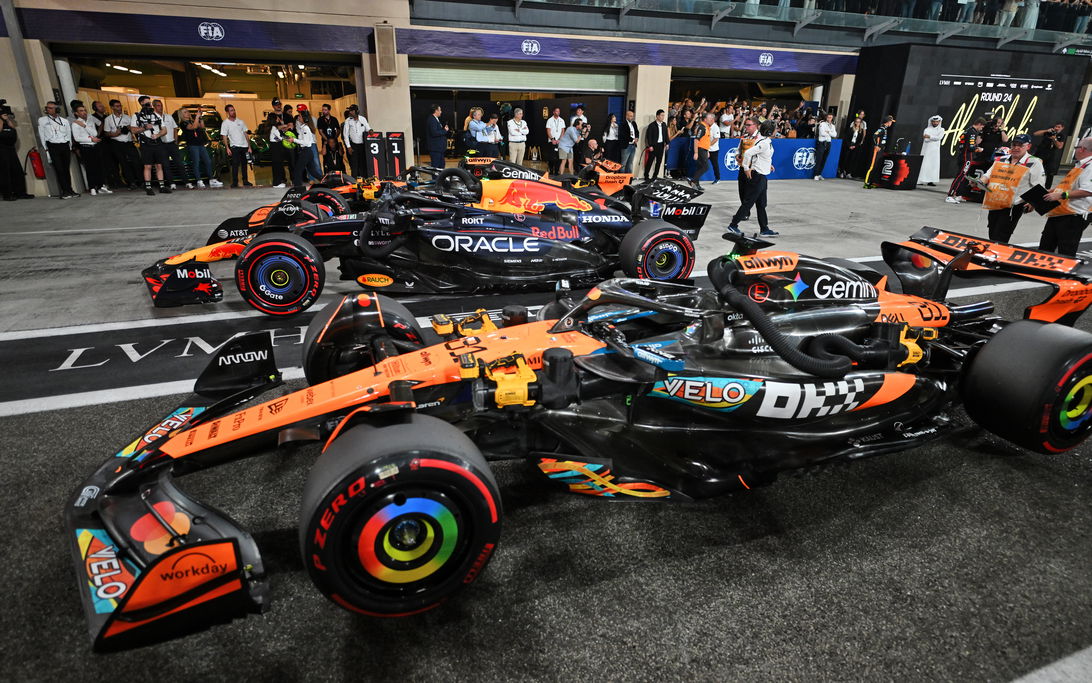
McLaren dominated the 2025 World Championship, finishing the season with 833 points and winning the constructors' title for the second consecutive time. The MCL39 was, in fact, the car that best interpreted the concept of a ground effect single-seater, seeking to eliminate, the critical issues that this type of car has proven to have intrinsically since its introduction in 2022.
In particular, the difficulty of travelling with reduced ground clearance without inducing porpoising, but also chronic understeer, a direct consequence of the fact that the centre of aerodynamic pressure, generated under the car's floor, was further back than the car's centre of gravity, making corner entry more problematic.
To overcome these problems, the Woking-based team's engineers, led by Rob Marshall, with Mark Ingham as Chief Designer, Neil Houldey as Head of Engineering, Peter Prodromou as Head of Aerodynamics, assisted by Giuseppe Pesce, took the concept to the extreme, with choices that were certainly not conservative, as team principal Andrea Stella himself was keen to point out immediately after the Abu Dhabi race.
"Last Christmas, I couldn't enjoy myself because I was worried about how far we had pushed ourselves, taking the concept to extremes with elements such as the steering box and front suspension," he said.
"I was concerned about how much risk we had agreed to take with a car that was world champion, with those solutions still in the final stages of development at the end of December."
The words of the McLaren boss refer, on the one hand, to the positioning of the steering box in a non-standard position, in front of the chassis, but inside it and behind the front attachment point of the lower triangle, a decidedly “intricate” area of the car, which would not have allowed, in the event of an error, a further modification to make it less extreme.
"But above all, the reference is to the front suspension, characterised by a very steep angle of the upper wishbone with the rear arm anchored far back, in order to achieve optimal aerodynamic platform management from a vehicle dynamics points of view. In essence, the MCL39 was not a simple development of the 2024 car, but a concept that went further, precisely to create a performance gap with its rivals that would not be easily closed, but above all, with solutions that could not be replicated during the season.
The article continues below.
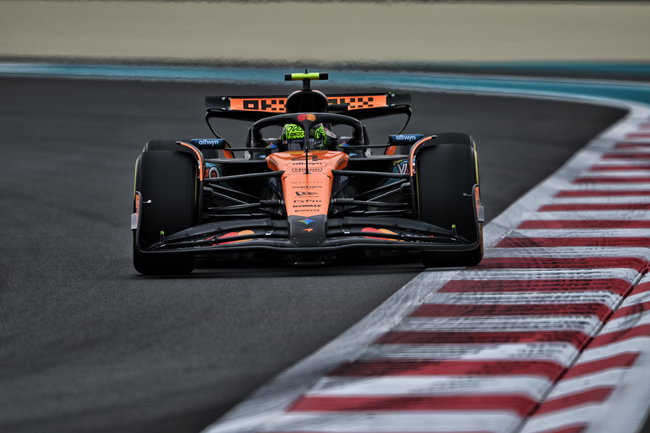
This was something once considered a characteristic modus operandi of Adrian Newey, but it is clear that it has been internalised and perfectly understood by Rob Marshall, who was his right-hand man for many years. However, it is fair to point out that the MCL39 was not without its flaws, at least in terms of adaptability to the driving styles of Norris and Piastri.
The extreme dynamic effectiveness of the front suspension, in fact, had initially destabilised both drivers in terms of driving feel when entering corners with the front end. Both drivers, with slight differences, had judged the front end to be “numb,” i.e., unable to provide them with a clear, direct feeling of precision on turn-in.
This led the Woking-based engineers to introduce an evolution of the front suspension in Austria during the season, but only Norris agreed that it was an improvement, while Piastri never wanted to adopt the evolved version, remaining faithful to the original configuration throughout the season.
While it is correct to argue that the strong convergence in performance between the cars justified, and indeed enhanced, the priority given to the drivers' driving sensations in order to extract the best performance, it is equally true that on some tracks, especially in the second half of the season, Piastri's choice may have been counterproductive for him, preventing him from extracting the maximum performance from the car, compared to Norris.
However, the extreme dynamic precision of the MCL39 actually betrayed both drivers on one occasion: the Las Vegas Grand Prix, when the Woking-based team's engineers, relying on that very quality, decided to adopt an extreme setup in terms of minimum ground clearance, confident that the asphalt on the Strip was completely free of bumps.
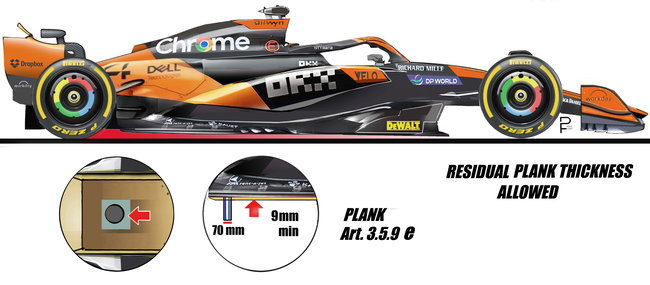
After the race, both MCL39s were disqualified for excessive plank wear, caused, according to Stella himself, after the race, by porpoising induced by the undulations that had been underestimated.
It therefore seems reasonable to conclude that, despite being the most effective car overall, the MCL39 was not always a car that both drivers were able to fully exploit, thus creating a small opening in which, from the Italian Grand Prix onwards, Max Verstappen and Red Bull managed to get involved in the fight for the drivers' title, right up to the last race.
The article continues below.
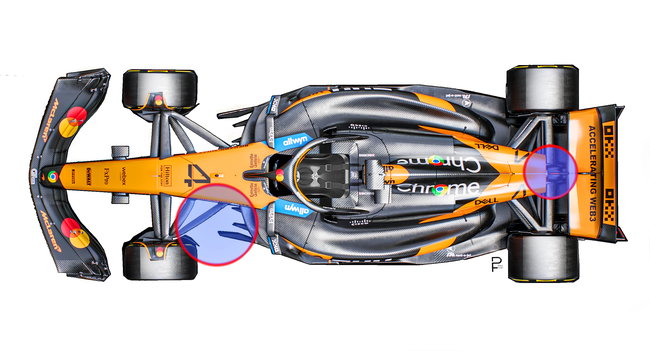
MCL39 view from above
From this perspective, you can see the very rearward positioning of the upper triangle of the front suspension, the extremely clean aerodynamic design of the sides and, above all, the reduced section of the engine cover towards the rear axle.
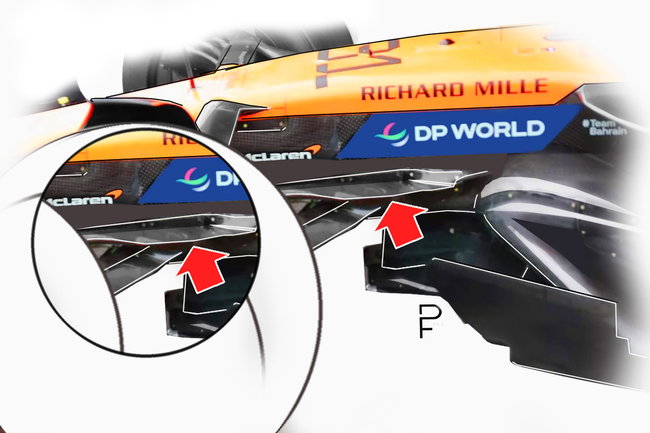
MCL39 SIDE VIEW AND SUSPENSION DETAIL
The side view reveals the strong macroscopic derivation of the design from the MCL38, but this is only a visual impression that conceals the changes, especially at the dynamic level, that characterise this car.
FRONT SUSPENSION DETAIL
The sharply inclined upper triangle with a very rearward attachment point are the distinctive features of a non-conservative design, which was its greatest strength.
Cause of Las Vegas disqualifcation
The illustration shows the maximum consumption limit that was exceeded at two measurement points on both cars in Las Vegas, resulting in their disqualification.
Most read
Never miss a thing from the Formula 1 season! Add the 2026 F1 schedule to your calendar at the touch of a button. Subscribe below and put the dates and times of every race directly on your PC or smartphone, so you don't miss a second from the new season.
Download the F1 calendar Download the F1 calendar
A variant with just the race and qualifying is also available.
Click here to download it..





Join the conversation!