


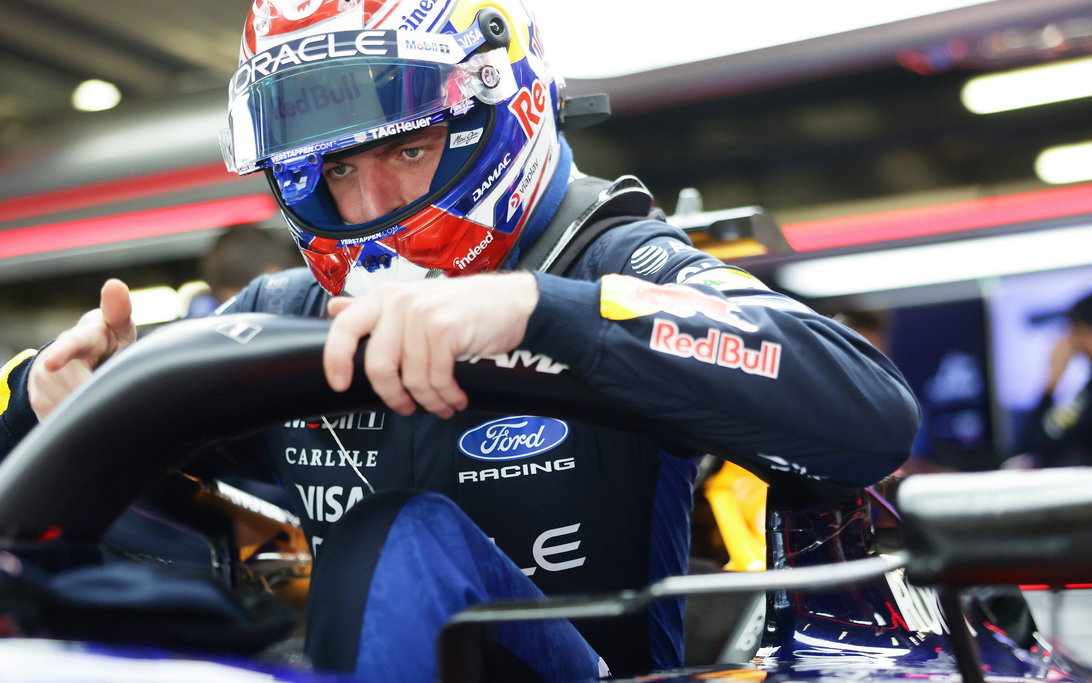
Max Verstappen’s retirement from the Chinese Grand Prix brought an end to what had already been an extremely difficult weekend for the Dutchman, with Red Bull’s RB22 visibly struggling around the Shanghai International Circuit.
From a technical standpoint, Shanghai represents a particularly demanding test. The layout combines a sequence of long, sweeping corners — notably Turns 1, 2 and 13 — with the 1.2-kilometre back straight that culminates in the heavy braking zone for Turn 14.
This mixture of sustained lateral load and prolonged full-throttle running places a premium on aerodynamic efficiency, tyre management and power unit performance.
Across the weekend, however, the RB22 appeared to lack the balance required to cope with these demands. The car once again displayed a nervous aerodynamic platform, with the imbalance between front and rear grip becoming especially apparent through the circuit’s long-radius corners.
As a consequence, Verstappen struggled with pronounced tyre graining — a problem amplified by the relatively abrasive Shanghai surface and the prolonged loading placed on the front tyres through the opening sector.
The issue appeared to stem from an underlying lack of aerodynamic load. Red Bull’s current configuration does not seem to generate sufficient downforce to stabilise the car during extended cornering phases, forcing the drivers to manage excessive tyre slip.
The result is accelerated surface degradation, which in turn further erodes grip over the course of a stint.



Red Bull's start line issues
Another weakness emerged at the start of the race. Verstappen once again struggled to launch effectively, though the problem appeared to be less related to driver execution and more to the power unit’s deployment and torque delivery settings.
It suggests that optimisation work remains necessary on the calibration side, particularly in the delicate phase where electrical deployment and internal combustion output must be perfectly synchronised.
Taken together, the situation indicates that Red Bull faces a multifaceted development challenge. Improvements will not only be required on the aerodynamic side — to generate greater downforce and provide a more predictable balance for tyre management — but also in terms of power unit integration and operational refinement.
The RBPT power unit made a positive impression during pre-season testing in Bahrain, especially in terms of reliability.
However, the early rounds of the championship suggest that it currently sits as the third-strongest package behind Mercedes and Ferrari, with a noticeable performance deficit.
That said, it remains difficult to determine how much of that gap is attributable to the engine itself and how much is masked by the RB22’s broader competitiveness issues.
After the opening two rounds of the season, the Milton Keynes-based team returns home with several question marks to address if it is to close the ground lost to its principal rivals.
There is, at least, some limited consolation in the situation faced by McLaren. Like Red Bull, the reigning constructors’ champions have begun the 2026 campaign on the back foot and currently sit some way behind the frontrunners — even though the MCL40 is powered by the Mercedes engine that has won both of the season’s opening races.
Also interesting:
Join RacingNews365's Ian Parkes, Sam Coop and Nick Golding, as they look back on the Chinese Grand Prix. The trio discuss Lewis Hamilton's praise of the new F1 regulations and Max Verstappen's striking criticism, before debating their own views!
Rather watch the podcast? Then click here!


Most read


In this article
Never miss a thing from the Formula 1 season! Add the 2026 F1 schedule to your calendar at the touch of a button. Subscribe below and put the dates and times of every race directly on your PC or smartphone, so you don't miss a second from the new season.
Download the F1 calendar Download the F1 calendar
A variant with just the race and qualifying is also available.
Click here to download it..





Join the conversation!