


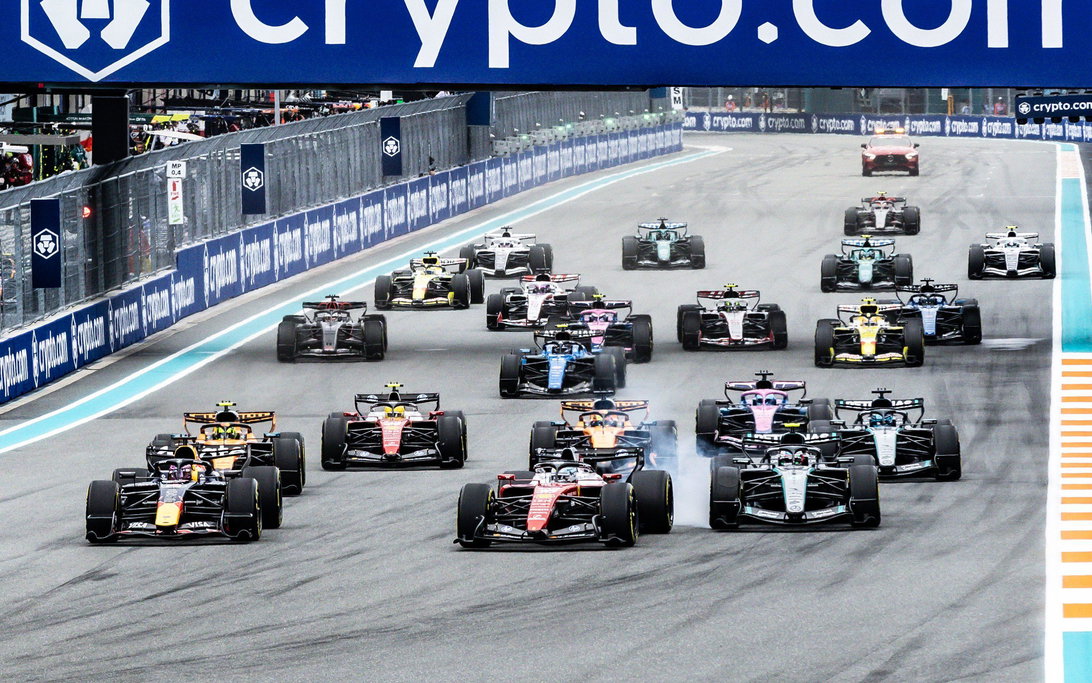
This year's major regulations overhaul has led to braking becoming a more complex task than previously in F1. But just how complex?
For a start, energy recovery has become integral following the 50-50 split in power between combustion and electrical energy. As a consequence, when, by how much, and how drivers slow down have had a major impact on the design of the braking systems.
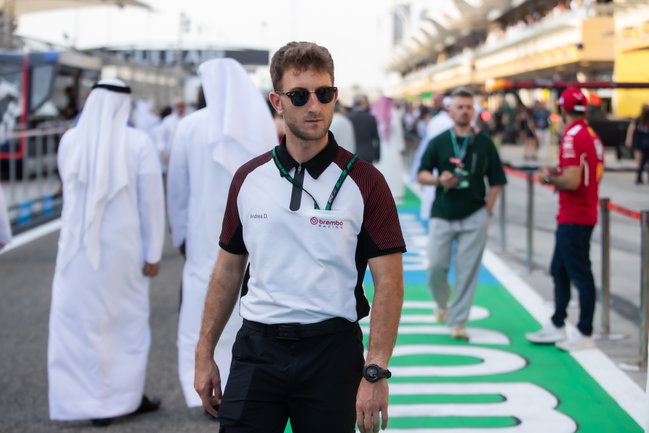
Speaking exclusively to RacingNews365, Brembo race engineer Andrea Dellavedova said: "The big part of the innovation for this year is about the regeneration.
"If you regenerate more, you dissipate less energy with the brakes. So all the dimensions and the design of the brake circuits, callipers, discs, pads, everything, we did considering the regeneration."
[Article continues below]
Wide spectrum
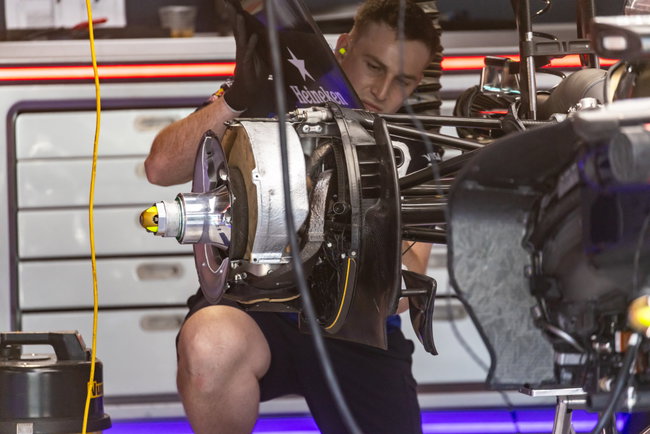
The size of the front brake discs has increased, with their maximum diameter expanded by 15 millimetres. Although the maximum diameter of the rear discs is unchanged, their thickness can now be up to 34 millimetres, instead of the previous year's maximum of 32.
The minimum diameter of the disc cooling holes has also changed, from three millimetres to 2.5 millimetres, whilst the calliper design has also become more flexible.
Previously, every calliper could have a maximum of six pistons, whereas now they can be fitted with between two and four, and a maximum of four brake pads. The mounting system has also been redesigned, meaning up to three mounting points are now possible.
Furthermore, the rear braking system must be capable of exerting 2500 Nm of braking torque on both rear wheels without assistance from the power unit. This torque value must be achieved at a maximum calliper pressure of 150 bar, and the hydraulic pressure of the rear braking system cannot exceed 1.2 times the pressure exerted by the driver.
"The most challenging part is that now this year we have a system that needs to work in a very big window of conditions, because if you have a circuit where you can regenerate a lot, you will use the brakes less," said Dellavedova.
"The temperature, in that case, will be lower compared to a circuit where you cannot regenerate more. The more you use the brake, the more the temperature will increase.
"So our brake system needs to work with both low and high temperatures. That is the most challenging part. For example, regarding the rear brakes, we are running at very low temperatures compared to last year because the regeneration is very high, so we need a material that can also work properly at low temperatures.
"This is one of the biggest qualities of our material that is a change from last year, and that we can work well at low temperatures. It means that you will have the same performances in all conditions."
[Article continues below]
Keyword: regeneration
Across the first few races of this year, it has been proven that braking and deceleration have become a true discipline.
Alongside traditional braking, and lift and coast, superclipping has emerged. This is a type of artificial engine braking: while the driver is pressing the accelerator, the electronic control unit (ECU) switches the MGU-K into energy recovery mode.
As a result, instead of the engine's full power reaching the rear wheels, a significant portion [up to 250 kW] recharges the battery, which leads to substantial deceleration. Drivers downshift more aggressively toward the apex of corners to increase the conversion of kinetic energy into electrical energy through higher engine revolutions, while smoothly modulating and extending their braking phases.
"It's not only about the brakes, but also about the regeneration," said Dellavedova. "In the past, we had to work on our materials, our design, and think only about that, because it was the only thing slowing down the car.
"Nowadays, our brakes must also cooperate with the electric part, the hybrid part of the cars, and they have to match perfectly. They must not be two separate things, because they are playing at the same time, doing the same thing, and so they have to match in the best way possible."
So, which track is the most difficult from a braking perspective? Dellavedova claims those which used to be difficult in the past are now easy, and vice versa.
"Suzuka, from our side, was very interesting, because the teams used the brakes very few times, so they were able to regenerate a lot," he said. "Speaking about temperature, because it's the heart of the braking performance, it was a bit tough to keep the temperature high enough to have good performance.
"But we have a range in the severity of the circuit for braking. Until last year, for example, Bahrain was the most difficult, because there we had a lot of hard braking, a lot of energy during a lap, so the brakes worked in very high energy and temperature conditions. It was difficult from that point of view.
"This year, due to the regeneration, the tricky part is no longer the high energy circuit, but the lower one, because there we can experience very low temps. So it's like we are moving from one side to the opposite."
Dellavedova's explanation was further confirmed in Montréal. In the past, the Circuit Gilles Villeneuve was considered very severe on brakes; however, the recent weekend showed it is now much less extreme due to the regeneration.
[Article continues below]
Interesting solutions
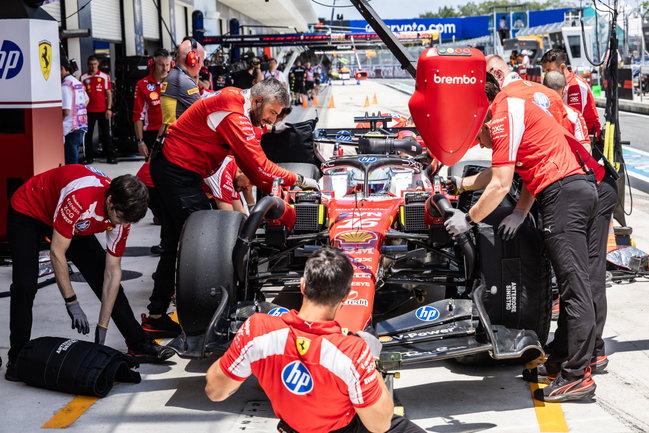
Whilst every manufacturer in MotoGP uses the same braking system, Brembo customises its brake systems in F1 to match each car's unique design and aerodynamic specifications. According to Dellavedova, some of this year's solutions are intriguing.
"From a technical point of view, it’s interesting that we have a completely new calliper design this year with one team, which has three fixing points - not two, the standard from the past - and with eight piston callipers with four pads," he said. "It's a completely different design on the calliper side. We have had very good feedback on it, so maybe that will be the future."
After the first few races, Dellavedova believes that Brembo has succeeded in achieving its goals, and its braking systems, which comply with the guidelines set by the new regulations, are performing well and meeting expectations.
"The design was pretty good because we don't have big complaints about the performance of the brakes," he said. "So the work that we did during the winter break was good.
"The most challenging part is the bleeding between the regeneration and the brake and the dissipative braking. That is up to the team to manage it.
"But we have been able to work properly, in a lot of different conditions, and for the moment, no big issues and no big complaints. It's going smoothly."
Also interesting:
Join RacingNews365's Ian Parkes, Sam Coop and Nick Golding as they look back on last weekend's Canadian Grand Prix! The trio discuss if Kimi Antonelli is now the title favourite, McLaren's major mistake, if Lewis Hamilton is back and Max Verstappen's demand to F1.
Rather watch the podcast? Then click here!


Most read

In this article
Never miss a thing from the Formula 1 season! Add the 2026 F1 schedule to your calendar at the touch of a button. Subscribe below and put the dates and times of every race directly on your PC or smartphone, so you don't miss a second from the new season.
Download the F1 calendar Download the F1 calendar
A variant with just the race and qualifying is also available.
Click here to download it..





Join the conversation!