


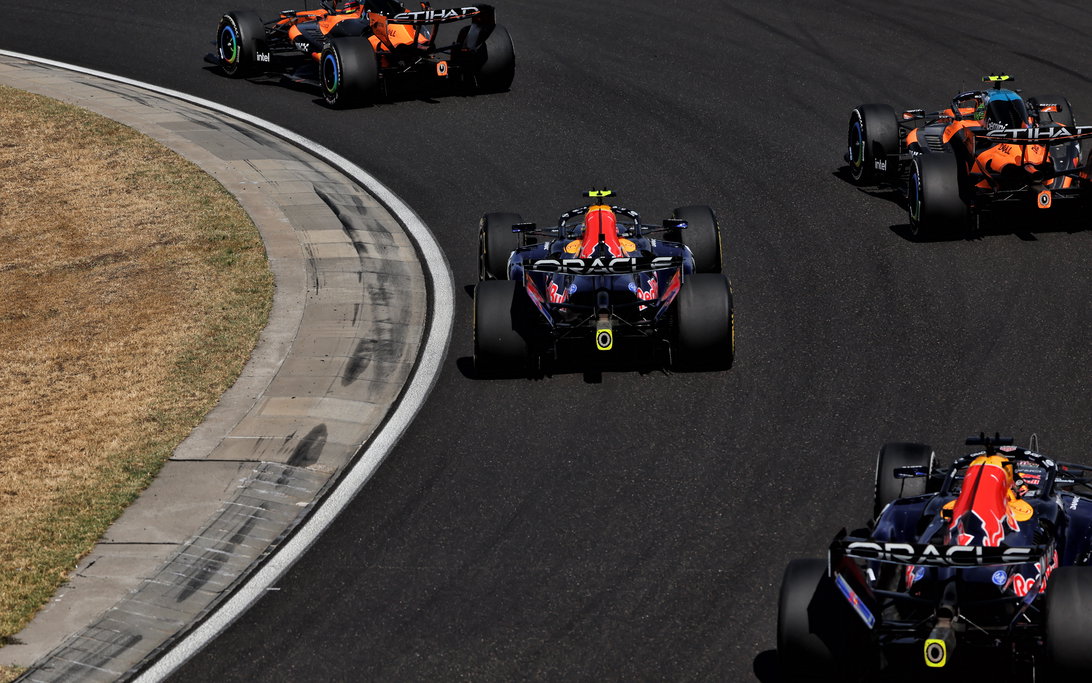
Weight reduction has been one of the most consequential technical battles of the 2026 Formula 1 season.
The combination of increased electrical power output and a regulatory drop in minimum weight, from 798kg in 2025 to the current 768kg, has presented every team on the grid with a genuinely complex engineering problem.
By the time the season opener arrived, virtually no car on the grid was running at the minimum weight limit. McLaren was perhaps the closest of anyone, and that proximity was no accident. It was the direct result of a deliberate design philosophy centred on a notably short wheelbase.
The 2026 regulations cap the maximum wheelbase at 3,400mm, down from 3,600mm the previous season. McLaren went further still, building the MCL40 around a wheelbase of approximately 3,250mm, roughly 150mm shorter than the average among its rivals.
Shortening the wheelbase is one of the most effective means of reducing overall car weight. A more compact chassis requires less material throughout, making it perhaps the most direct route to hitting the weight target.
However, as McLaren demonstrated during the opening phase of the season, that efficiency comes with real drawbacks.
The MCL40 proved difficult to balance in the early rounds, and generated less downforce than its competitors. The reason is straightforward: shorter aerodynamic surfaces, both above and crucially beneath the car, mean less area over which to build aerodynamic load.
A shorter car is lighter but aerodynamically more constrained, and finding performance gains during the development phase without upsetting that balance has proven to be an evident limitation of the approach.
The more common route: structural refinement
For most teams, the more practical and sustainable path to weight reduction runs through the incremental refinement of structural components.
By redesigning individual parts with greater precision, engineers can reduce their volume whilst maintaining the same structural integrity, shaving grams across dozens of components simultaneously.
Historically, magnesium was widely used for mechanical components precisely because of its low density. It was eventually banned due to its flammability, closing off that particular avenue entirely.
Today, the focus falls on more accurate design of both mechanical components, such as uprights and hubs, and composite parts. This is the most widely adopted and reliable method available to current engineering departments.
It is worth emphasising, however, that redesigning components with the specific intent of reducing unsprung mass is far from a quick process.
Each part must go through an extensive validation programme to ensure it meets the same standards of reliability and structural resistance as the version it replaces. Cutting weight in this area demands patience.
Among the teams that have most clearly pursued a systematic weight-reduction strategy throughout the season, Red Bull stands out.
The aerodynamic developments introduced on the RB22 have not been aimed solely at improving outright downforce or airflow efficiency; weight saving has been a parallel objective, and the overall effect has been a gradual improvement in the car's power-to-weight ratio.
The significance of that metric is well established within the paddock. Reducing a car's weight by ten kilograms translates to a lap time improvement in the region of three to four tenths of a second, depending on the circuit characteristics.
That alone makes the painstaking work of component refinement entirely worthwhile for every team still chasing those final kilograms.
Most read







In this article
Never miss a thing from the Formula 1 season! Add the 2026 F1 schedule to your calendar at the touch of a button. Subscribe below and put the dates and times of every race directly on your PC or smartphone, so you don't miss a second from the new season.
Download the F1 calendar Download the F1 calendar
A variant with just the race and qualifying is also available.
Click here to download it..





Join the conversation!