


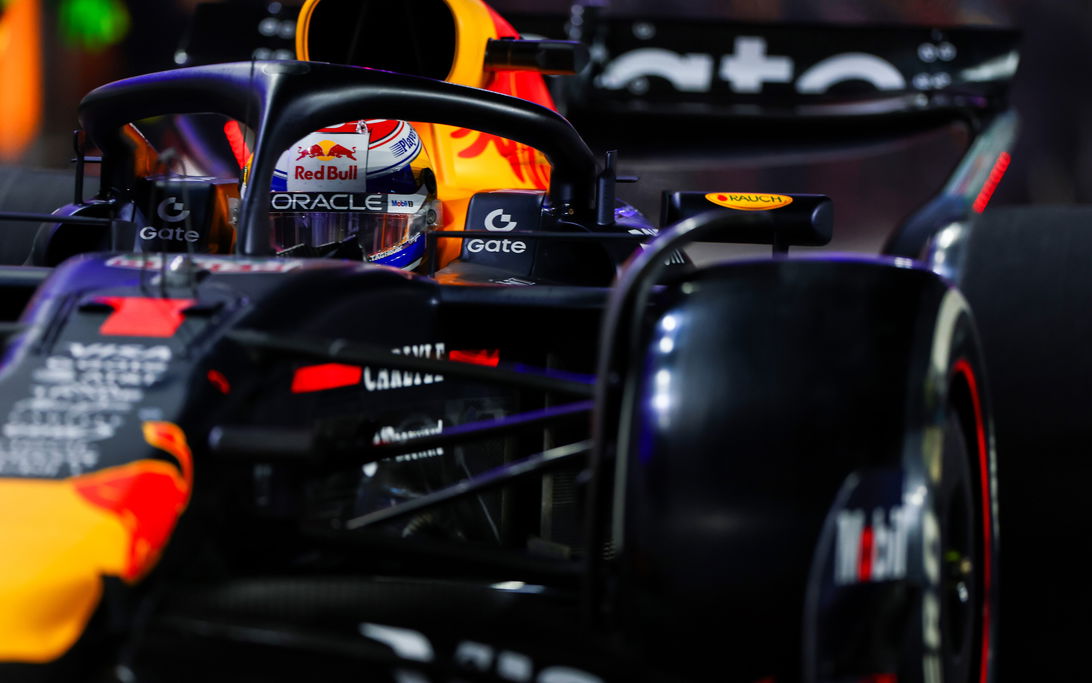
Formula 1’s 2026 season is beginning to warm up, with Audi taking to the track in Barcelona on Friday for a filming day. Next Thursday, Red Bull and Racing Bulls will both unveil the liveries of its respective cars in Detroit.
The Milton Keynes-based team is currently working at pace to complete the RB22, which will make its track debut during a closed-door test at the end of the month, also in Barcelona.
According to information emerging from Red Bull's base, the approach of the outfit led by Laurent Mekies will be very aggressive, clearly differentiating itself – particularly in the preparation phase for the season – from the programmes of other teams.
The new RB22, while not specifically targeting outright performance – since the first test session will serve for all teams as a functional shakedown of the various electronic systems managing the power unit, as well as the creation of driving automatisms to help drivers manage active aerodynamics and available battery charge – will arrive in Barcelona with a fairly definitive first aerodynamic specification. This will then evolve in a non-dramatic manner during the subsequent public tests in Bahrain.
In reality, this approach does not indicate a less dynamic development programme compared to rivals; on the contrary, it represents a fundamental pillar of Red Bull’s strategy.
The greater definition of the RB22’s initial aerodynamic concept will serve as a benchmark for approving subsequent developments, which, according to our sources, will be extremely intensive during the first half of the season.
This programme has been outlined for some time and is also based on strengthening personnel and calculation and simulation tools, which are essential for verifying and correlating data coming from the wind tunnel.
Viewed by others:
Red Bull's aerodynamic approach
Although the wind tunnel has undergone progressive upgrades, it is not the new facility currently under construction in Milton Keynes.
For this reason, the aerodynamics department led by Enrico Balbo has, for several months now – and not yet concluded – undertaken an intensive recruitment campaign for specialised technicians. These range from aerodynamic performance engineers to data correlation specialists, as well as heads of CFD and dynamic simulation.
As Red Bull approaches 2026 with a car powered by a power unit developed by Red Bull Powertrains in collaboration with Ford, the team intends to place strong emphasis on continuous vehicle development.
This is also seen as a way to compensate for any potential issues that may emerge from what is still a relatively immature power unit project.
The complexity of managing electrical energy deployment represents a challenge for all manufacturers. As such, Red Bull is aiming to gain a competitive advantage during phases in which everyone will, to varying degrees, have to contend with power unit-related issues and with still-limited familiarity in managing active aerodynamics.
In short, while many initially imagined F1 in 2026 as a formula dominated exclusively by power unit performance, Red Bull has already shown that this does not lead to a single approach to the problem. A competitive advantage can also be sought through intensive refinement of the car’s aerodynamic concept.
Ultimately, it appears that in Milton Keynes – just as has happened in the past – they never choose well-trodden paths, but instead pursue entirely original interpretations.
Also interesting:
The 2026 F1 Cars Revealed: Everything You Need to Know!
Discover how the 2026 F1 regulations will revolutionise the sport, with a shift to movable wings instead of traditional DRS, to the increased electrical power in the hybrid systems, and the introduction of 100% sustainable fuel.
Most read
In this article
Never miss a thing from the Formula 1 season! Add the 2026 F1 schedule to your calendar at the touch of a button. Subscribe below and put the dates and times of every race directly on your PC or smartphone, so you don't miss a second from the new season.
Download the F1 calendar Download the F1 calendar
A variant with just the race and qualifying is also available.
Click here to download it..





Join the conversation!