


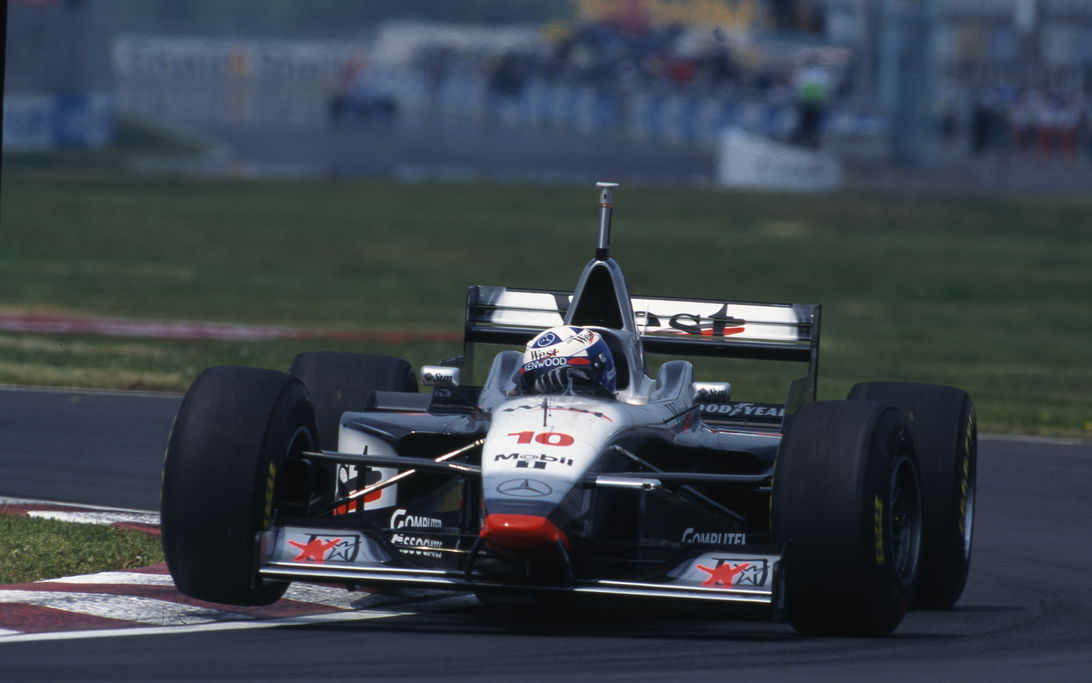
The wait had been agonising. Forty-two years is an eternity in motorsport, yet that is how long Mercedes-Benz had been absent from the top step of a Formula 1 podium before David Coulthard's victory at the 1997 Australian Grand Prix ended its drought.
For a marque synonymous with racing success, the gap between Juan Manuel Fangio's championship-sealing triumph at Monza in 1955 and Coulthard's breakthrough in Melbourne was far too long, but it marked the return of one of F1's most influential brands.
Mercedes had withdrawn from motorsport after the 1955 Le Mans disaster, a catastrophe that claimed over 80 lives and cast a long shadow over the brand's racing ambitions.
Its return as an engine supplier in the 1990s, partnering with McLaren from 1995, was meant to signal a new era.
Yet the early years proved frustrating, with the MP4/10 plagued by unreliability despite flashes of speed.
Coulthard's victory in Australia, McLaren's first in 50 races, finally validated the partnership's potential.
Viewed by others:
Chaos from the first corner
The race itself was settled more by attrition than outright pace. Jacques Villeneuve had secured pole position for Williams, over 1.5 seconds clear of Coulthard in fourth, but his afternoon lasted barely a few hundred metres.
Eddie Irvine's Ferrari misjudged the braking point into Turn 1 on the opening lap, locking up and collecting both Villeneuve and Johnny Herbert's Sauber.
All three cars ended up stranded in the gravel, Villeneuve's championship defence in tatters before it had truly begun. Irvine limped on for another lap before a puncture and suspension damage forced his retirement.
That left Heinz-Harald Frentzen, Villeneuve's Williams team-mate, in control. Running a two-stop strategy whilst most of the field attempted a single stop, Frentzen pushed hard early, building a 19-second advantage at one stage.
It appeared the German would deliver Williams' first victory of the season.


Frentzen's brake nightmare
But Frentzen's race began to unravel during his second pit stop on lap 40. A stubborn right-rear wheel nut cost him six precious seconds, allowing both Michael Schumacher's Ferrari and Coulthard's McLaren to close in.
Worse still, his brakes were beginning to fail.
For several laps, clouds of carbon dust billowed from Frentzen's Williams as the brake discs disintegrated under sustained stress.
With just three laps remaining and running second, the inevitable happened. The right-front brake gave way completely as Frentzen attempted to slow for Turn 1 on lap 54, sending him spinning out of contention and into the gravel.
Coulthard inherited the lead and cruised to victory by 20 seconds over Schumacher, with team-mate Mika Hakkinen claiming third. It was a breakthrough moment for all involved.
 Australian GP
A drought ended
For Coulthard, it marked his first victory since the 1995 Portuguese Grand Prix, ending a personal winless streak spanning over a season.
For McLaren, it was vindication after three successive winless campaigns that had seen it fall from F1's elite.
But for Mercedes, the significance ran deeper. Fangio's Monza victory in 1955 had capped a dominant era in which the German marque won back-to-back championships before withdrawing from the sport entirely.
Coulthard's triumph in Melbourne proved Mercedes could compete again at the highest level. It was the first step on a journey that would eventually see the partnership claim multiple championships and establish Mercedes as F1's dominant force in the modern era.
Forty-two years is a long time to wait. But on 9 March 1997, the wait finally ended.
Also interesting:
Join RacingNews365's Ian Parkes, Sam Coop and Nick Golding, as they look back on the Australian GP and look ahead to China! The trio discuss the first taste of F1's new regulations, Max Verstappen's frustration but also Lewis Hamilton's striking positivity.
Rather watch this episode? Then click here!


Get the latest F1 news from RacingNews365 directly in your Google feed! Click on the link below and you’ll see your favourite F1 website appearing even more often. That way, you’ll never miss any news, analyses, interviews, or exclusives.
Follow RacingNews365 on GoogleMost read



In this article
Never miss a thing from the Formula 1 season! Add the 2026 F1 schedule to your calendar at the touch of a button. Subscribe below and put the dates and times of every race directly on your PC or smartphone, so you don't miss a second from the new season.
Download the F1 calendar Download the F1 calendar
A variant with just the race and qualifying is also available.
Click here to download it..






Join the conversation!