


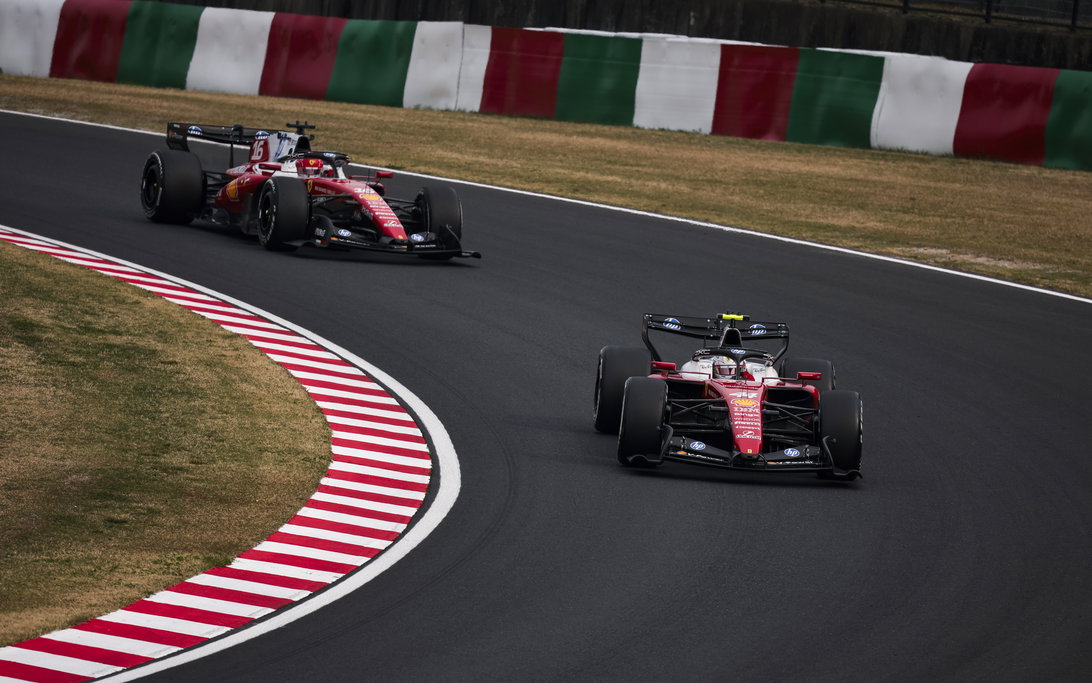
Lewis Hamilton has made an encouraging start to the F1 season, but Ralf Schumacher believes there may be a deeper reason behind his resurgence.
After a difficult 2025 campaign— his first with Ferrari —in which Hamilton struggled for consistency and took time to adapt to a new environment, the seven-time world champion appears rejuvenated this year.
A first grand prix podium for Ferrari in China marked a clear step forward, and Hamilton has spoken positively about the racing under the latest regulations.
While he has been critical of aspects such as super clipping linked to energy deployment, Hamilton has welcomed the improved ability for drivers to follow each other more closely. Despite some overtakes appearing artificial, he has largely viewed the changes as a step in the right direction.
His upturn in form has also coincided with a series of eye-catching on-track battles with team-mate Charles Leclerc. In Shanghai, the pair went wheel-to-wheel in a hard but fair fight as Hamilton secured his maiden Ferrari podium, underlining a more competitive dynamic within the team.
Schumacher, however, suspects there is more behind Hamilton's improved form.
"I'm actually of the opinion — and this will probably attract a lot of criticism again, but I don't care — that Hamilton has a contract which gives him exactly that freedom [on track]," Schumacher said on Sky Sport Germany's F1 podcast Backstage Boxengasse. "It does make me very happy that he is clearly back in the mix this year."
He went further by suggesting that even team principal Fred Vasseur may have limited influence over the Briton's on-track decisions.
"I can imagine that even Fred Vasseur has no say in it, even if he wanted to. Hamilton can probably decide for himself what he does.
"He will likely have some kind of number one status, I think. That means Ferrari has no real way of controlling it; he decides that himself. But that naturally has an impact within a team."



Contract concerns raised
Schumacher pointed directly to contractual arrangements as a potential source of tension.
"I think it mainly comes down to the contracts, and that's actually the main problem. You shouldn't underestimate that there are two egos in those cars," the six-time grand prix winner said.
"I completely understand that — it was the same in the past. But it does have an impact on the team."
The German highlighted the broader effect such dynamics can have beyond the drivers themselves.
"The mechanic who is there from morning to evening, giving everything — just like everyone in the team — feels that as well," he explained.
"And if those two 'bulls' at the front lose a position, or five seconds, or maybe even damage parts because they collide, then that affects the entire team. Sometimes you simply have to respond to that."
Despite his concerns, Schumacher acknowledged that the situation adds intrigue from a spectator's perspective.
The former Jordan, Williams and Toyota driver said: "For us, it's obviously great: we have something to talk about and it makes things exciting.
"And as long as they don't hit each other, it's fine. But as we also said after the previous race, for the team, it's obviously not the fastest way to win a race. That's beyond doubt."
Also interesting:
Join RacingNews365's Ian Parkes, Sam Coop and Nick Golding as they look back on last weekend's Japanese Grand Prix! The trio discuss what F1 and the FIA must change across the five-week break and if Max Verstappen could actually retire.
Rather watch the podcast? Then click here!


Most read

In this article
Never miss a thing from the Formula 1 season! Add the 2026 F1 schedule to your calendar at the touch of a button. Subscribe below and put the dates and times of every race directly on your PC or smartphone, so you don't miss a second from the new season.
Download the F1 calendar Download the F1 calendar
A variant with just the race and qualifying is also available.
Click here to download it..





Join the conversation!