


The Miami Grand Prix not only marked a fresh starting point for the 2026 season regarding the revised energy management regulations aimed at reducing the effects of super clipping — the sharp loss of electrical deployment at the end of long straights — and energy management more generally, but also represented the first race in which several teams introduced major aerodynamic upgrades.
Ferrari, McLaren and Red Bull — three of the four leading teams — all brought significantly revised cars compared to the specifications seen during the opening three rounds.
Looking back at the upgrade packages introduced in Florida, regardless of the competitive outcome of the weekend, it is particularly interesting to focus on the elements that formed the foundations of these developments, whether visually striking or more subtle in nature.
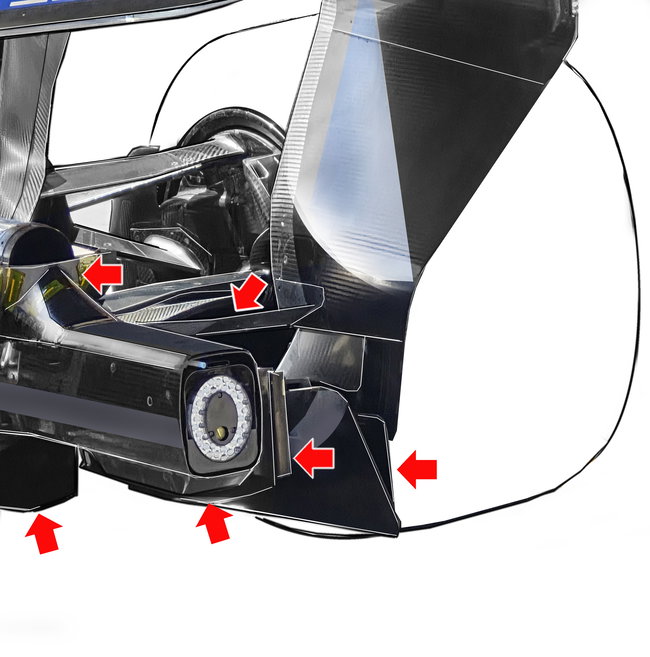
One of the most intriguing examples was the rear-end development of the Ferrari SF-26. Beyond the long-awaited introduction of the new, "Macarena" rear wing featuring a movable flap, the majority of the car's most significant updates were concentrated around the diffuser and exhaust area.
Ferrari appeared to have carried out extensive aerodynamic analysis in this region. This was evident starting from the latest evolution of the FTM profile — the curved flap positioned directly behind the exhaust outlet, designed to stall the main rear wing profile on the straights.
Airflow conditioning around both the upper section of the diffuser and, more importantly, the lower central volume, was heavily refined through the addition of new median flow separators alongside the existing elements. The result was an increase in exit flow velocity, helping to generate a larger low-pressure area beneath the car.
Equally interesting was the CFD-driven study aimed at extending the brake duct fairings towards the rear section of the diffuser, effectively prolonging the lateral channels within the expansion zone.
In essence, Ferrari pursued a highly targeted approach to increase downforce generation while simultaneously improving outwash around the rear wheels.
Ferrari SF-26 rear aerodynamics
The complexity of this aerodynamic area is immediately apparent, beginning with the latest FTM specification, characterised by a curved central profile that directs exhaust gases upwards to promote rear wing stalling on the straights.
The lower section of the diffuser is equally sophisticated. The central area features multiple vertical flow diverters creating channels of varying sections, increasing exit flow velocity.
Particularly interesting is the extension of the lower brake duct fairings which, together with the diffuser sidewall, generate twin channels that further enhance outwash.
McLaren
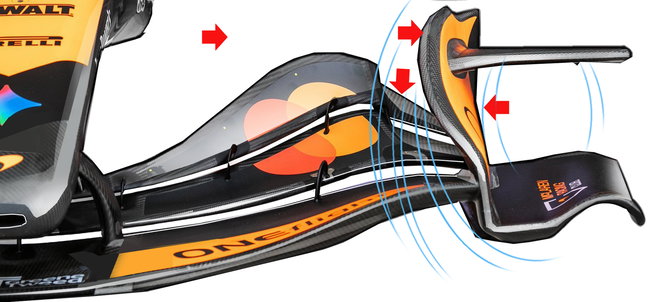
Turning to the McLaren MCL40, which also featured substantial floor modifications, it is worth emphasising that the entire upgrade package revolved around the revised front wing.
The design represents a genuine engineering masterpiece in terms of flap section geometry and, above all, the way the elements transition towards the endplates.
The objective was to increase the effectiveness of the active aerodynamics by widening both the downforce and drag delta between the activated and closed configurations.
Naturally, the precise management of these two operating modes had significant repercussions on the floor development.
The revised package not only generated more load but also delivered a clear improvement in both aerodynamic balance and overall vehicle dynamics throughout the weekend.
McLaren MCL40 front wing
Although it was not the only upgrade introduced in Florida, it is fair to say that the latest front wing evolution influenced the entire package.
The study of the flap sections and their curvature — with a strong emphasis on outwash generation — was specifically aimed at improving the effectiveness of the active aerodynamic system.
Red Bull
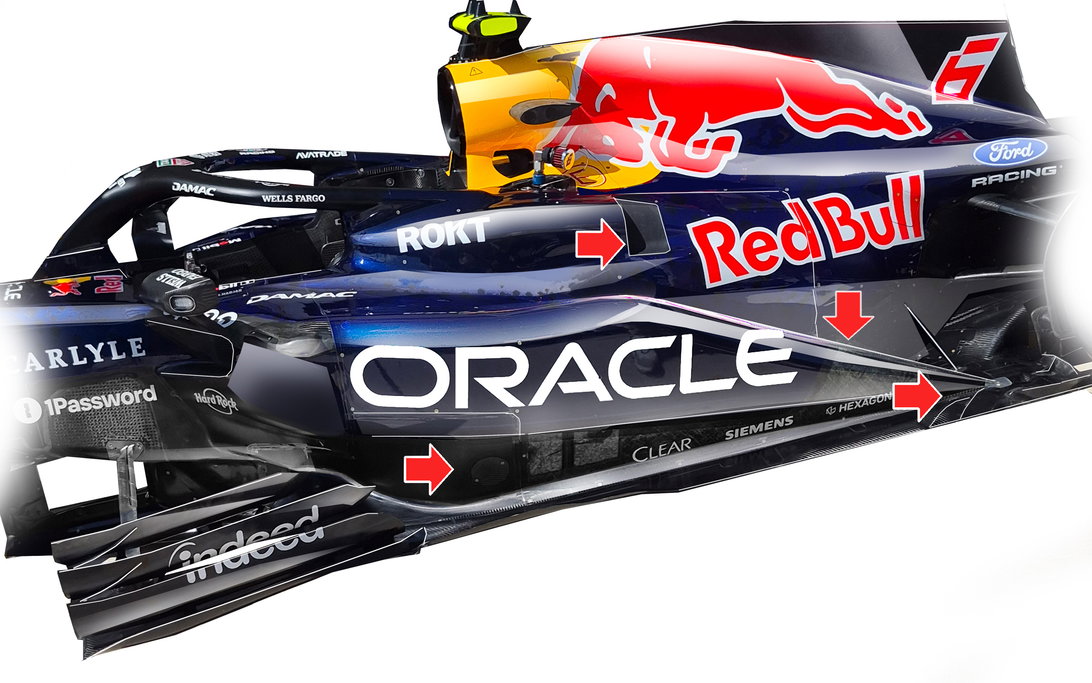
Last, but certainly not least, was the RB22, which arrived in Miami under close scrutiny as Red Bull sought to understand whether it could revive a season that had begun with evident difficulties.
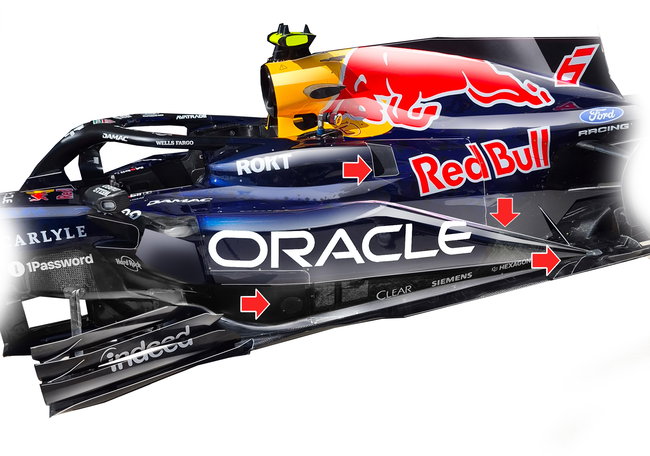
The development package introduced in Florida centred around the new sidepods — effectively the definitive version of the concept first seen in Japan.
Of particular significance was the redesign concealing a major revision of the internal airflow architecture, including extremely compact radiators.
One of the emerging strengths of the Red Bull-Ford power unit appears to be its ability to operate at very high temperatures without compromising reliability. This characteristic has allowed the aerodynamic department to fundamentally rethink the car’s aerodynamic maps, introducing a new distribution of load generated by the bodywork.
Especially noteworthy was the evolution of the undercut, which now enables more effective airflow behaviour beneath the sidepods towards the rear of the car.
More importantly, the decision to position the cooling inlet much further forward allowed Red Bull to better control the airflow travelling along the bodywork towards the rear, keeping it attached to the car and minimising vortex generation.
This proved crucial in preserving rear aerodynamic efficiency. The rear-end concept was characterised not only by the Milton Keynes-based squad's interpretation of the "Macarena" solution, but also by a highly refined exploitation of exhaust blowing, with the exhaust outlet heavily angled downwards.
RB22 sidepods
Red Bull's development direction revolved around the latest sidepod specification, characterised by a heavily inclined rear ramp concealing a channel designed to generate a high-pressure zone ahead of the rear wheels.
Equally significant was the evolution of the undercut, highlighting a refined management of airflow beneath the sidepods, ultimately helping to divert turbulence generated by the rear wheels further outboard.
Also interesting:
Join RacingNews365's Nick Golding and Samuel Coop as they look back on last weekend's Miami Grand Prix! The duo offer their thoughts on F1's rule changes in action and Max Verstappen remaining unhappy despite an exciting race.
Rather watch the podcast? Then click here!


Most read


In this article
Never miss a thing from the Formula 1 season! Add the 2026 F1 schedule to your calendar at the touch of a button. Subscribe below and put the dates and times of every race directly on your PC or smartphone, so you don't miss a second from the new season.
Download the F1 calendar Download the F1 calendar
A variant with just the race and qualifying is also available.
Click here to download it..





Join the conversation!