


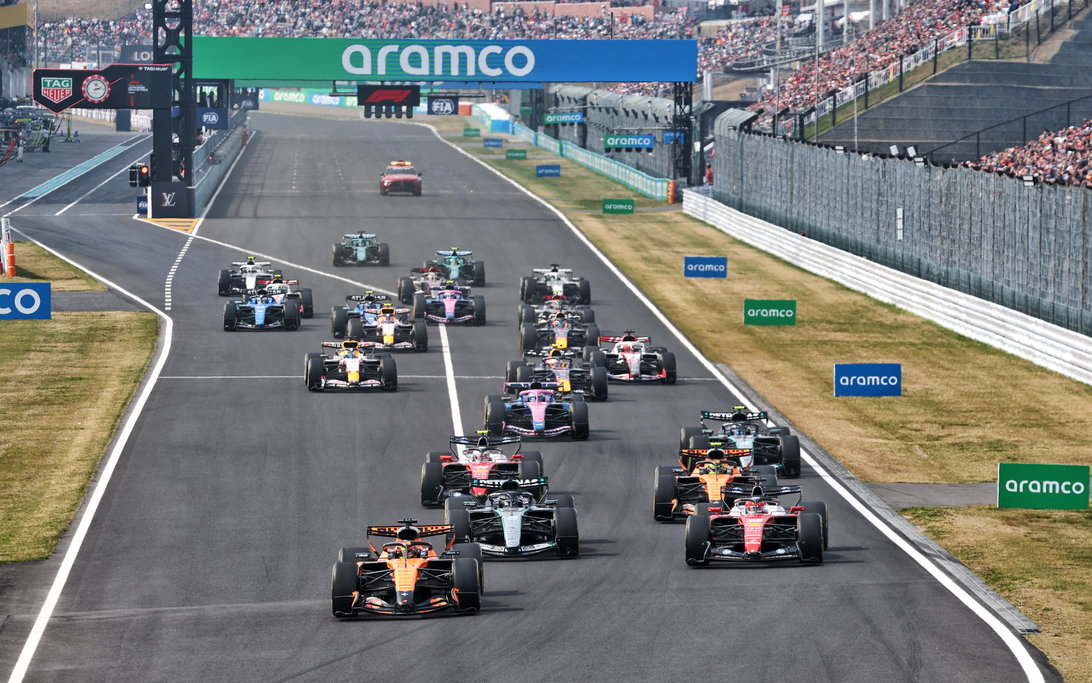
The biggest point of frustration with the new regulations stems from the influence of the new battery and how it has changed the approach for drivers.
50 per cent of the total power comes from electrical power, but it cannot be used indefinitely. As a result, drivers have to adopt an unnatural driving style to get the maximum performance and lap time out of the car.
It has seen drivers lose speed at the end of long straights when the battery is depleted, while race overtakes are largely dictated by who has more energy available.
The FIA already tried a small rule change during qualifying in Japan. Drivers were only allowed to generate 8MJ of energy during their flying laps instead of 9MJ. It seemed to be a band-aid on the wound, as frustration was still evident among some drivers.
But the big question is: Is there a relatively easy-to-apply solution that will ensure that all the problems with the new power source can be fixed at once?
It seems virtually impossible, given the complex nature of the new power source.
However, a solution has been presented by former race engineer Antonio Cuquerella.
The Spaniard, who previously worked for Super Aguri, BMW, HRT, and Ferrari, and now serves as a commentator, has conducted a number of simulations in which he experimented with the total power and available capacity of the battery.
Article continues below.
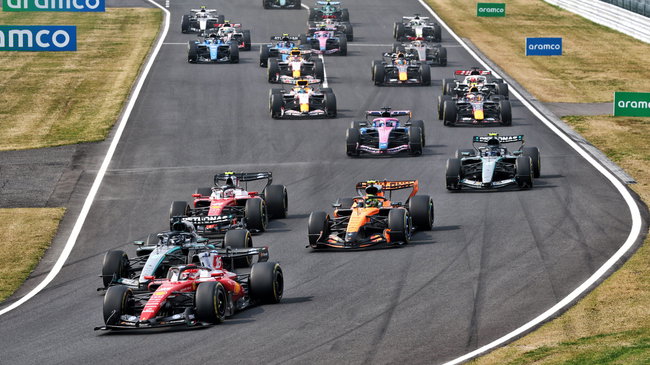
A possible solution?
Cuquerella used the Miami International Autodrome, where the next grand prix will be held, as a test case for the simulations.
The circuit contains a mix of high, low and medium-speed corners, as well as two long straights.
For the first simulation, he used the regulations in their current form and unsurprisingly, there was super clipping and derating at the end of straights.
On the two long straights between Turns 8 and 11 and between Turns 16 and 17, the cars would reduce their speed as early as halfway down the straight.
In total, superclipping would occur over a distance of 230 meters. Simply put, the scenes that arose in Suzuka would happen again in Miami.
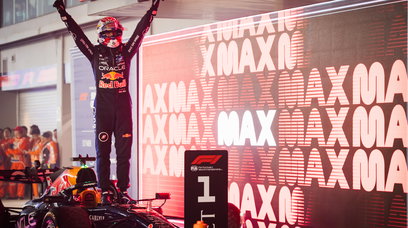
The estimated lap time would be 1:28.2. Max Verstappen's pole lap in 2025 was a 1:26.204.
But Cuquerella appears to have presented a solution. In his post on social media, he emphasises that it is an improvement that does not require changing the hardware.
He proposed a number of changes in his simulations, namely reducing the maximum power of the battery (MGU-K), reducing the recharge and lowering the transition speed (slew rate).
You can read the results of the simulations below the X-embed
Results of the simulations
Cuquerella performed seven different simulations. These played with the maximum power (250/200/150 kW), the maximum recoverable energy (6/9 MJ) and the transition speed (50/100 kW/s).
From this, two combinations emerged that completely eliminate superclipping without causing an extreme difference in lap time. When the safety around power loss is also taken into account, one clear "solution" remains.
In this finding, the maximum power of the battery is reduced from 350 kW to 200 kW, so the ratio of combustion engine power to battery power goes from 50/50 to 64/36.
In addition, the maximum "recharge" is reduced from 9 MJ to 6 MJ, which means the battery has 33% less energy. The maximum charging power remains 350kW under braking.
Finally, the transition speed (the speed at which the engine builds up or down its power) is reduced from 100 kW/s to 50 kW/s.
This solution has both advantages and disadvantages:
Advantages:
- Superclipping disappears;
- Improved safety due to less sudden reduction of electric power and thus speed;
- Top speed is achieved at the end of the straight, instead of halfway through;
- Higher speed when entering corners;
- Less artificial overtaking
- Less/no lift-and-coast in corners, allowing drivers to push again and increasing cornering speed in low and medium speed corners;
Disadvantages:
- Lower top speed;
- Cars accelerate slower;
- Loss of 1.4 s of lap time in Miami. 3.4 s compared to 2025;
- Less overtaking
On paper, this solution seems almost ideal. A small portion of the speed is traded for more natural racing and added safety.
Whether the solutions envisioned by the FIA, F1 and the teams are similar or identical to the measures proposed by Cuquerella, we will see in the coming weeks.
Also interesting:
Join RacingNews365's Ian Parkes, Sam Coop and Nick Golding as they look back on last weekend's Japanese Grand Prix! The trio discuss what F1 and the FIA must change across the five-week break and if Max Verstappen could actually retire.
Rather watch the podcast? Then click here!


Most read
In this article
Never miss a thing from the Formula 1 season! Add the 2026 F1 schedule to your calendar at the touch of a button. Subscribe below and put the dates and times of every race directly on your PC or smartphone, so you don't miss a second from the new season.
Download the F1 calendar Download the F1 calendar
A variant with just the race and qualifying is also available.
Click here to download it..





Join the conversation!