


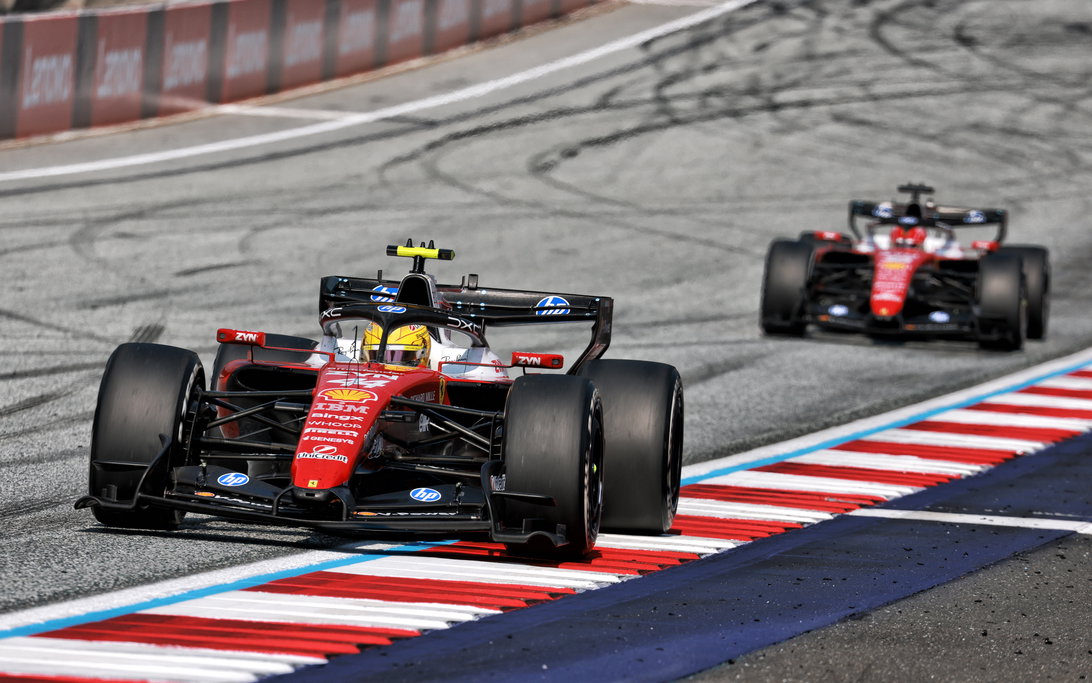
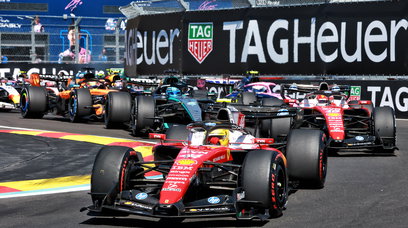
Ferrari heads to Silverstone with cautious optimism after the Austrian Grand Prix once again highlighted the weaknesses of the SF-26.
At the Red Bull Ring, the Italian team introduced a revised power unit, featuring its first development step made possible by the additional development scope granted by the FIA.
The expectation was that, on a circuit where engine performance plays a decisive role, Ferrari would be able to make a noticeable step forward.
However, that improvement largely failed to materialise. While Ferrari managed to recover in Saturday’s qualifying session, the race revealed that the underlying issues were still very much present.
The strong qualifying result was mainly the consequence of an extremely aggressive car setup. At a track like the Red Bull Ring, where the emphasis is almost entirely on top speed and acceleration, Ferrari was able to temporarily reduce the gap to its rivals.
Other car characteristics, such as corner balance or aerodynamic efficiency, played a far smaller role over a single lap.
In the race, the picture changed completely. Tyre degradation became Ferrari’s main enemy. This was particularly evident in Lewis Hamilton’s stint, where the rapid loss of grip forced an early pit stop. However, because the pace was not strong enough, the strategy failed to deliver any real advantage.
The following stints brought no improvement either. Ferrari attempted to switch to soft tyres in a final effort to gain short-term performance, but this also failed to produce meaningful gains.
The setup that had worked in qualifying proved counterproductive over a race distance, placing too much stress on the tyres and leaving Ferrari with very limited strategic options.
Notably, this was not caused by major updates to the car. Aside from the revised power unit and a few minor changes, the SF-26 remained largely the same machine that had looked significantly more competitive in Barcelona.
Conditions also played a major role. With track temperatures approaching 53 degrees Celsius, Ferrari found itself in a perfect storm scenario. The upgraded power unit showed little obvious performance gain, while the aggressive setup significantly increased tyre wear compared to its rivals.
Looking ahead to the British Grand Prix, the outlook appears more promising. Silverstone demands not only strong engine performance, but also a stable car through high-speed direction changes and well-balanced aerodynamic performance.
These are areas where Ferrari previously showed stronger form earlier in the season, including in Barcelona.
As a result, Ferrari should not be constrained to 'damage limitation' this weekend. If the SF-26 can once again unlock its chassis and aerodynamic strengths, the Italian team has a solid opportunity to rejoin the fight at the front and potentially challenge for podium positions.
Also interesting:
Join RacingNews365's Nick Golding and Samuel Coop as they look back on last weekend's Austrian Grand Prix but also look ahead to Silverstone! What Red Bull must do to keep Max Verstappen is a lead discussion, as is Kimi Antonelli's costly mistakes.
Rather watch this podcast? Then click here!


Most read



In this article
Never miss a thing from the Formula 1 season! Add the 2026 F1 schedule to your calendar at the touch of a button. Subscribe below and put the dates and times of every race directly on your PC or smartphone, so you don't miss a second from the new season.
Download the F1 calendar Download the F1 calendar
A variant with just the race and qualifying is also available.
Click here to download it..





Join the conversation!