


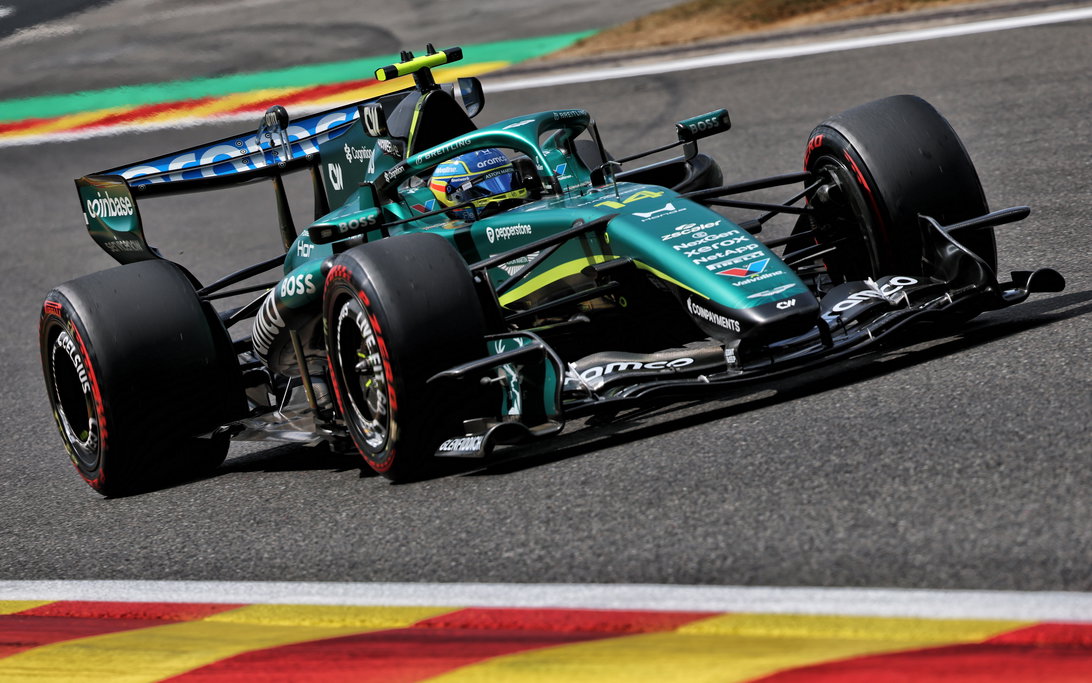
Aston Martin has brought a significantly upgraded version of the AMR26 to Budapest, with the first iteration of the car designed under Adrian Newey’s leadership having proven to be the least competitive on the grid, in addition to suffering from obvious reliability issues.
To gauge its performance, one need only consider the gap between Fernando Alonso and Lance Stroll’s lap times to pole-sitter Kimi Antonelli at Spa, which was 3.698s in Q1, and 5.641s (to Alonso) once Antonelli set his Q3 pole-lap.
It is well known that the Honda power unit is the least efficient with enormous problems regarding electrical charge management; but it is also worth noting that the packaging of this car had caused further issues, such as the vibrations generated by the battery itself, linked to a design that was perhaps too extreme, following a guiding principle so dear to Newey.
That is, the principle of sacrificing every element of the car to achieve maximum aerodynamic efficiency and the most effective vehicle dynamics. Considering these were the objectives with which the AMR26 was launched this year, it is clear that they were spectacularly missed; therefore, the current season has become, for the Silverstone team, a long test session to determine solutions that can be adopted on next year’s car.
This principle underpins the strategic decision to introduce a major revision to the car specifically for the final race before the summer break. The primary purpose is not to achieve a tangible performance increase, but rather to establish a solid foundation for effectively measuring improvements to the power unit once Honda has utilised its allotted ADUOs.
Essentially, the radical modification to the sidepods, specifically regarding the inlet section and, above all, the development of the underbody, effectively results in a different approach to the power unit’s packaging on the AMR26. By this, we mean that one of the objectives was precisely to eliminate certain structural constraints inherent in the original design of the car that further limited the already lacklustre performance of the power unit.
In practice, the combination of the PU, chassis, and aerodynamics in the first part of the season represented a sort of sum of the limitations of the individual components, which were in turn influenced by one another. Consequently, identifying the specific problems by analysing the overall picture of the inadequate performance was no easy task.
But above all, trying to find a common thread that would allow us to distinguish the car’s design elements that might have worked from those that, on the contrary, compounded the PU’s weaknesses was even more complex.
For this reason, an in-depth analysis of the data collected during the first races served as the starting point for building a comeback strategy, certainly not a short-term one, that begins with the thoroughly revised version of the AMR26 introduced here in Hungary.
Also interesting:
Join RacingNews365's Ian Parkes, Samuel Coop and Nick Golding as they look back on the Belgian GP and look ahead to this weekend's race in Hungary. George Russell's major setback is a key discussion, as is Toto Wolff stating Mercedes has the best power unit.
Rather watch this episode? Then click here!


Get the latest F1 news from RacingNews365 directly in your Google feed! Click on the link below and you’ll see your favourite F1 website appearing even more often. That way, you’ll never miss any news, analyses, interviews, or exclusives.
Follow RacingNews365 on GoogleMost read

In this article
Never miss a thing from the Formula 1 season! Add the 2026 F1 schedule to your calendar at the touch of a button. Subscribe below and put the dates and times of every race directly on your PC or smartphone, so you don't miss a second from the new season.
Download the F1 calendar Download the F1 calendar
A variant with just the race and qualifying is also available.
Click here to download it..






Join the conversation!