


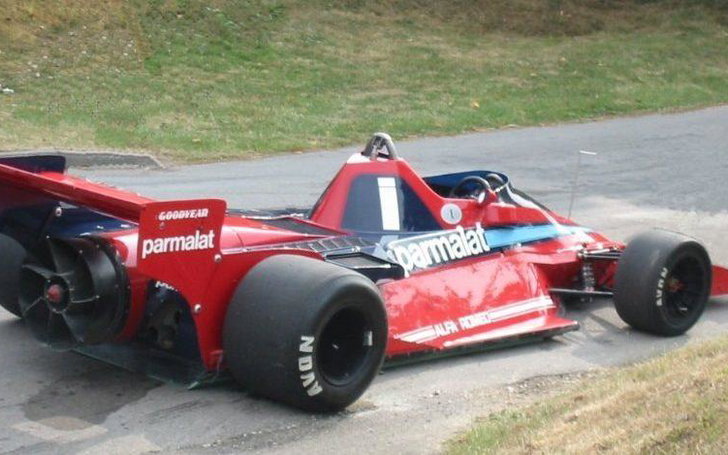
F1 history contains no shortage of technological marvels, yet few machines have generated such immediate controversy as the Brabham BT46B.
Gordon Murray's audacious creation raced just once, at the 1978 Swedish Grand Prix, before disappearing from the grid forever, a victim of political pressure masquerading as regulatory concern.
The so-called 'fan car' emerged from desperation rather than inspiration. When Lotus's Type 79 appeared at Zolder, its ground-effect venturi tunnels generated downforce levels that left rivals floundering.
Brabham faced a fundamental problem: the team's flat-12 Alfa Romeo engine was too wide to accommodate the sidepod tunnels that made the Lotus untouchable. Murray needed a different solution.
His answer bordered on genius. Rather than shape airflow beneath the car aerodynamically, Murray employed a large rear-mounted fan, driven by the engine's crankshaft through a complex clutch system, to mechanically extract air from the sealed underbody.
The result was devastating downforce that increased proportionally with engine speed, causing the car to visibly squat on its suspension when drivers blipped the throttle.
Brabham
A vacuum cleaner on wheels
The justification was elegantly simple. Cooling, Murray argued, was the fan's primary function, with downforce merely a beneficial side effect.
He ensured that 55 per cent of the fan's capacity served the horizontally mounted radiator above the engine, keeping the design within regulations that explicitly banned movable aerodynamic devices. The FIA accepted the rationale, clearing the BT46B to race.
At Anderstorp on 17 June 1978, Niki Lauda qualified the fan car on the front row behind Mario Andretti's pole-sitting Lotus. After initially trailing, Lauda capitalised on a minor Andretti error to sweep into the lead and pulled away with embarrassing ease, eventually winning by 34.6 seconds over Riccardo Patrese's Arrows.
The reaction was immediate and hostile. Andretti, prompted by Lotus boss Colin Chapman, complained that the car threw debris at following vehicles. "It is like a bloody great vacuum cleaner," Andretti protested. "It throws muck and rubbish at you at a hell of a rate."
Murray dismissed the claim with technical precision: "The fan couldn't spit anything out the back because the fan efflux was only 55mph. Besides, the radial fan would have sent any stones flying sideways."



Politics trumps performance
The protests mattered little. Despite the FIA ruling the car legal for the remainder of the season, Bernie Ecclestone withdrew it after that single race.
As both Brabham owner and head of the Formula 1 Constructors' Association, Ecclestone faced threats of boycotts from rival teams who feared an uncontrolled technical escalation. He chose political unity over competitive advantage.
The BT46B never appeared in Formula 1 again, and the FIA subsequently banned fan cars outright. Lauda's Swedish Grand Prix victory stands as the car's sole official result, a monument to what might have been had politics not intervened.
Even Lauda himself was ambivalent about the machine, later describing it as unpleasant to drive due to the extreme lateral loads it generated.
The fan car remains a reminder that in Formula 1, being too fast can prove as problematic as being too slow.
Most read



In this article
Never miss a thing from the Formula 1 season! Add the 2026 F1 schedule to your calendar at the touch of a button. Subscribe below and put the dates and times of every race directly on your PC or smartphone, so you don't miss a second from the new season.
Download the F1 calendar Download the F1 calendar
A variant with just the race and qualifying is also available.
Click here to download it..





Join the conversation!