


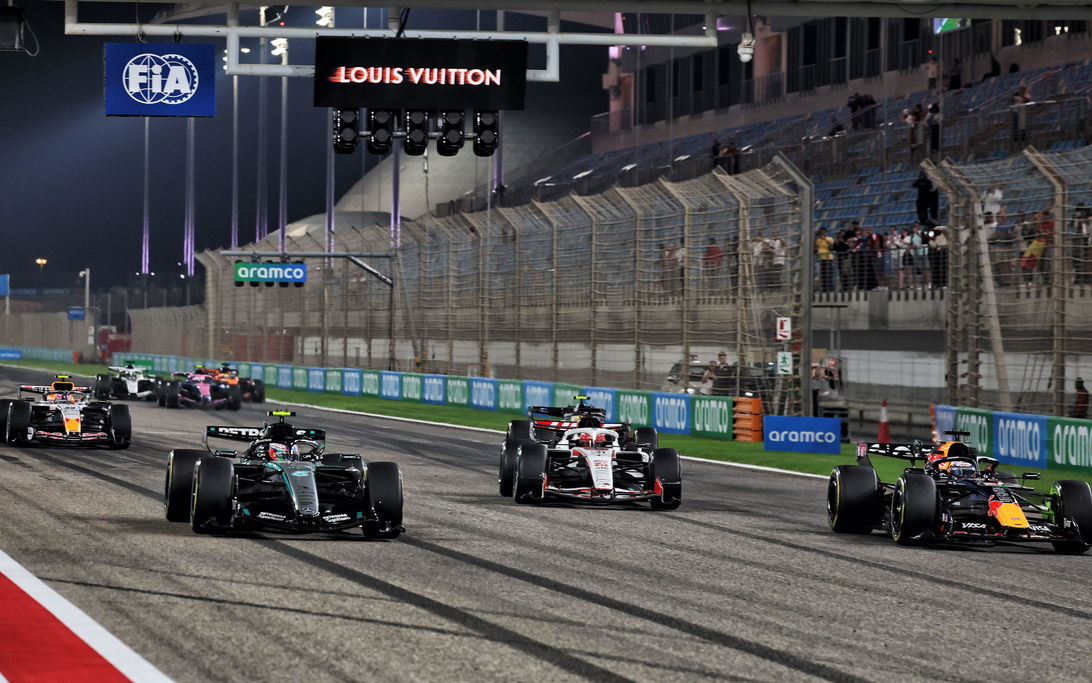
Battery charging in F1 was the dominant theme of pre-season testing, during which time, it emerged that one charging mode in particular could be the best way for drivers to harvest energy, whilst not ruining the competition on track: 'super-clipping'.
It has become the preferred method of energy recovery, although it is still not optimal.
Super-clipping is essentially the engine starting to harvest electrical energy whilst the driver is at full throttle.
When it is being used, it can recapture 250kw of energy, with the new beefed-up batteries capable of holding the 350kw which is recaptured by the MGU-K under braking.
Teams are starting to gravitate towards super-clipping as the method for harvesting owing to the fact that, compared to lift and coast, there is no sudden slowdown of the car, something with strong implications for safety, with drivers also able to enjoy a more natural driving style.
Used mainly at the end of straights or in high-speed corners, such as Turn 12 in Bahrain, the use of super-clipping also allows the car to remain in straight mode with its front and rear wing active aerodynamics open, thus reducing drag.
Herein lies the critical difference to lift and coast, where, although the extra 100kw of power for full harvesting is available, the car will revert to corner mode, with the active aero wings closed.
This will be costly in terms of straight-line speed and drag. Discussions are underway to change the regulations and raise the super-clipping limit to 350kw, with McLaren testing the configuration, much to its satisfaction.
The data collected still needs to be evaluated by the FIA, but there is some reluctance to change the rule amongst the teams.
Any rule change would shift the balance in favour of those who have found an effective charging solution with their power unit compared to rival manufacturers.
However, the added benefits of fewer sudden slowdowns from cars and the increased safety benefits this brings could be used by the FIA to impose the change.
Also interesting:
Join RacingNews365's Ian Parkes, Sam Coop and Nick Golding, as they look back on pre-season testing and start to look ahead to the Australian GP! Aston Martin's major issues are a lead discussion, as is Ferrari's lightning starts.
Rather watch the podcast? Then click here!


Most read





In this article
Never miss a thing from the Formula 1 season! Add the 2026 F1 schedule to your calendar at the touch of a button. Subscribe below and put the dates and times of every race directly on your PC or smartphone, so you don't miss a second from the new season.
Download the F1 calendar Download the F1 calendar
A variant with just the race and qualifying is also available.
Click here to download it..





Join the conversation!