


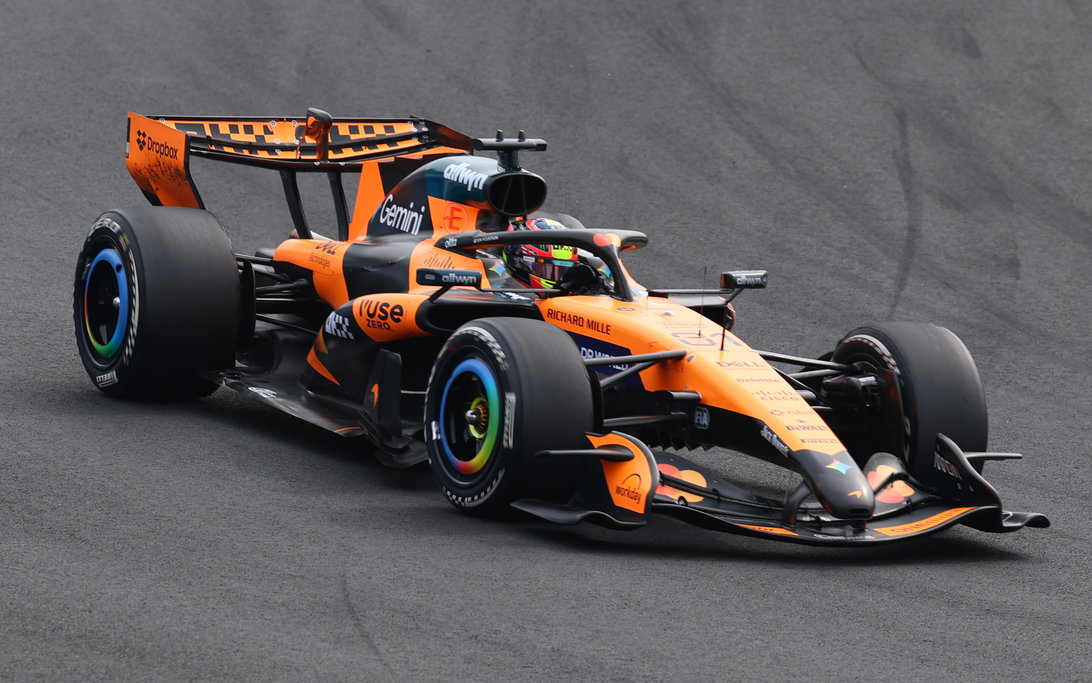
McLaren technical director Mark Temple has provided detailed insights into the fundamental changes shaping the 2026 Formula 1 regulations, focusing particularly on power unit energy management and aerodynamic modifications that are already influencing driver behaviour.
Speaking during a technical briefing alongside team principal Andrea Stella and chief designer Rob Marshall, Temple outlined the significant differences between current and future aerodynamic concepts, emphasising the crucial 50/50 power split between internal combustion engines and electrical components that defines the new era.
Temple supported his explanations with detailed telemetry data from Australian Grand Prix qualifying simulations, comparing 2025 performance with projected 2026 electrical energy management profiles.
The analysis included simulations using recharging parameters introduced from the Miami race weekend.
In any case, certain performance levels, namely speeds in specific sectors of the track, particularly sequences of fast corners such as the section after Turns 6 and 7 at Albert Park, followed by the Turns 9 and 10 chicane, highlighted quite marked differences.
These were not so much due to different energy management, but rather to a clear reduction in available aerodynamic downforce.
The McLaren technical chief indicated that beyond overall performance differences generated by reduced downforce, other factors significantly impacted driver behaviour during the opening three races, prompting FIA intervention with corrective measures from Miami.
The explicit reference was to the power unit, and specifically to energy management, outlining how regulatory changes follow two parallel development strands.
Viewed by others:

Authentic qualifying returns
The first strand focuses on restoring genuine qualifying sessions where drivers avoid compromising their competitive approach to flying laps.
Temple's telemetry analysis demonstrated how increasing superclipping power output to 350kW from Miami effectively eliminates lift and coast techniques whilst reducing inertia phases in specific circuit sections.
The increase in superclipping power output planned for Miami to 350 kW effectively eliminates the need for lift and coast, and reduces inertia phases in certain sections of the circuit, specifically at Turn 1, where the coasting phase before braking has been removed, and significantly reduced at Turn 6 and at Turns 9 and 10.
This effect results from combining reduced energy usage with shorter, more powerful superclipping phases that require less time to generate required energy levels.
From a driving perspective, the changes target extended coasting periods through high-speed chicanes that characterised the first three races, replacing them with natural acceleration and heavy braking patterns.
So-called 'lift and coast' should no longer be used in qualifying. Previously, the driver would lift off the throttle, coast into the braking zone, and then brake sharply. From Miami, the situation changes: it becomes more efficient for this process to be managed by the power unit through enhanced superclipping.
This allows drivers to maintain full throttle whilst the power unit recovers energy, significantly reducing total superclipping phases. When they occur, they become shorter and more similar to previous tyre management or low fuel scenarios.
Overtaking modifications
The second regulatory strand addresses overtaking artificiality observed during the opening races.
Using maximum 350kW power output made overtaking relatively straightforward, but complete electrical energy depletion prevented defending against immediate counterattacks.
Non-straight sections now limit electrical power to 250kW maximum, making overtaking more challenging in specific track areas. Temple illustrated this using Miami's first four corners, where boost activation under previous regulations produced very high straight-line speeds.
With the reduction in power from 350 to 250 kW, the speed advantage over a reference car is reduced, making overtaking in those sections more difficult. This was intentional, as such areas are not considered suitable for overtaking unless they include a straight.
Additional modifications affect boost activation timing. Previously, activating boost late when power had peaked and begun decreasing still delivered 350kW. The new system reduces this value whilst maintaining current power levels, or restoring power to 150kW if it has dropped below that threshold.
With the new 150 kW limit, activating boost at the end of a straight where power is already decreasing still provides a speed increase, but at a slower rate. As a result, drivers cannot build such a large speed advantage.
This creates progressive overtaking opportunities due to reduced power output whilst maintaining legitimate overtaking chances.
Temple believes the modifications will reduce opportunistic overtakes in unsuitable track areas, representing a fair safety compromise whilst preserving straight-line overtaking effectiveness.
The technical director expects spectators' perception to evolve towards genuinely competitive on-track battles, where advantages prove less fleeting and less affected by power unit electrical energy depletion, fundamentally changing how races develop across the 2026 season.
Also interesting:
Join RacingNews365's Nick Golding and Sam Coop as they dissect the biggest storylines looking ahead to the rest of the 2026 F1 season, and why so much depends on what changes are made to the F1 regulations by the FIA.
Rather watch the podcast? Then click here!


Most read






In this article
Never miss a thing from the Formula 1 season! Add the 2026 F1 schedule to your calendar at the touch of a button. Subscribe below and put the dates and times of every race directly on your PC or smartphone, so you don't miss a second from the new season.
Download the F1 calendar Download the F1 calendar
A variant with just the race and qualifying is also available.
Click here to download it..





Join the conversation!