


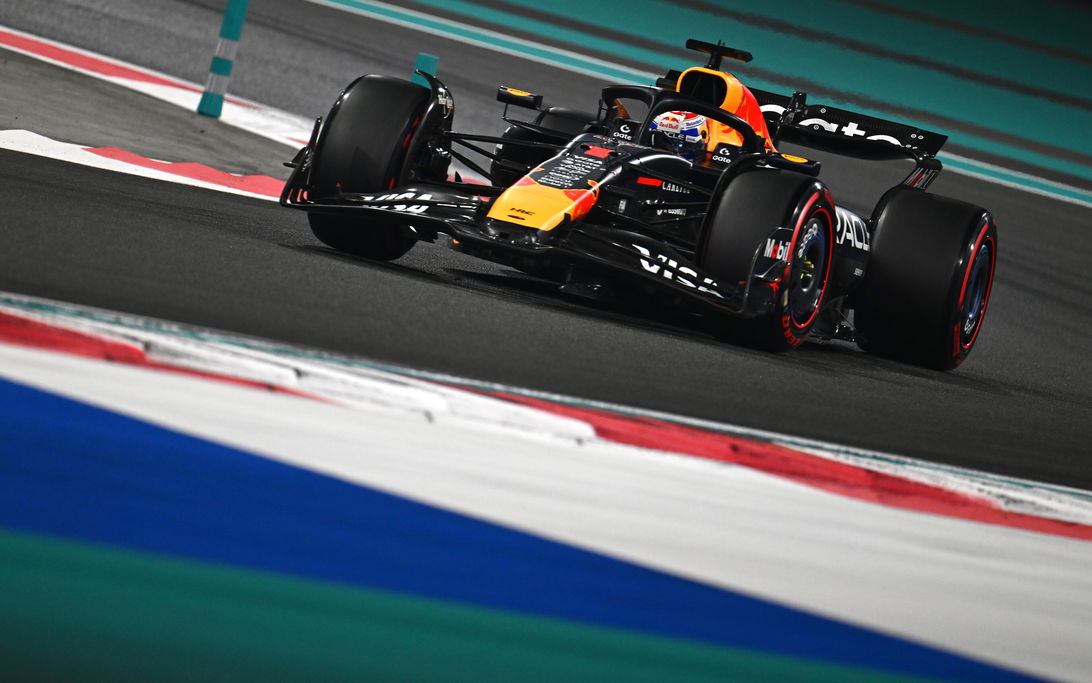
Max Verstappen clinched pole position for the Abu Dhabi Grand Prix, but a significant share of the credit must also go to the Red Bull engineers.
Their work after FP2 proved decisive, transforming a struggling RB21 into the benchmark package once again — a turnaround that should not be overlooked.
On Friday, Verstappen described the car as lacking grip and, above all, traction. Red Bull had opted for a low-downforce setup, but the compromise simply wasn’t working.
Increasing downforce to improve stability and traction in the final sector may sound straightforward, yet doing so typically comes at the expense of straight-line speed — a key factor around Yas Marina’s long straights.
Finding the sweet spot was anything but trivial.
By FP3, Verstappen had recovered confidence in the rear of the car, though a hint of understeer remained.
Crucially, he chose not to add extra front load ahead of qualifying, preferring to preserve the RB21’s aerodynamic efficiency and straight-line performance — a decision that ultimately paid off.
Red Bull achieved the balance through a rear-wing configuration with a more aggressive flap angle, combined with revised mechanical settings.
In practice, the team completely reworked the car’s load distribution, determining that a slightly rear-biased setup would deliver the strongest overall package.
Rapid performance turnarounds have become something of a Red Bull trademark over the years. It’s a characteristic long associated with Adrian Newey’s presence at the team.
Even though “the genius” departed last season, his methodology clearly lives on within the technical department, now led by Pierre Waché and supported trackside by Paul Monaghan and Gianpiero Lambiase.
In short, despite seeming paradoxical, Newey’s influence in Milton Keynes remains unmistakable.
Most read

In this article
Never miss a thing from the Formula 1 season! Add the 2026 F1 schedule to your calendar at the touch of a button. Subscribe below and put the dates and times of every race directly on your PC or smartphone, so you don't miss a second from the new season.
Download the F1 calendar Download the F1 calendar
A variant with just the race and qualifying is also available.
Click here to download it..





Join the conversation!