


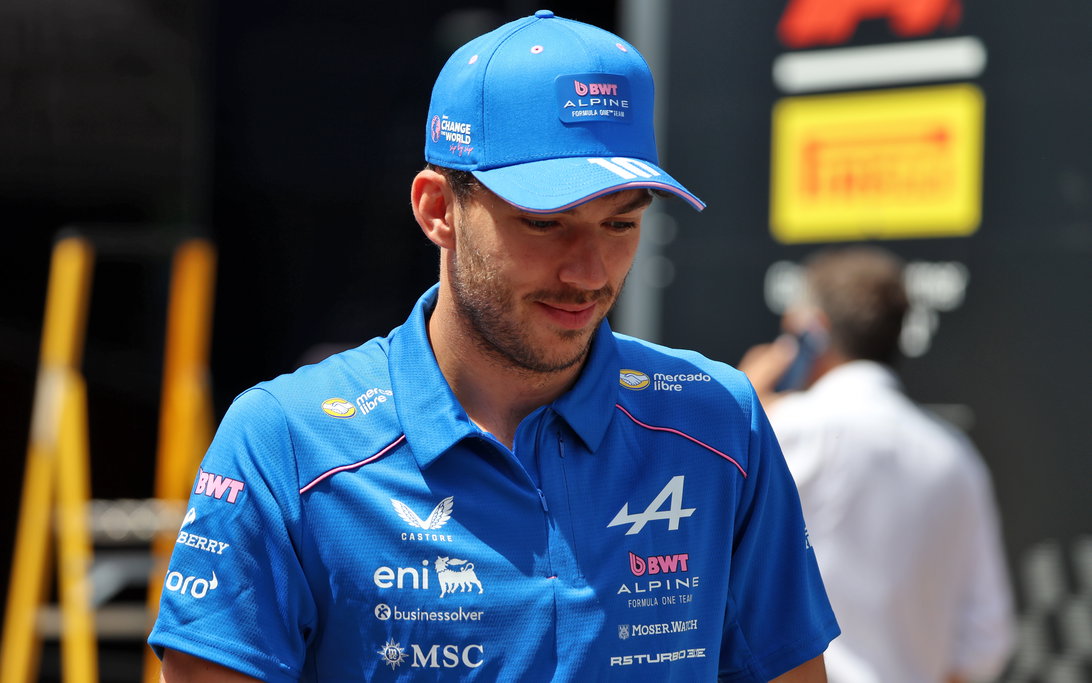
Alpine's Right of Review into Pierre Gasly's two penalties at the Monaco Grand Prix have been found admissible by the stewards overseeing the hearing.
This means the petition will now move on to its next phase, as it seeks to understand how the French driver was twice punished for speeding in the pit lane in Monte Carlo.
The one-time grand prix winner was one of five drivers found at fault across the 78-lap race in the Principality, alongside Lewis Hamilton, George Russell, Oscar Piastri and his Alpine team-mate Franco Colapinto.
Gasly, however, was the only competitor sanctioned twice and with his cumulative 10 seconds of penalties added to his race time at the chequered flag, it cost the 30-year-old a podium finish.
It is worth noting that Gasly was partly in the top three because others, like Piastri and Russell, had served their representative punishment for the same infraction.
And because drivers served their punishments during the race, any change to the results is an unlikely possibility at this stage.
The more direct mechanism for doing so would have been for Alpine to protest or appeal the outcome of the race, and the team taking these steps is to establish what happened; essentially, how and why the penalties were handed down.
The two petitions are being dealt with concurrently, and the FIA confirmed that four decisions were made in the first part of the two-part hearing; firstly, to determine the admissibility of each petition, and secondly, to confirm whether there is significant and relevant new element for each which was unavailable to the stewards at the time of each of the original decisions, there being no hearing conducted at the time of those decisions.
This is a standard barrier to entry for Rights of Review, and Alpine passed on all four criteria. The official decision document from the FIA confirms that the second part of the hearing can now take place.
What does the decision document say?
Decision 1: The petition of review in relation to the first petition is admissible.
Decision 2: The petition of review in relation to the second petition is admissible.
Decisions 1 and 2 are subject to appeal.
Decision 3: There is a significant and relevant new element which was unavailable to the Stewards at the time of the decision in Document 73, no hearing having been conducted at the time.
Decision 4: There is a significant and relevant new element which was unavailable to the Stewards at the time of the decision in Document 75, no hearing having been conducted at the time.
Reasons (which apply to both Decisions 3 and 4):
1. Significance
In its written submission, Alpine argued that there were four matters which demonstrated the “significance” of the element, namely:
a. That the FIA and FOM, but not the Race Stewards, were aware in advance of the race that there was an issue with the timing loops in the pit lane
b. That Alpine had data that demonstrated that the driver of Car 10 (Pierre Gasly) activated the pin lane speed limiter in advance of entry into the pit lane and did not exceed the pit lane speed limit
c. A witness statement from Pierre Gasly that he took a cautious approach before entering the pit lane having been warned by his engineers
d. FOM, as Official Timekeeping Supplier to the Competition, provided evidence that the distance used in calculating the F1 Official Timing (and hence the pit lane speed) was inaccurate and overestimated the speed of Car 10
The Stewards determine that item d. above is sufficient on its own to meet the required standard of “significant”.
[It is NOTED that the FIA and FOM representatives strongly refuted the assertion in “Significance” point 1a, that they had advance awareness of the issue with the timing loops in pit lane. The Stewards also NOTED that they became concerned after the third alleged speeding breach was reported to them by the Official Timekeeper, and at that time, asked Race Control if it was aware of any issue or irregularity with the system. Race Control reported back that it raised the matter with the Official Timekeeper and was reassured that there were no issues.]
2. Relevance
In its written submission, Alpine argued that the new element was relevant in that it directly related to the speed of Car 10 in the Pit Lane.
The Stewards determine that this meets the standard of “relevant”.
3. New Element
The information concerning the inaccurate distance measurement was provided by FOM on Wednesday, June 10; therefore, was “new” and unavailable to the Stewards at the time of the two decisions referred to in Documents 73 and 75 (June 7).
Conclusion: Both the first and second petitions meet the required standards for a Right of Review in accordance with Article 14.1.1 of the FIA International Sporting Code.
Accordingly, Part 2 of the Hearing will be conducted into both matters referred to in Documents 73 and 75 [the original penalty decision documents from after the Monaco Grand Prix].
With the agreement of the parties, both Hearings will be conducted concurrently...
Decisions 3 and 4 are not subject to appeal.
Also interesting:
Join RacingNews365's Nick Golding and Samuel Coop as they look back on the Monaco GP and look ahead to this weekend's Barcelona-Catalunya GP! The duo discuss Kimi Antonelli's insane form, Lewis Hamilton leaking some major news and George Russell's serious struggles.
Rather watch this podcast? Then click here!


Get the latest F1 news from RacingNews365 directly in your Google feed! Click on the link below and you’ll see your favourite F1 website appearing even more often. That way, you’ll never miss any news, analyses, interviews, or exclusives.
Follow RacingNews365 on GoogleMost read


In this article
Never miss a thing from the Formula 1 season! Add the 2026 F1 schedule to your calendar at the touch of a button. Subscribe below and put the dates and times of every race directly on your PC or smartphone, so you don't miss a second from the new season.
Download the F1 calendar Download the F1 calendar
A variant with just the race and qualifying is also available.
Click here to download it..





Join the conversation!