


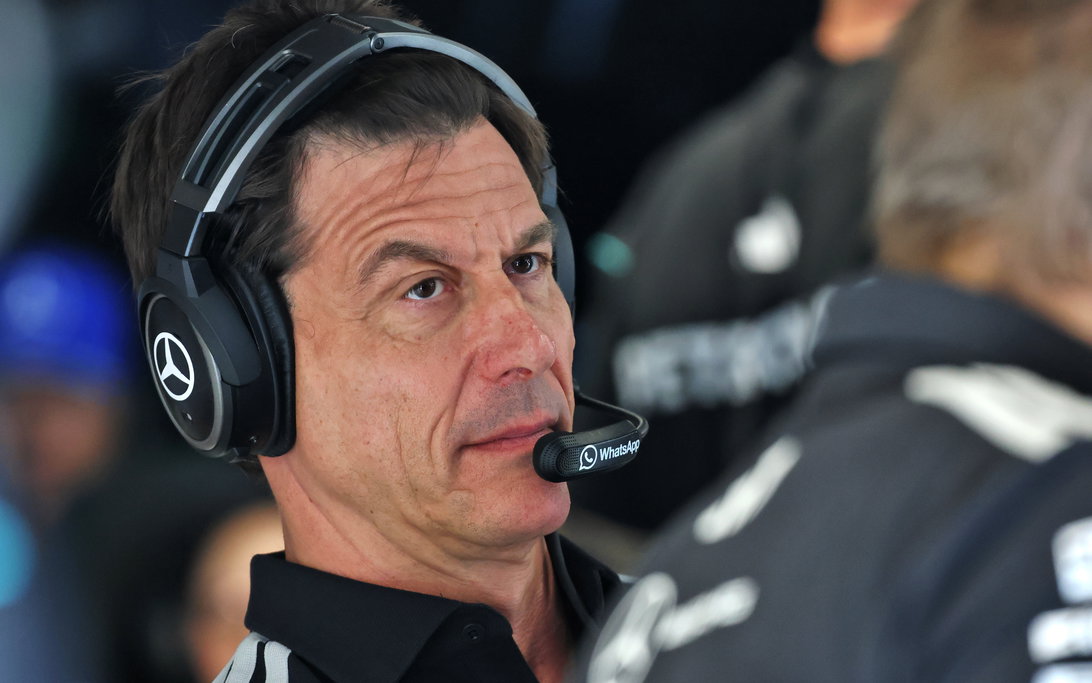
Toto Wolff has outlined his opposition to major F1 cost cap changes Williams boss James Vowles is trying to force through.
Vowles is hoping to tweak F1's current cost cap rules to enable those teams which finish further down the constructors' standings to access more money than those which finish higher up the standings on a sliding scale.
A similar sliding-scale mechanism has been used to determine how much aerodynamic testing each team gets through the ATR, with CFD and wind-tunnel time reduced for those teams which finish higher in the championship for the following season.
For Vowles' plan to succeed at a vote of the F1 Commission for 2027, he requires six votes from fellow teams, with Alpine, Aston Martin, Audi, and Cadillac all believed to be in favour, whilst McLaren, Red Bull, Ferrari, and Mercedes are understood to be against, although Zak Brown of McLaren has signalled he would be open to discussions.
That leaves Haas and Racing Bulls, one of which Vowles would need to vote in his favour, but both have signalled their opposition, with the Williams chief hoping that should his idea be approved, it could then have enough time to fully bed in for the expected regulation change for 2030, when F1 will return to V8 engines.
Voicing his stance, Wolff explained his opposition, including the use of "red mist" to describe his dislike of balance of performance.
"Where we stand, I'd love to have a little bit more room in the cost cap for lower salaries, a bracket, rather than buying new front wings, but give the possibility of paying a little bit more and being attractive as a sport," Wolff told media, including RacingNews365.
"Obviously, it also depends on the size of the team. I think we agreed that is something we would like to do, but if you have the reality of the budget, a smaller team is not going to be happy about us having five million more in the cost cap to spend for PhDs. So that's the second point.
"The third point is that what James is alluding to is the CapEx allowance or the CapEx possibilities. Now, how the regs were changed was that rather than having this CapEx budget, your CapEx would go into operational costs, into OpEx. So, the consequence is the teams that spent a lot in the past on CapEx, like us, for example, have a huge amount of costs that we need to depreciate in the cost cap. The ones that haven't spent a lot obviously have much more possibility to spend on infrastructure or whatever you want to, what was CapEx before.
"So I think I have super sympathy with a team like Williams and with James, and he's super clever, but we just need to find the right balance of not undoing something that we actually consciously changed a year or two ago. So, yeah, it's just a forward-moving discussion.
"Personally, I don't like the concept of adjustment based on some positions. BoP for me is like a red mist. We're having these tiny little adjustments on aero time, ATR, which is almost invisible to the spectator and hasn't been a big thing because it's really tiny.
"We have the catch-up mechanisms on the power units. If someone were to fall behind dramatically, then you get that opportunity, but it wasn't a leapfrogging mechanism. So, the job that the FIA have done in that respect I think, is very good.
"They haven't allowed any politics to creep in, people making noises that they wanted to do or not. I think they handled that very well. So, do we really want another mechanism where you're being allowed to have more CapEx, OpEx based on your championship position? I'm not sure."
[Article contiunes below]

Wolff's F1 warning
With the introduction of the cost cap, teams have been unable to offer long-serving employees more fruitful contracts, with the turnover of senior figures from one team to another increasing, such as Rob Marshall leaving Red Bull for McLaren.
Wolff also pointed to the restructuring bigger teams like Mercedes had to do when the cost cap was introduced for the 2021 season and how F1 was risking losing emerging talent.
"The reason the cost cap came in was in order to balance the performances between small teams and bigger teams. We had to actually quite dramatically restructure, whilst other teams were below the cap and they were able to hire," he continued.
"So, I think that was the main idea. Now, where the cost cap has taken us is that obviously we have profitable entities, and that is, from a pure economic effect, nice. But it's also suppressing salaries.
"We were always an aspirational sport. We attracted the best talent from the best universities because of the possibilities you had in Formula 1.
"Now you can get someone into a Formula 1 team today on enthusiasm, but at a certain stage, after five, six or seven years and you have a PhD, your salaries are still depressed versus a tech company or a hedge fund or investment banking; that becomes a problem."
Also interesting:
Join RacingNews365's Ian Parkes, Sam Coop and Nick Golding as they look back on last weekend's Singapore Grand Prix! Max Verstappen's Marina Bay masterclass is a lead talking point, as is F1's deadline approaching to make a call on how the 2026 season will end.
Rather watch this podcast? Then Click here!


Most read


In this article
Never miss a thing from the Formula 1 season! Add the 2026 F1 schedule to your calendar at the touch of a button. Subscribe below and put the dates and times of every race directly on your PC or smartphone, so you don't miss a second from the new season.
Download the F1 calendar Download the F1 calendar
A variant with just the race and qualifying is also available.
Click here to download it..





Join the conversation!