


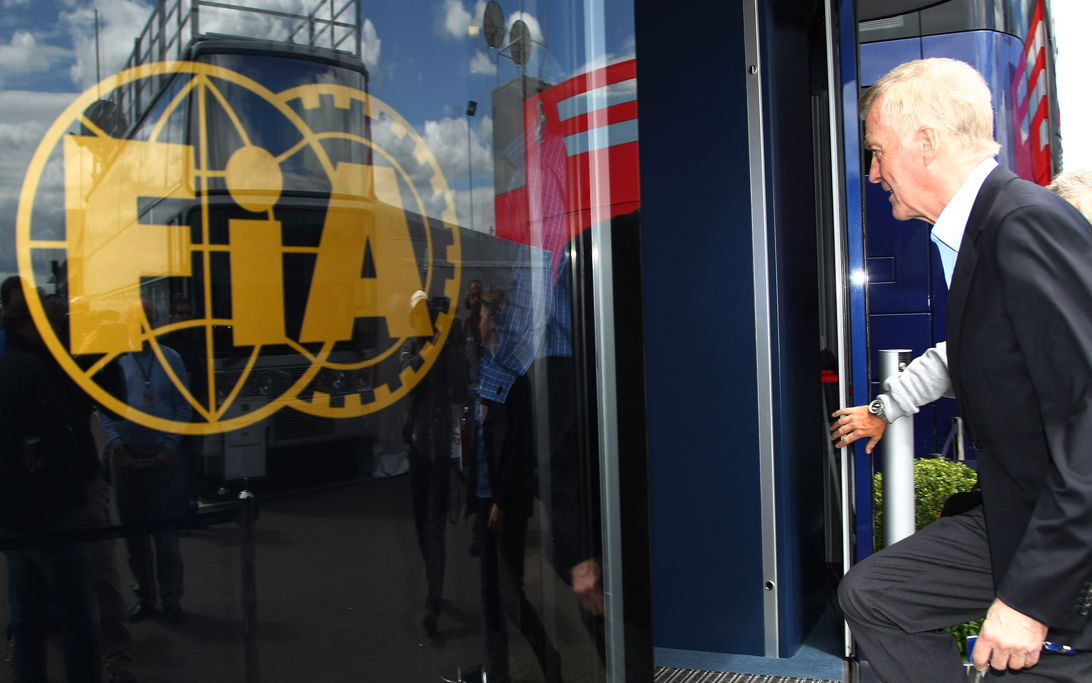
On February 10, 2003, FIA President Max Mosley issued a stark warning about F1’s direction — one that would prove uncomfortably accurate just a few years later.
While the sport was enjoying a surge of manufacturer involvement, Mosley cautioned that F1 was becoming dangerously reliant on companies whose commitment could vanish overnight.
At the time, seven major car manufacturers were involved in F1, bringing unprecedented resources and technical sophistication.
Mosley acknowledged the upside, but stressed the risks, writing that the situation "brings benefits, but presents two significant difficulties".
The first was competitive imbalance. "Any team not backed by a major manufacturer is likely to find itself short of money and technology, particularly in an economic recession," Mosley warned, highlighting how independent teams were being squeezed out of contention.
The second concern was existential. Unlike private teams, manufacturers were not bound to the sport. "There is no guarantee that one or several of these manufacturers will not stop racing," he wrote, pointing to history as evidence.
Aside from Ferrari, Mosley noted that BMW, Ford, Honda, Mercedes and Renault all had "a history of coming and going over the years".
His argument was clear: F1's foundations were being weakened by its growing dependence on manufacturers. Independent teams, he stated, were the only truly stable pillar of the championship.
"The FIA Formula 1 World Championship is the core business of an independent team," Mosley explained. "Unlike a manufacturer, an independent team cannot just stop racing."
Viewed by others:

For Mosley, the solution lay in actively protecting private outfits such as Williams and Jordan — teams whose survival depended entirely on F1 itself.
"Thus, the way to guarantee the long-term health and stability of the championship is to make sure there is a solid group of independent teams," he insisted.
Perhaps his most blunt assessment captured the issue perfectly: "We can rely on the independent teams. We cannot rely on the manufacturers. Although their presence is very welcome, the car manufacturers will come and go as it suits them — they have always done this and they always will."
At the time, those warnings were largely ignored. Manufacturer involvement was seen as a sign of F1’s strength and prestige.
Yet by 2009, Mosley’s predictions had been fulfilled. BMW, Honda and Toyota had all exited the sport, while Ford had already withdrawn earlier in the decade.
Today, F1 remains closely tied to manufacturers, with Mercedes a dominant force and Audi preparing to enter the championship.
However, with F1 booming and growing in popularity, the value of teams has skyrocketed, and the championship has become significantly more lucrative.
The cost cap, which was introduced in 2021, has curbed extreme spending and helped independent teams not just survive, but also thrive.
But with fewer true private teams than ever, Mosley’s 2003 warning still resonates — a reminder that manufacturers may power the sport, but independents are what truly sustain it.
Also interesting:
Join RacingNews365's Ian Parkes, Sam Coop and Nick Golding, as they look ahead to the first of two three-day tests in Bahrain! The trio discuss who to keep an eye on and the fascinating approaches being taken to car development in 2026.
Rather watch the podcast? Then click here!


Most read

Never miss a thing from the Formula 1 season! Add the 2026 F1 schedule to your calendar at the touch of a button. Subscribe below and put the dates and times of every race directly on your PC or smartphone, so you don't miss a second from the new season.
Download the F1 calendar Download the F1 calendar
A variant with just the race and qualifying is also available.
Click here to download it..


Join the conversation!