


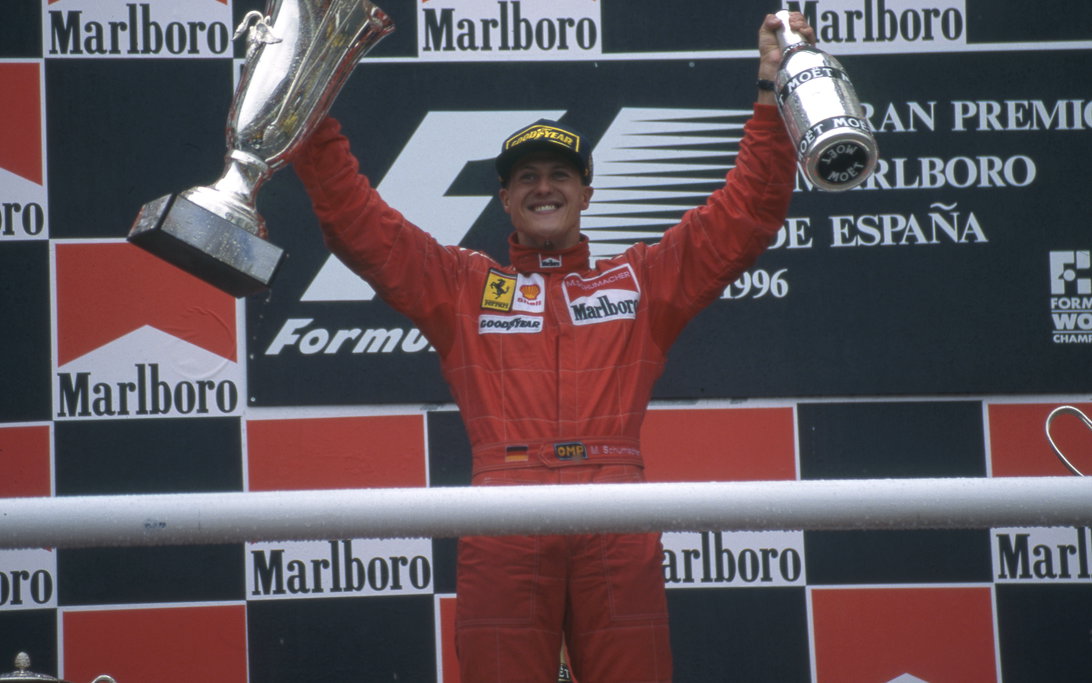
Michael Schumacher produced what many still regard as the single greatest wet-weather drive in Formula 1 history, on 2 June, 1996.
At a rain-lashed Circuit de Barcelona-Catalunya, he won the Spanish Grand Prix by 45.3 seconds, lapping every car on the grid bar the two other podium finishers.
It was his first victory for Ferrari, his 20th overall, and a performance that would reverberate through the paddock, and go down in F1 folklore.
The Ferrari F310 was, by common consensus, not a winning car. Later described by insiders as desperately uncompetitive, it had no business being at the front of the field, particularly against the dominant Williams-Renault package that had locked out the front row through Damon Hill and Jacques Villeneuve. Schumacher qualified a distant third, nearly a full second adrift of pole.
And when the lights went out, things immediately got worse. A clutch problem off the line saw Schumacher lose several positions, his sluggish getaway contributing to a chaotic opening sequence on the drenched main straight that eliminated five cars.
Where a lesser driver might have settled for damage limitation, Schumacher began one of the most remarkable recovery drives in the championship's history.
Through the spray and standing water, he picked off rivals one by one, working his way up to the lead by lap 11.
From there, the performance became something close to otherworldly. On lap 14, Schumacher set the race's fastest lap, a 1:45.517 that was a staggering 2.2 seconds quicker than the best lap managed by any other driver across the entire 65-lap distance.
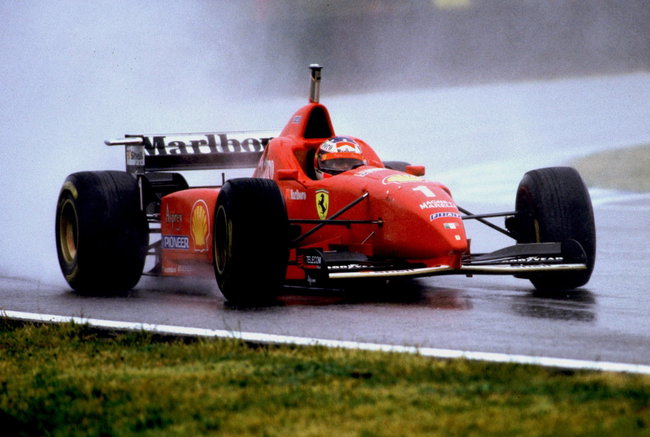
A masterclass in impossible conditions
The carnage behind him was relentless. Hill, the championship leader, spun out of the lead. Gerhard Berger, Johnny Herbert, and Eddie Irvine all fell victim to the treacherous conditions.
Of the 20 starters, only six would see the chequered flag.
Around lap 35, Schumacher felt a strange noise from the rear of the car. The Ferrari's V10 engine had dropped to eight cylinders, costing him roughly 10 km/h on the straights. It barely mattered. His advantage was so vast that even a partially crippled car could not be caught.
Jean Alesi finished second for Benetton, 45.3 seconds adrift. Villeneuve, who had started from the front row, completed the podium a further three seconds back. Every other finisher was at least a lap behind.
Schumacher's five consecutive championships with Ferrari from 2000 to 2004 were built on machinery that matched his talent, but the Spanish Grand Prix in 1996 was different; it was a driver dragging an inferior car to a result it had no right to achieve, in conditions that decimated the rest of the field.
It was not simply a victory; it was a statement. The man Ferrari had signed to rebuild its fortunes had shown, in the most dramatic fashion imaginable, exactly why the Scuderia had chosen him.
Also interesting:
Join RacingNews365's Ian Parkes, Sam Coop and Nick Golding as they look ahead to this weekend's Monaco Grand Prix! Lewis Hamilton having a huge chance of victory is a key talking point, as is the fact Red Bull are likely to face a very difficult event.
Rather watch the podcast? Then click here!


Most read

In this article
Never miss a thing from the Formula 1 season! Add the 2026 F1 schedule to your calendar at the touch of a button. Subscribe below and put the dates and times of every race directly on your PC or smartphone, so you don't miss a second from the new season.
Download the F1 calendar Download the F1 calendar
A variant with just the race and qualifying is also available.
Click here to download it..





Join the conversation!