


There are moments in Formula 1 history that will be forever etched into the memories of many.
These can be moments that decide a world championship, such as Max Verstappen’s pass on Lewis Hamilton on the final lap of the fiercely fought 2021 campaign, or that same Hamilton overtaking Timo Glock at the final corner of the 2008 season to snatch the title right from under Felipe Massa’s nose.
But unfortunately, there are also more than enough moments remembered for less positive reasons, especially in the first thirty years of the F1 World Championship, when it wasn’t a question of if a fatal accident would happen, but when. Some circuits at the time had built a reputation for all the wrong reasons. The Nürburgring Nordschleife was one of them.
By 1976, the Nordschleife was already unsuitable for modern Formula 1. The circuit was 22.8 kilometres long and featured many fast corners, significant elevation changes, blind slopes, and had almost no run-off areas.
This made it very difficult to ensure proper safety. Marshals and emergency services simply could not reach every spot quickly enough. Niki Lauda, as chairman of the Grand Prix Drivers' Association in 1976, knew this all too well.



1 August 1976
It was 1 August 1976, the day of the German Grand Prix, on that same Nordschleife. The weather was just as treacherous as the Nordschleife itself. Shortly before the start, it had rained, but not everywhere on the circuit. Some sections were wet, while others were already dry again. Due to the track’s enormous length, the weather conditions could vary drastically from one section to the next.
Lauda recognised that the combination of the ever-present danger on the track, coupled with the weather conditions, was a recipe for tragedy.
On the morning of the race, Lauda therefore called the drivers together. He proposed that they not race. A discussion among the drivers ensued.
The fact that Lauda was the drivers' championship leader and that cancelling the race would work in his favour, combined with the fact that not all of his colleagues were fond of him, led a majority of the drivers to vote for the race to go ahead.
Lauda accepted that decision and took his place in second on the grid, next to title rival James Hunt.
Viewed by others:
The accident
Almost all the drivers started the race on wet-weather tyres. Already after the first lap, it became clear that the track was drying out quickly. Virtually the entire field pitted to switch to slicks. Lauda did the same. With cold, dry tyres on a track that was still damp in some places, he headed back out onto the Nordschleife.
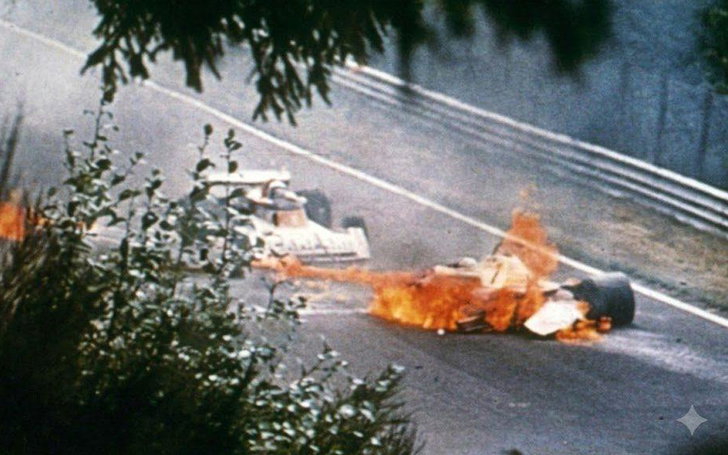
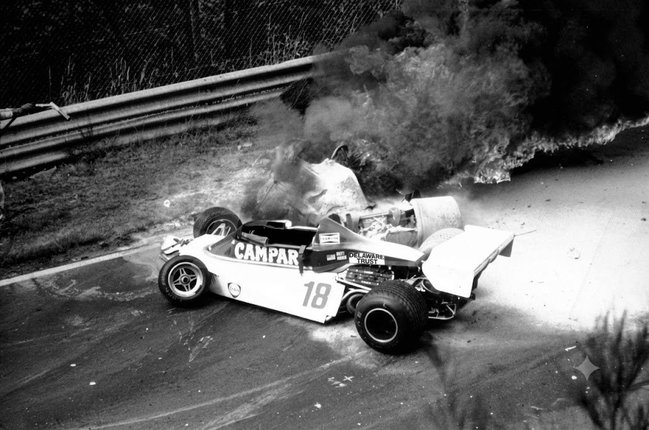
Things went wrong on the second lap. In a fast left-hand turn, just before Bergwerk, Lauda suddenly lost control of his Ferrari 312T2. The most commonly cited cause is a problem with the rear suspension, but this has never been confirmed with absolute certainty.
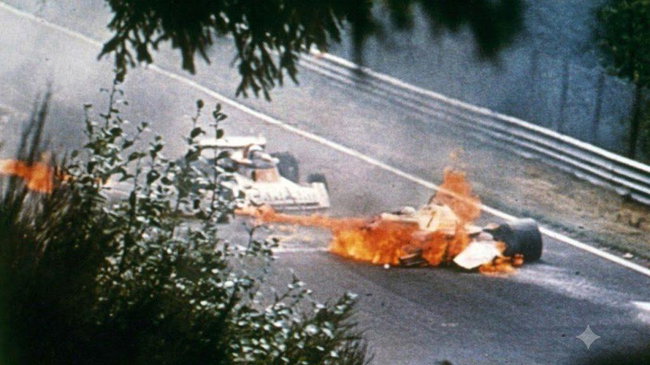
Cold tyres on a partially wet track likely played a role as well. The car veered to the right, struck a rock wall, bounced back onto the track, and burst into flames.
Life-Threatening Injuries
Lauda’s helmet was ripped off his head by the impact. The fuel tank was torn open, causing his Ferrari to burst into flames in the middle of the track.
Other drivers right behind him, including Brett Lunger and Harald Ertl, were unable to swerve out of the way and struck the burning wreckage. Guy Edwards managed to avoid the car and stopped to help.
Lauda was trapped in the burning car for nearly a minute. The heat was intense. The man who ultimately made the difference was Arturo Merzario. The Italian stopped immediately when he saw the accident, ran to the Ferrari, climbed onto the car, unbuckled Lauda’s seatbelts, and pulled him out of the fire. In doing so, Merzario suffered burns to his hands.
Lauda was seriously injured. He had severe burns on his face and head. A large part of his right ear was gone, as were his eyebrows and eyelashes. His eyelids were also severely damaged.
The greatest danger, however, lay in his lungs. Lauda had inhaled toxic and hot gases. At the hospital, his condition was so critical that doctors were not sure if he would survive.
The race resumed later. James Hunt won, ahead of Jody Scheckter and Jochen Mass.
Resurrection
Lauda missed two races: Austria and the Netherlands. Then something happened that almost no one thought possible.
On 12 September 1976, just 42 days after the accident, he was back on the starting grid, at Monza, Ferrari's home race.
He was clearly still injured and had bandages wrapped around his head. Lauda later admitted that he was terrified upon his return. Still, he didn’t want his rivals to know it.
The fact that he raced anyway, despite that fear, perhaps says everything about his character. Lauda finished fourth at Monza, scored points, and was back in the fight for the title with Hunt. That battle would not be decided until the final race of the season.
 German GP
Legacy
For many younger fans, the 2013 film Rush is the main reason they learned more about Lauda’s crash. The film focused on the rivalry between Lauda and Hunt in 1976.
The crash scene was filmed at the exact same spot on the Nordschleife where the accident actually occurred. Cars from that era were also used.
In some respects, the film took some liberties with reality. The atmosphere among the drivers was made more dramatic, Merzario’s role as a rescuer received less attention, and the rivalry between Hunt and Lauda was portrayed as more intense than it actually was. Hunt and Lauda were not only rivals but also friends.
Still, the core of the story held up. Lauda himself felt that the film accurately portrayed the events. The hospital scenes, in particular, made a deep impression on him, because it was only then that he truly realised what the doctors had needed to do to keep him alive.
The true story of 1976 lies not in the crash itself, but in the transformation that followed. That day at the Nürburgring, Lauda did not become the victim of a tragedy, but the architect of one of the greatest sporting comebacks ever.
With his characteristic, almost icy pragmatism, he didn’t focus on what he had lost, but on what was still possible.
Lauda showed the world that true strength lies not in denying your vulnerability, but in refusing to let it paralyse you.
He wore his scars not as a sign of what he had suffered, but as armour representing what he had overcome — on his own, inimitable terms.
And that is how Formula 1 and its fans will always remember him — even 50 years after his life-threatening crash and long after his death in 2019.
Also interesting:
Join RacingNews365's Nick Golding and Samuel Coop as they look back on last weekend's Hungarian Grand Prix. Mercedes being comfortably beatable is a major talking point, as is whether Lando Norris has the capability of completing a title fight comeback.
Rather watch this episode? Then click here!


Most read



In this article
Never miss a thing from the Formula 1 season! Add the 2026 F1 schedule to your calendar at the touch of a button. Subscribe below and put the dates and times of every race directly on your PC or smartphone, so you don't miss a second from the new season.
Download the F1 calendar Download the F1 calendar
A variant with just the race and qualifying is also available.
Click here to download it..





Join the conversation!