


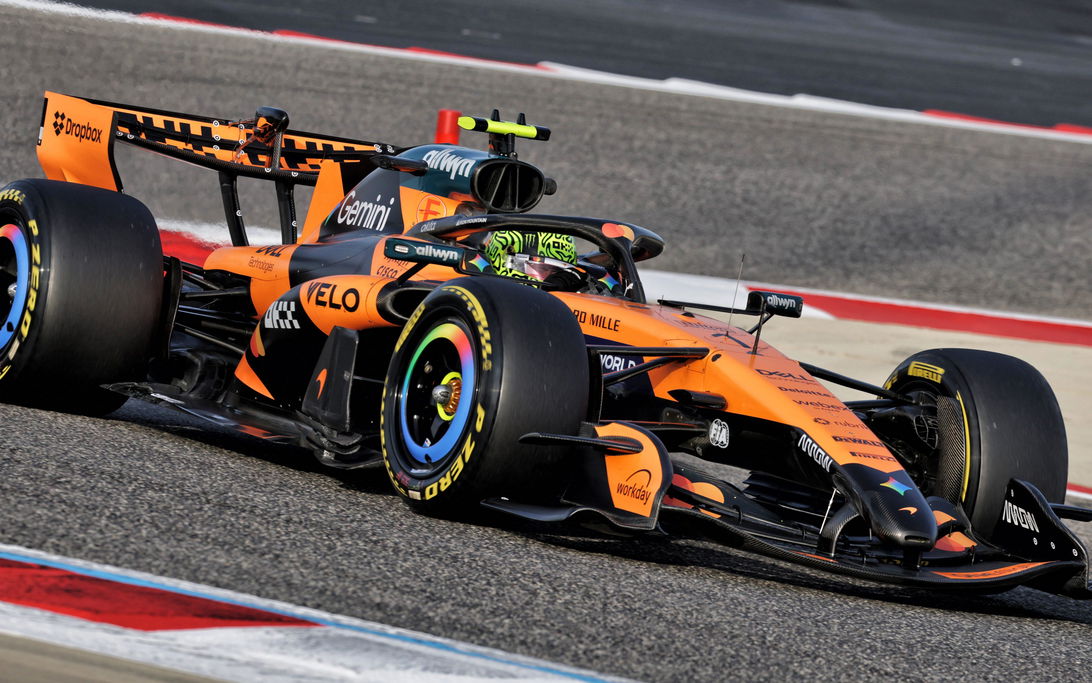
McLaren boss Andrea Stella believes F1 teams and the FIA should "play the game of responsibility" over a number of safety concerns he has.
Throughout the first week of testing in Bahrain, the topic of race starts has become topical as drivers try to adapt to the new methods of launching from a standing start.
With the removal of the MGU-H from the power units for 2026, to achieve a perfect launch, drivers must now spool the turbo up for 10 seconds to minimise lag upon launch, but also try to avoid over-charging the battery.
This raises the possibility of some cars being unsighted on the grid in the early races as drivers get used to the new processes and ramming into a car ahead which has failed to launch.
Stella also raised a concern about the energy harvesting demands placed on the new batteries, and cars suddenly slowing down on straights, pointing to two examples of drivers being launched aerially in the past after hitting a slower car.
"I have three elements, in terms of the racing, which I think deserve quite a lot of attention," Stella told media, including RacingNews365, in Bahrain.
"One is the race start. We need to make sure that the race start procedure allows all cars to have the power unit ready to go, because the grid is not the place where you want to have cars slow in taking off.
"This is a bigger interest than any competitive interest, so I think all teams and the FIA should play the game of responsibility when it comes to what is needed in terms of the race start procedures.
"I think about, for instance, the timing of the lights, the timing before the lights, and they need to be in the right place to make sure that, first of all, it is a safe phase of the way we go racing.
"I have also identified overtaking as a point of potential, and the fact that there could be cars which are following, and the car ahead may want to lift to harvest, and this may not be an ideal situation where you follow closely.
"This could give rise to situations [where cars become airborne and rotate through 360 degrees], like Mark Webber in Valencia [2010] and Riccardo Patrese in Portugal [1992], and we definitely don't want to see that anymore in Formula 1.
"So I think starts, overtaking, and launches are the three situations that we need to look at with a great level of attention in the Formula 1 community, independently of us being competitors on track."
Also interesting:
In this video, we explore a fascinating Mercedes engine theory that is engulfing the F1 paddock. We break down how it works, why it matters, and why this advantage — if real — may be brilliant, legal… but only temporary.
Most read
In this article
Never miss a thing from the Formula 1 season! Add the 2026 F1 schedule to your calendar at the touch of a button. Subscribe below and put the dates and times of every race directly on your PC or smartphone, so you don't miss a second from the new season.
Download the F1 calendar Download the F1 calendar
A variant with just the race and qualifying is also available.
Click here to download it..





Join the conversation!