


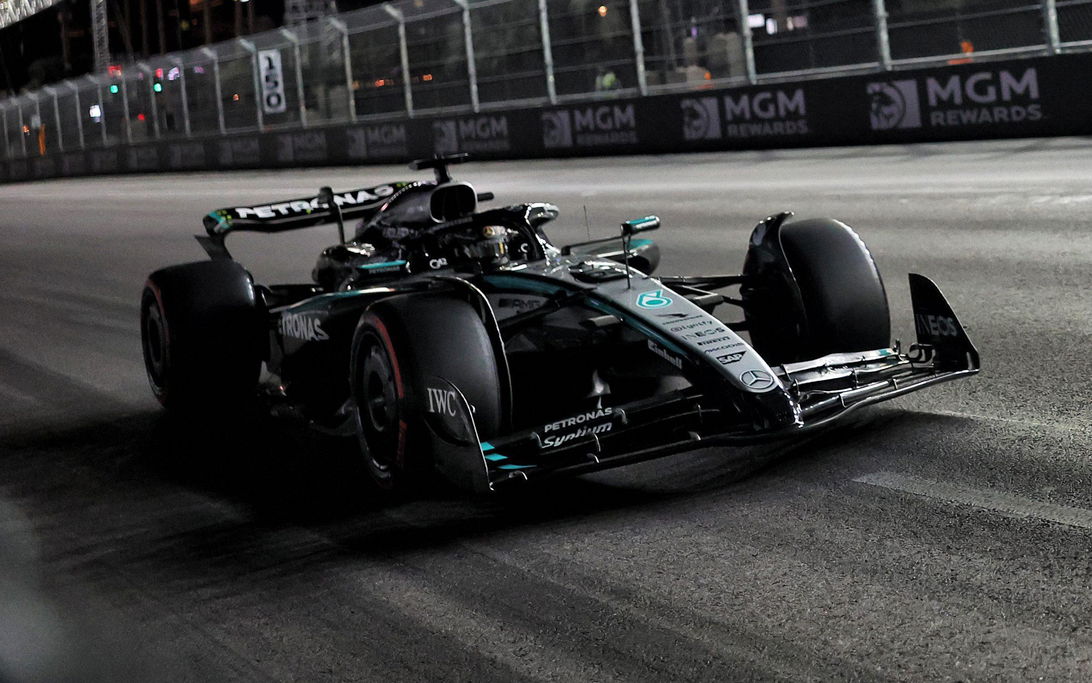
George Russell has revealed that his wish of collecting Formula 1 cars has, for now, been ruined by the FIA and its strict rules surrounding the cost cap.
Old F1 cars from the ’90s being sold for millions at auction has become a common sight, with recent examples including Michael Schumacher’s first race-winning Benetton and Ayrton Senna’s McLaren from his 1991 Brazilian Grand Prix victory.
Modern F1 cars have very rarely been spotted anywhere other than the racetrack or museums, for a reason that is stopping Russell from collecting them.
As part of the budget cap, teams produce significantly fewer monocoques to last across an F1 season, meaning there is not enough for a driver to take their car home after a campaign has concluded.
According to Russell, Mercedes now produces up to four monocoques a year, whereas teams built "15 to 20" before the cost cap was introduced.
The last driver known to have received a modern F1 car is Carlos Sainz, who was given his 2022 SF-75 as a parting gift when he left Ferrari—the exact car in which he won his first race.
"I would love to collect my own Formula 1 cars, but because of the budget ceiling, we still only produce three or four monocoques a year," Russell told Auto Motor und Sport.
"Twenty years ago, when teams had unlimited testing, each team built 15 to 20 chassis.
Russell's push for an F1 car collection
Despite teams designing new cars for each season, the monocoques for each year are often kept in each outfit's possession for its own displays or to be transferred to museums.
It leaves the drivers without the chance of keeping an F1 car, something Russell tried to negotiate in his last contract.
"I tried to get a Formula 1 car during my last contract negotiations, but unfortunately it didn't work out," revealed Russell.
Russell remains eager to collect F1 cars and is keen to see changes made by the FIA regarding the cost cap going forwards, to allow teams to build additional monocoques for non-competitive reasons.
"I would like to see a way for the teams to produce some monocoques outside the budget ceiling," he added. "We have enough copies of all sorts of other parts.
"Each driver has five engines a year. Mercedes, I believe, produces about sixty a year. We also have enough rear wings: high downforce, medium downforce, low downforce.
"There are also enough front wings and floors. We have at least ten sets of all the other parts available. But we only have three or four monocoques. Maybe I should talk to the FIA about that."
Also interesting:
The 2026 F1 Cars Revealed: Everything You Need to Know!
Discover how the 2026 F1 regulations will revolutionise the sport, with a shift to movable wings instead of traditional DRS, to the increased electrical power in the hybrid systems, and the introduction of 100% sustainable fuel.
Most read


In this article
Never miss a thing from the Formula 1 season! Add the 2026 F1 schedule to your calendar at the touch of a button. Subscribe below and put the dates and times of every race directly on your PC or smartphone, so you don't miss a second from the new season.
Download the F1 calendar Download the F1 calendar
A variant with just the race and qualifying is also available.
Click here to download it..





Join the conversation!