


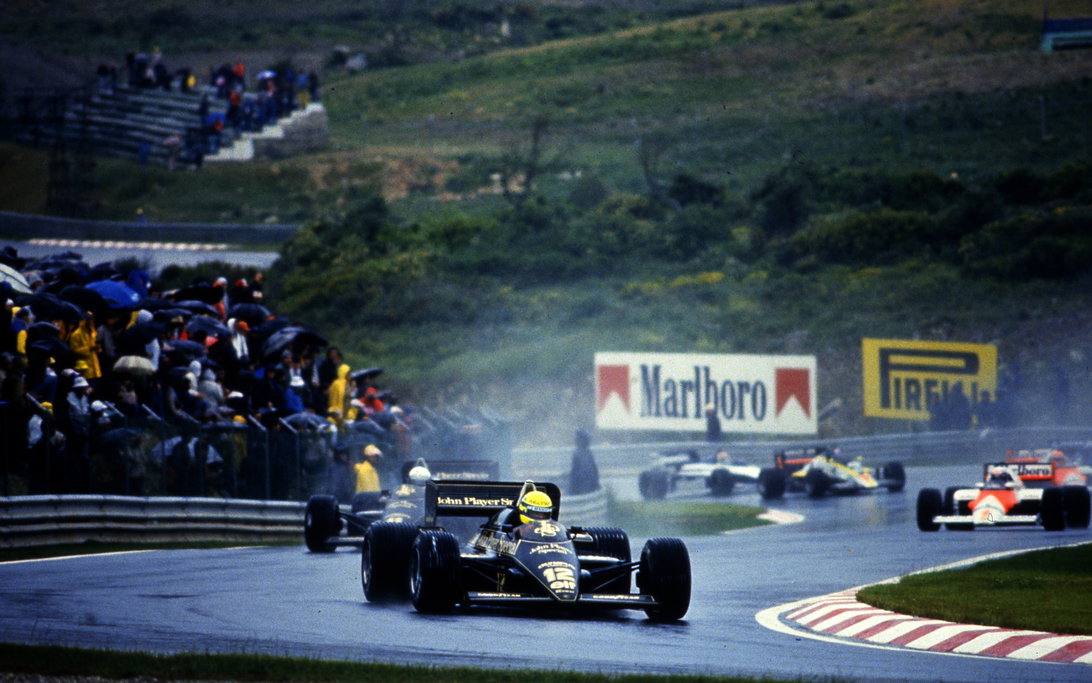
On this day, 41 years ago in 1985, Formula 1 witnessed the birth of a legend in the sodden chaos of Estoril.
Ayrton Senna's maiden grand prix victory at the Portuguese Grand Prix was not merely a breakthrough, it was an exhibition of raw talent in conditions that rendered machinery almost irrelevant.
At 24 years old, competing in just his 17th F1 race, the Brazilian delivered a performance that would set the template for his entire career.
The torrential rain that battered the Estoril circuit on 21 April 1985 created a spectacle of survival. Patrick Tambay, who finished third that day, captured the brutality of the conditions perfectly.
"That race was a nightmare," Tambay said. "It was p*ssing with rain from start to finish, very, very flooded everywhere, the cloud ceiling very low and the light very poor. It was survival of the fittest."


Senna's masterclass
Senna had stamped his authority on the weekend during qualifying, securing pole position nearly half a second ahead of Alain Prost's McLaren and a full second clear of Lotus teammate Elio de Angelis. It was the first of what would become 61 career pole positions.
When the lights went out, Senna led into the first corner and never looked back. Within 10 laps, he had opened a 13-second advantage over the field. By lap 20, that gap had stretched to an astonishing 30 seconds, despite the conditions deteriorating with every tour.
The carnage unfolded behind him. Riccardo Patrese and Stefan Johansson collided on lap four whilst battling for position.
Keke Rosberg spun on lap 16, sitting stranded in the middle of the circuit for several laps whilst cars navigated around him. The attrition was relentless, reducing the race to a test of nerve and car control.
Senna led every single lap of the 67 completed before race control called time at the two-hour limit, three laps short of the scheduled distance.
Michele Alboreto finished second, the only other driver on the lead lap, more than a minute adrift. The Brazilian had lapped the entire field except the Ferrari driver.
Senna's race engineer Steve Hallam recognised immediately what he had witnessed.
"To win in those conditions takes an exceptional talent," Hallam said. "There were 20-odd exceptional talents out there that you could say failed miserably on that day, and he didn't. He brought it home convincingly."
Even Senna acknowledged the razor's edge he had walked to secure the historic victory, which started a long run of remarkable performances.
"It was a hard tactical race, corner by corner, lap by lap because conditions were changing all the time," Senna explained. "The main thing was to keep concentration and get used to the wet track that we [hadn't had] for the whole weekend.
"So we were going through the race with a very slippery track. The car was sliding everywhere, it was very hard to keep the car under control."
For Lotus, the victory ended a six-year drought. For F1, it announced the arrival of a driver who would rewrite the sport's history books with 41 grand prix wins and three world championships.
But on that rain-soaked afternoon in Portugal, Senna was simply a young Brazilian proving he belonged amongst the very best.
Also interesting:
Join RacingNews365's Nick Golding and Sam Coop as they dissect the biggest storylines looking ahead to the rest of the 2026 F1 season, and why so much depends on what changes are made to the F1 regulations by the FIA.
Rather watch the podcast? Then click here!


Most read



In this article
Never miss a thing from the Formula 1 season! Add the 2026 F1 schedule to your calendar at the touch of a button. Subscribe below and put the dates and times of every race directly on your PC or smartphone, so you don't miss a second from the new season.
Download the F1 calendar Download the F1 calendar
A variant with just the race and qualifying is also available.
Click here to download it..




Join the conversation!