


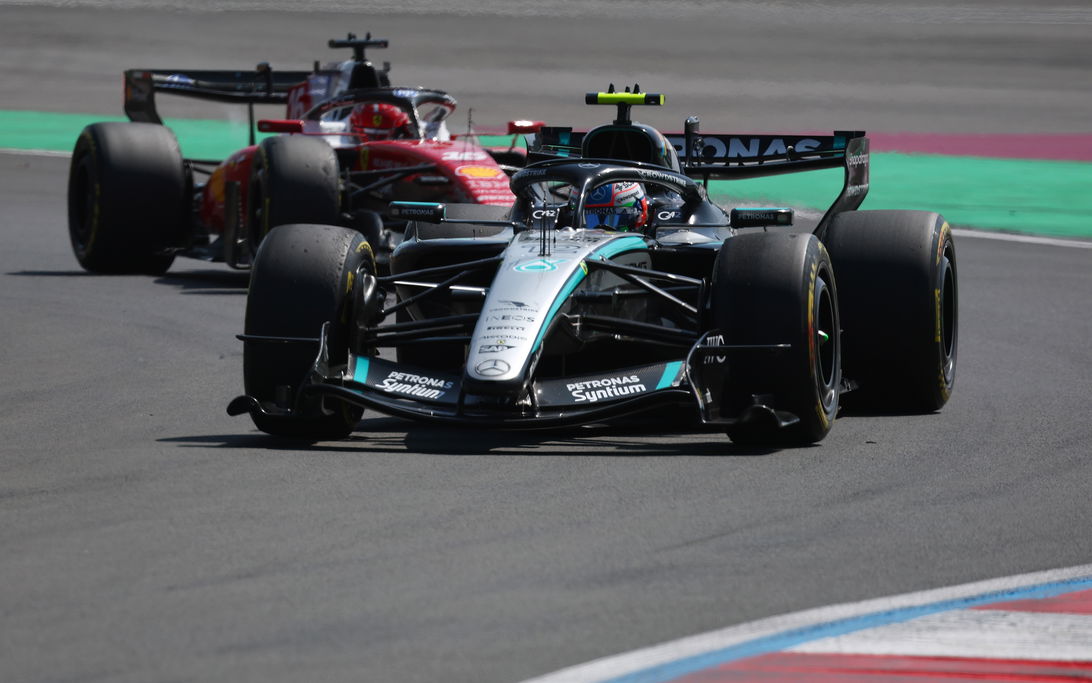
The Chinese Grand Prix sprint and qualifying sessions clearly outlined the current performance profile of F1.
Mercedes undoubtedly occupies the leading position, but the characteristics of this leadership are becoming increasingly clear and comprehensible to its rivals.
Following the duel between George Russell and Charles Leclerc over the opening 10 laps of last weekend's season-opening race in Australia, the Mercedes versus Ferrari battle resurfaced in the sprint at the Shanghai International Circuit.
Ferrari again took advantage of its smaller turbo, which allowed Lewis Hamilton to take the lead on the opening lap from third on the grid, sparking a battle between the seven-time F1 champion and his former team-mate, until the tyres on Hamilton's SF-26 began to grain due to the stress of trying to contain his fellow British driver's attacks.
In qualifying for the grand prix, Ferrari progressively modified its energy management strategy, drawing inspiration from Mercedes, which then displayed its first signs of vulnerability when Russell stopped on track during his first attempt in Q3.
The sudden activation of the engine brake and the partial lockup of the gearbox were unmistakable signs that the problem was linked to the battery charging strategy.
This is not a worry for Mercedes, but it highlighted how easily the team which has so far managed the system the best, can quickly become a victim. Performance isn't free for anyone, not even Mercedes.
Taking energy charging to extremes can, as seen, induce false signals in the system in terms of speed or wheel rotation. With an error detected, the system's electronic protection was triggered.
As we also saw with track excursions from other cars across Friday and Saturday, power spikes can be caused by false readings from the system when exiting corners, sending power surges to the wheels, leading to a loss of control of the rear axle.
The technical PU revolution is not only having the greatest impact on performance but also on reliability.
It, therefore, seems interesting to assess whether those currently at the top of the rankings have, in fact, knowingly taken risks precisely for the sake of an immediate performance improvement.
Conversely, those behind could, by taking fewer reliability risks, gradually close the gap, separating them from the performance peak over the course of a few races, and having chosen a strategy with its PU project that could be more profitable over the distance of the season
Also interesting:
Most read



In this article
Never miss a thing from the Formula 1 season! Add the 2026 F1 schedule to your calendar at the touch of a button. Subscribe below and put the dates and times of every race directly on your PC or smartphone, so you don't miss a second from the new season.
Download the F1 calendar Download the F1 calendar
A variant with just the race and qualifying is also available.
Click here to download it..





Join the conversation!