


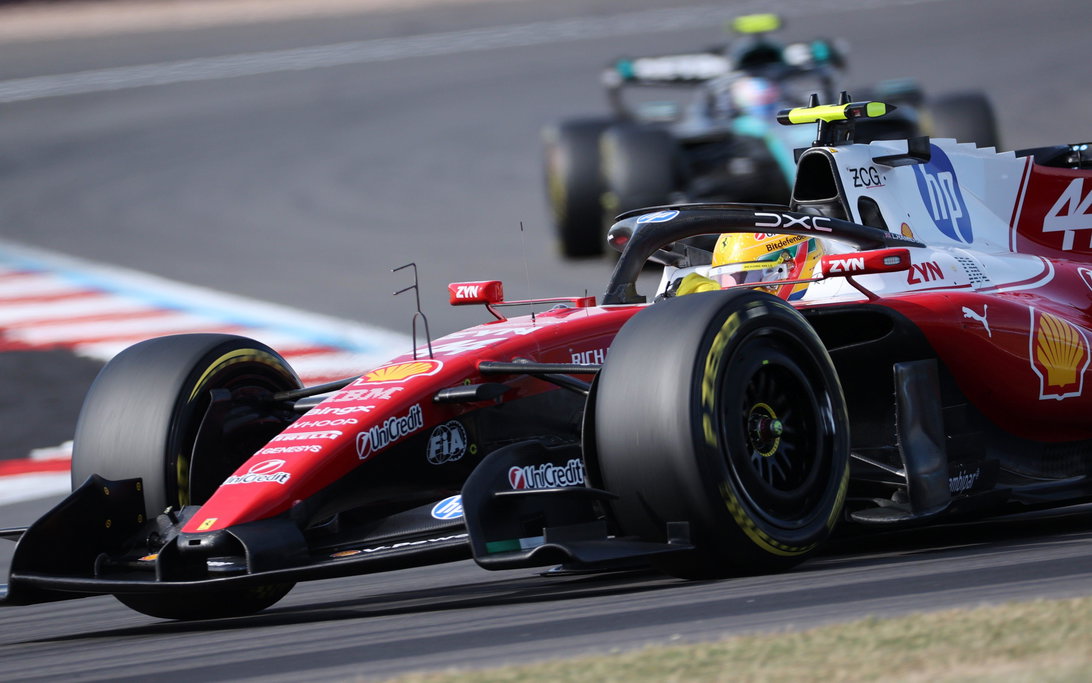
The competitive picture between Ferrari and Mercedes that emerged from the Austrian Grand Prix told only part of the story.
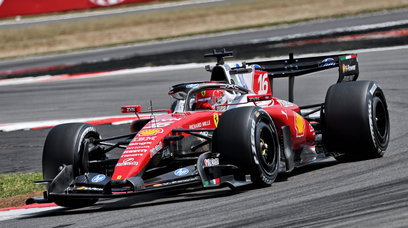
The Italian team's performance at the Red Bull Ring — in theory boosted by its first ADUO (Additional Development and Upgrade Opportunities) update — was heavily influenced by setup choices, but crucially, the SF-26's aerodynamic qualities were largely irrelevant at that particular venue.
The Styrian circuit rewards raw power unit output and mechanical traction above all else; the wings and diffusers barely get a say. Silverstone is an altogether different proposition.
At the British Grand Prix, outright power still matters enormously, but aerodynamic efficiency and car balance are equally decisive.
And it is precisely in that context that a less obvious phenomenon has begun to surface, one with significant implications for how we understand the relationship between aerodynamics and energy management on modern hybrid F1 machinery.
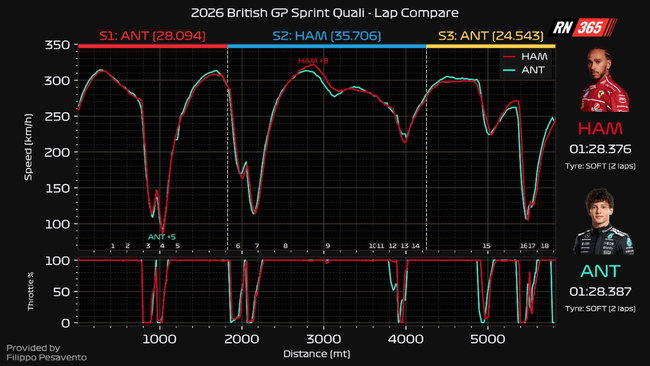
Check out the comparison between Lewis Hamilton and Kimi Antonelli's SQ3 laps below. Article continues beneath.
The clipping gap tells the real story
To the untrained eye, aerodynamic efficiency might not seem like the kind of factor capable of fundamentally altering a car's energy balance.
But the data from Lewis Hamilton's sprint pole lap at Silverstone suggests otherwise, and rather emphatically at that.
In the micro-sectors along the straight that follows the Maggotts-Becketts-Chapel complex, the SF-26 was running at higher speeds than Antonelli's W17 and considerably faster than Russell's.
The underlying reason points directly to battery deployment and recovery, specifically to what is known as clipping.
Clipping is the phase during which the MGU-K is recharging the battery rather than delivering power. The W17 was spending almost two additional seconds per lap in clipping mode compared to the Ferrari.
That figure is telling, but it is important to interpret it correctly. It does not mean that Mercedes' battery takes longer to reach the same state of charge under identical conditions. Rather, it indicates that the W17 was consuming a greater proportion of its electrical energy over the course of the lap, forcing a correspondingly longer recovery window.
The explanation lies in the SF-26's aerodynamic superiority. A more efficient car requires less energy to sustain a given speed.
By generating less drag for the same downforce, the Ferrari was drawing less heavily on its electrical reserves throughout the lap, which in turn meant it arrived at those high-speed straights with more charge available and less time spent replenishing it.
The result was a tangible performance advantage in precisely the zones where clipping is most costly.
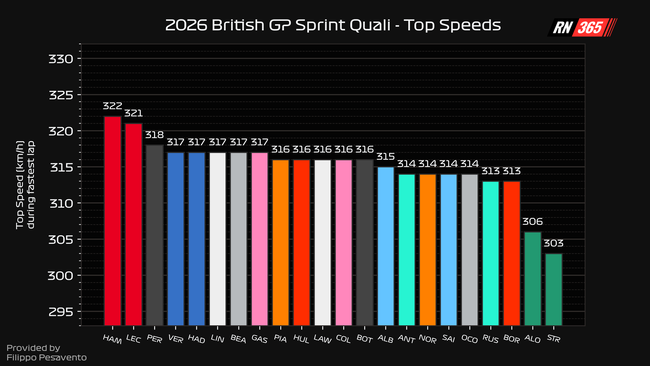
Ferrari defied expectations to set the top speeds in sprint qualifying. Article continues beneath.
Efficiency as a competitive weapon
What this reveals is something the season's opening rounds had only hinted at: the energy balance of a power unit cannot be assessed in isolation from the aerodynamic characteristics of the car it is installed in, nor from the nature of the circuit it is being asked to tackle.
Global efficiency, rather than peak power alone, is emerging as a decisive competitive variable, and one that is becoming harder to dismiss as the season progresses.
That carries particular significance for Ferrari's standing in the power unit hierarchy. Despite introducing an evolved unit in Austria, incorporating the first application of the ADUO concept, the Scuderia still appears to be giving away ground to Mercedes in terms of raw power output.
That gap, however poorly it flatters Ferrari in pure engine terms, is being partially offset and in some cases reversed by the SF-26's aerodynamic package, which is recasting the energy equation in Ferrari's favour on circuits where efficiency is rewarded.
On a track like Silverstone, where the car spends extended periods at high speed through technically demanding corners, the compounding benefit of reduced drag and superior balance accumulates across the lap.
The less electrical energy a car burns cornering, the more it retains for deployment on the straights, and the less time it spends in clipping mode when it matters most.
Hamilton's sprint pole is the clearest illustration yet of how that dynamic can translate into meaningful lap time.
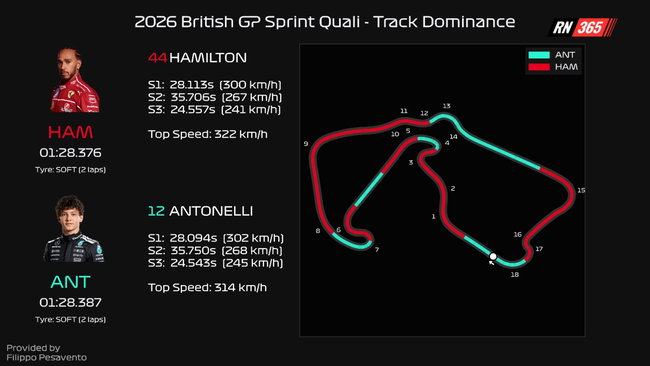
The track dominance between Lewis Hamilton and Kimi Antonelli from SQ3 is below.
Get the latest F1 news from RacingNews365 directly in your Google feed! Click on the link below and you’ll see your favourite F1 website appearing even more often. That way, you’ll never miss any news, analyses, interviews, or exclusives.
Follow RacingNews365 on GoogleMost read



In this article
Never miss a thing from the Formula 1 season! Add the 2026 F1 schedule to your calendar at the touch of a button. Subscribe below and put the dates and times of every race directly on your PC or smartphone, so you don't miss a second from the new season.
Download the F1 calendar Download the F1 calendar
A variant with just the race and qualifying is also available.
Click here to download it..






Join the conversation!