


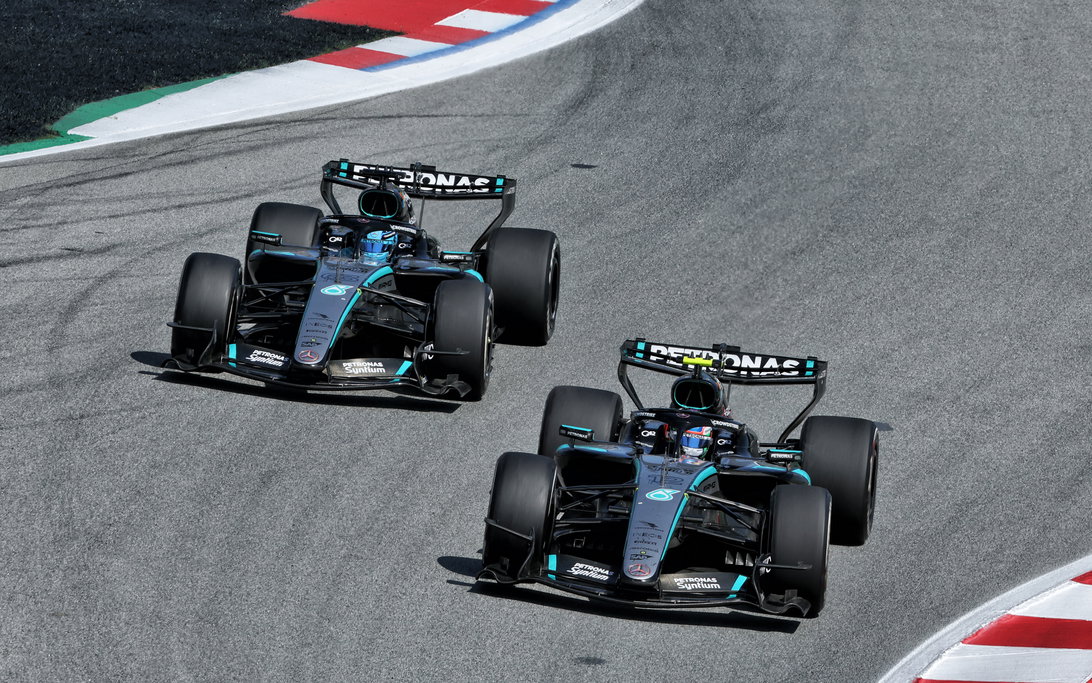
At first glance, analysing Mercedes' first half of the season appears almost too straightforward.
After all, assessing a team that has claimed eight victories from the opening 11 rounds should amount to little more than recognising a campaign that has left its rivals fighting over the scraps.
However, looking beyond the headline results reveals a more nuanced picture. While Mercedes has been the benchmark in terms of victories, it has not been as comprehensively dominant as those numbers suggest.
Several underlying trends indicate that the Brackley-based team will need to find another step in performance during the second half of the season if it is to retain its championship advantage, particularly as its closest rivals have made significant progress over the final five grands prix before the summer break.
Viewed by others:
What makes the W17 so competitive?
The W17 is an exceptionally well-balanced car. From both a chassis and aerodynamic perspective, it does not appear to possess one standout characteristic that clearly surpasses the competition.
Instead, its greatest strength stems from a concept that was developed entirely around the requirements of Mercedes' power unit.
The clearest evidence of this is the car's remarkable thermal efficiency. Even at the hottest events of the season, Mercedes has needed only minimal changes to both its internal and external cooling layouts, avoiding the extensive use of additional cooling louvres and gills seen elsewhere on the grid.
In practical terms, the packaging around the internal combustion engine has remained virtually unchanged throughout the opening 11 rounds.
The W17's balance is the result of an effective combination of design choices, from its wheelbase to its suspension geometry.
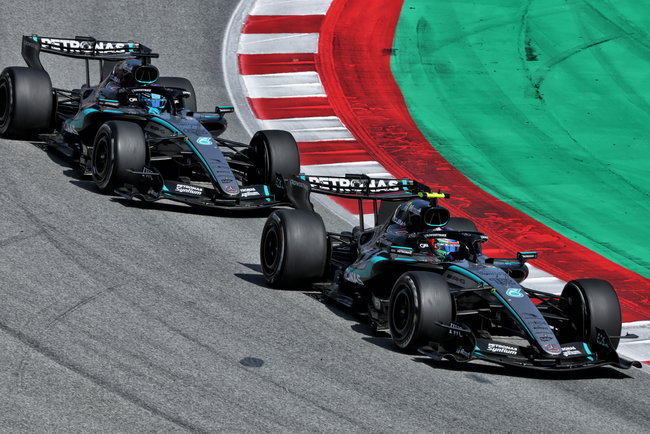
Its kinematics provide excellent stability, even when operating at the limit, allowing Kimi Antonelli and George Russell to exploit every inch of available track.
Particularly in the Italian's case, at times, that has resulted in a few excursions beyond the track limits, but it has also enabled the 19-year-old to extract additional cornering speed.
A strength, but also a limitation
Ironically, Mercedes' biggest challenge is also one of its greatest strengths. Beyond its well-established power unit advantage, it is difficult to identify a single area in which the W17 excels above everything else.
When every aspect of a car is already operating in close harmony, finding further performance requires a holistic approach rather than improvements in one isolated area.
In other words, Mercedes now needs upgrades that enhance the car's overall performance, making it faster across a complete lap rather than simply improving one specific characteristic, such as high-speed cornering, at the expense of agility through slower sections.
Achieving that kind of all-round gain is extremely difficult and, as a result, any future upgrade package is likely to involve compromises.
With Mercedes deliberately gearing its development path towards the second half of the season, as outlined by Toto Wolff, the team may have to prioritise gains in certain performance areas over others depending on the characteristics of upcoming circuits, and there is no guarantee that such choices will deliver the desired outcome.



The power unit question and the Monza gamble
Alongside aerodynamic and chassis development sits another crucial factor: improving the reliability of the power unit.
As is well known, Mercedes' engineers at Brixworth have long identified vulnerabilities within the system, particularly concerning overheating issues affecting elements of the Energy Store.
According to our information, Mercedes is considering introducing an updated version of this component at the Italian Grand Prix at Monza.
The high-speed nature of the circuit offers one of the best opportunities to recover positions after serving a grid penalty, making it the logical venue should the team exceed its permitted allocation of power unit components.
There is another reason behind this timing. Introducing the revised battery at Monza would ensure the updated specification is available from only the second race after the summer break, removing reliability concerns at an early stage of the title run-in.
Leaving those issues unresolved would represent a significant risk, particularly as Mercedes' direct rivals are expected to debut their latest, more powerful power unit specification at Monza, featuring the new ADUO 2 technology for their internal combustion engines.
With that in mind, the remaining 11 or 12 rounds of the season look set to develop into a far more complex strategic battle than the current championship standings suggest.
Mercedes may hold the advantage today, but maintaining it is unlikely to be nearly as straightforward as the results so far would imply.
Also interesting:
Join RacingNews365's Nick Golding and Samuel Coop as they reflect on the first half of the 2026 F1 season, answering who they believe has been the best, most disappointing, surprised us and requires a huge end to the year.
Rather watch this episode? Then click here!


Most read




Never miss a thing from the Formula 1 season! Add the 2026 F1 schedule to your calendar at the touch of a button. Subscribe below and put the dates and times of every race directly on your PC or smartphone, so you don't miss a second from the new season.
Download the F1 calendar Download the F1 calendar
A variant with just the race and qualifying is also available.
Click here to download it..





Join the conversation!