


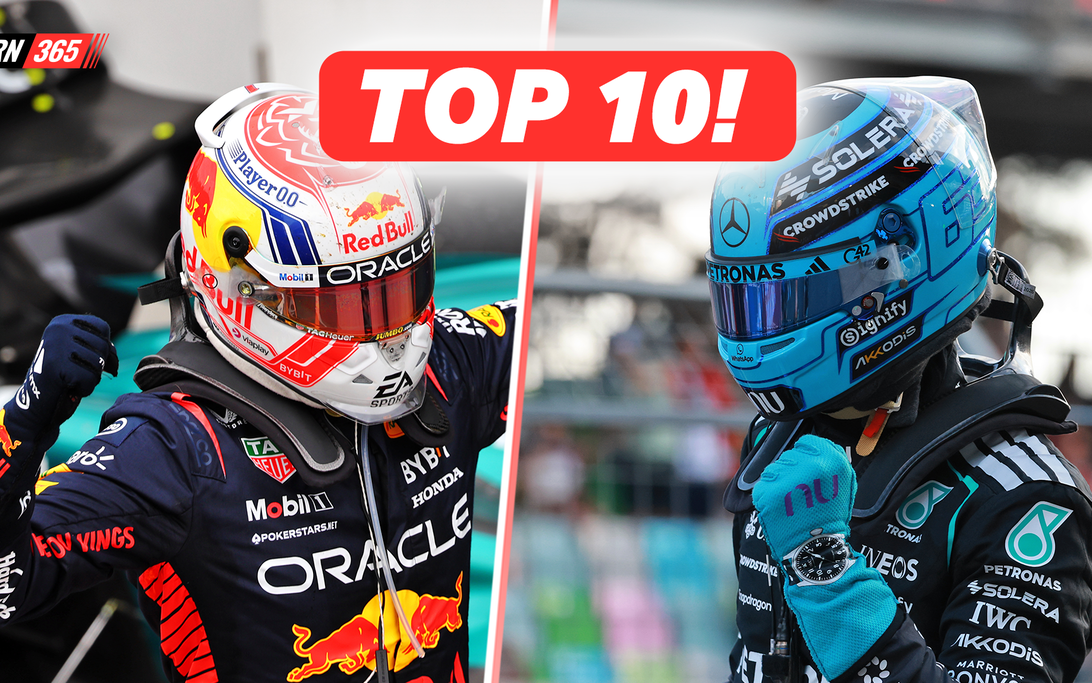
George Russell produced one of the most dominant qualifying laps of the season in Baku, putting his Mercedes on pole for the Azerbaijan Grand Prix by 0.837 seconds over Charles Leclerc's Ferrari.
It was a scarcely believable gap around a street circuit where tenths, not tenths of a second gaps like this, usually separate the front two.
The margin instantly raises a question: where does it sit among the biggest pole advantages of the past decade?
The answer places Russell in rare company, behind only three drivers who have ever qualified by a bigger buffer in the last ten years.
Check out the biggest grand prix pole margins of the last decade below!


1. Max Verstappen, 2023 Canadian Grand Prix, 1.244s
Max Verstappen's 2023 Canadian Grand Prix pole remains the benchmark, the Dutchman beating the field by 1.244 seconds in changeable conditions that turned qualifying into a lottery he alone seemed to solve with total command of the tricky Montreal grip levels.
2. Lewis Hamilton, 2020 Styrian Grand Prix, 1.216s
Lewis Hamilton's 2020 Styrian Grand Prix effort follows at 1.216 seconds, a lap delivered at the Red Bull Ring during Formula 1's pandemic-disrupted restart, where Mercedes' pace advantage over the field was at its most brutal.
3. Lewis Hamilton, 2017 Italian Grand Prix, 1.148s
Hamilton also holds third spot, his 2017 Italian Grand Prix pole at Monza coming in 1.148 seconds clear, a staggering figure at a circuit where slipstreaming usually compresses the times.
4. George Russell, 2026 Azerbaijan Grand Prix, 0.837s
Russell's Baku lap slots in fourth at 0.837 seconds, ahead of two Verstappen poles from 2023 and 2022. It represents the biggest pole margin since the introduction of the new power unit regulations.
5. Max Verstappen, 2023 Belgian Grand Prix, 0.820s
Verstappen's Spa pole that year yielded a 0.820-second margin, underlining the Red Bull's straight-line advantage around the Ardennes circuit.
6. Max Verstappen, 2022 Emilia Romagna Grand Prix, 0.779s
His Emilia Romagna Grand Prix pole in Imola came in at 0.779 seconds amid difficult, drying conditions that made setting a clean lap a considerable challenge.
7. Nico Rosberg, 2016 European Grand Prix, 0.757s
Nico Rosberg's 2016 European Grand Prix pole in Baku itself, back when the circuit ran under that title, produced a 0.757-second gap during Mercedes' near-total qualifying supremacy that campaign.
8. Charles Leclerc, 2019 Belgian Grand Prix, 0.748s
Charles Leclerc's 2019 Belgian Grand Prix pole for Ferrari came in at 0.748 seconds, part of the run of form that preceded his maiden win at Spa that weekend.
9. Lewis Hamilton, 2018 Belgian Grand Prix, 0.726s
Hamilton's 2018 Belgian Grand Prix pole rounds out another Spa entry at 0.726 seconds, a lap that underlined Mercedes' one-lap edge over Ferrari that year.
10. Nico Rosberg, 2016 Russian Grand Prix, 0.706s
Rosberg completes the list with his 2016 Russian Grand Prix pole in Sochi, a 0.706-second margin that came during the German's imperious run to that year's title.
Most read
In this article
Never miss a thing from the Formula 1 season! Add the 2026 F1 schedule to your calendar at the touch of a button. Subscribe below and put the dates and times of every race directly on your PC or smartphone, so you don't miss a second from the new season.
Download the F1 calendar Download the F1 calendar
A variant with just the race and qualifying is also available.
Click here to download it..





Join the conversation!