


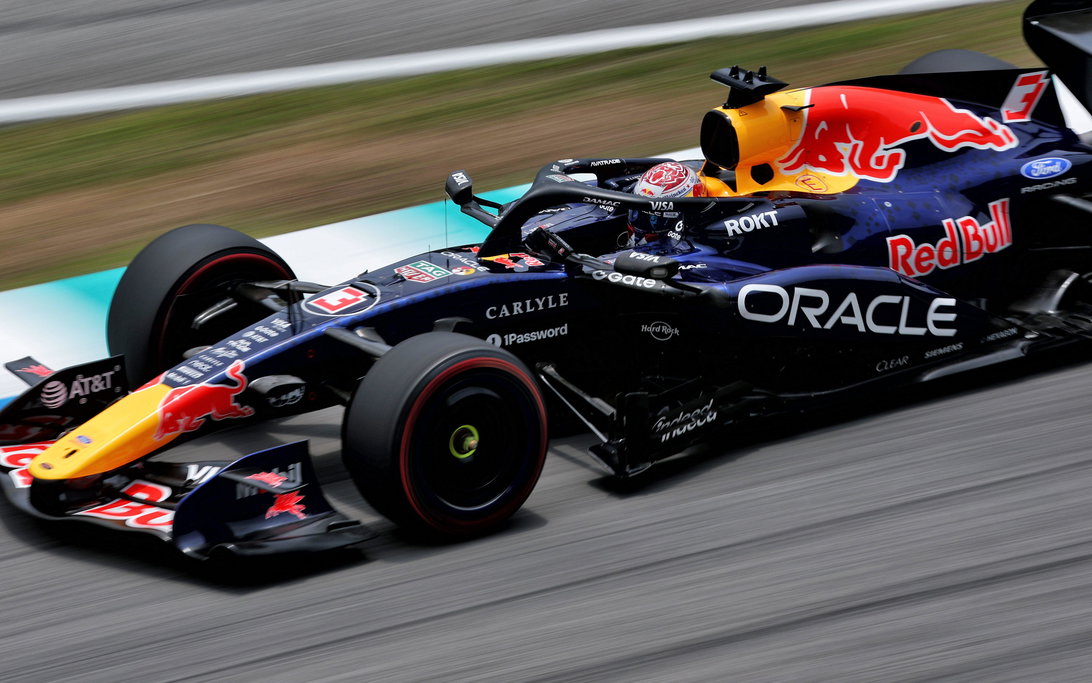
Red Bull technical director Pierre Waché has identified promising signs for the team after a strong opening day at the Sepang International Circuit, despite brutal conditions during Friday practice for the Bahrain Grand Prix in Malaysia.
Max Verstappen topped FP1 with a 1:37.520s, before Isack Hadjar backed that up with second place in FP2, just 0.099s shy of Charles Leclerc's benchmark time. Verstappen rounded out the second session in fourth.
The four-time F1 champion's FP1 time, however, was the quickest of the day, and unusually he was one of only two drivers not to use a set of soft compound tyres in the second session.
The timesheets came against a backdrop of extreme heat, with ambient temperatures exceeding 33 degrees Celsius and track temperatures climbing to almost 62 degrees early in FP2.
The circuit, hosting Formula 1 for the first time since 2017, was also notably dusty and low on grip due to the lack of recent rubbering-in, with the abrasive original asphalt from nine years ago now sitting alongside a newer resurfaced section between Turns 6 and 12, creating inconsistent grip levels across a single lap.
Waché described the session as a steep challenge for both car and tyres, with the key opportunity for Red Bull lying in the learning process the team can extract from such a demanding and unfamiliar track.
"It was very warm, very difficult for the car and for the tyres," Waché said after FP2. "And also, there had not been much running on the track before our sessions.
"The track was quite dusty, and the grip evolved a lot, and the temperature was very high; track [temperature] reached 60 degrees, which we have never achieved with this type of [F1] car yet.
"It was difficult. The balance of the car is also tricky, but it's a learning process for the weekend."



Verstappen bucking the trend
Verstappen's FP2 programme notably omitted any running on the soft compound, a decision Waché put down to prioritising race preparation over outright pace.
"The main priority was to do a long run on medium that we didn't do this morning [in FP1]," he added to explain Verstappen's lack of soft tyre usage.
"Then, with the risk of rain in the middle of FP2, we didn't want to risk getting the long run in, and we switched to [it] very quickly. After that, we didn't have time to do the soft run."
Hadjar, meanwhile, was heard complaining over team radio about brake oscillations during his running.
Waché linked the issue to the unique demands the Sepang layout places on the braking system, with its two long straights feeding into heavy braking zones at Turn 1 and Turn 15 that place simultaneous strain on brake cooling and tyre thermal management.
"He had a difficult time with energy management and how you use the brakes on this track," Waché explained. "But hopefully we will sort out this problem."
Most read

In this article
Never miss a thing from the Formula 1 season! Add the 2026 F1 schedule to your calendar at the touch of a button. Subscribe below and put the dates and times of every race directly on your PC or smartphone, so you don't miss a second from the new season.
Download the F1 calendar Download the F1 calendar
A variant with just the race and qualifying is also available.
Click here to download it..





Join the conversation!