


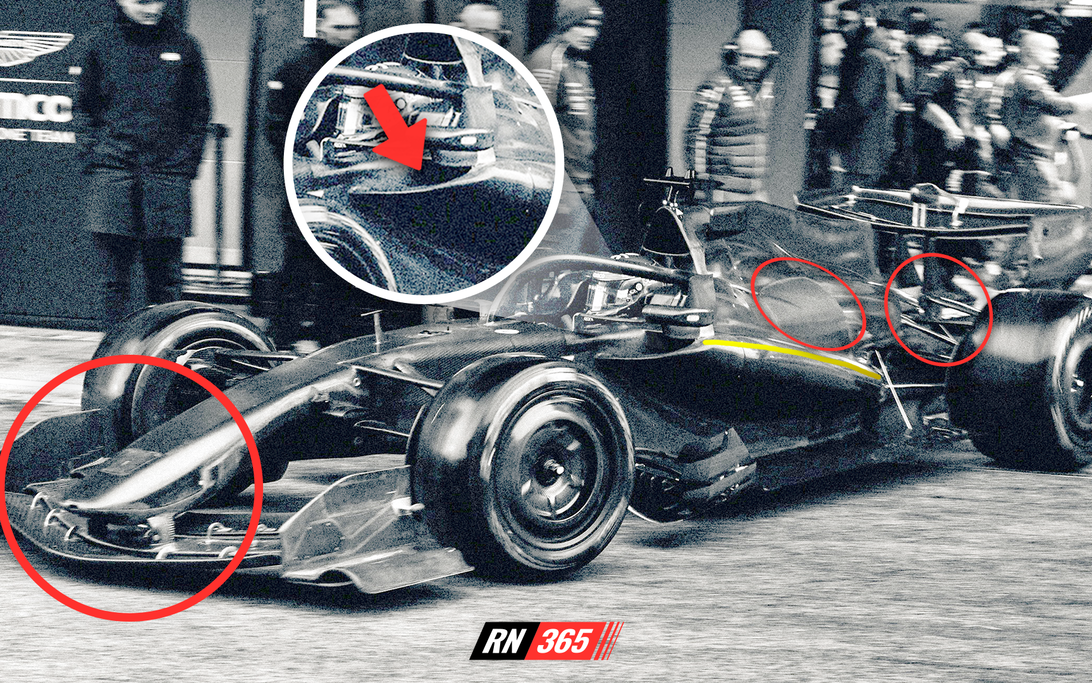
The anticipation surrounding Aston Martin's AMR26 reached its crescendo in Barcelona this afternoon as Lance Stroll finally brought the eagerly-awaited machine to life on circuit, with Fernando Alonso scheduled to take over driving duties tomorrow. The extended wait has proven thoroughly worthwhile.
As RN365 had previously reported, the car's belated track debut stemmed from specific inconsistencies that team principal Adrian Newey identified during the summer between simulator readings and wind tunnel data, raising concerns about the reliability of the processed information.
However, the reality behind the programme's delayed schedule, which has become something of a Newey hallmark, lay primarily in securing final approval for an aerodynamic package that, as evidenced by the initial photographs released by Aston Martin this afternoon, represents a radical departure from every rival design.
The AMR26 systematically rejects the conventional design philosophies adopted across the grid, beginning with its distinctive wide-section nose cone. The component's lower profile creates an unmistakably seagull-like appearance, linking to the front wing through compact pylons. Meanwhile, the sidepods suggest that the recent trend towards letterbox-style air inlets may be reaching its conclusion.
On Aston Martin's latest creation, the inlets function essentially as upward-facing periscopes, incorporating a funnel-shaped opening accompanied by a tray positioned along the inlet's lower edge. The sidepods themselves are not merely highly inclined in profile but also exceptionally short and narrow, emphasising an extreme Coke-bottle philosophy.
This approach explains the implementation of substantial, forward-positioned vents on the engine cover, situated well clear of the car's rear section. The power unit air intake adopts a triangular configuration that mirrors last year's Ferrari concept, though it equally resembles the current iteration through the twin winglets positioned on either side.
A substantial shark fin crowns the engine cover, extending almost to the rear bodywork's limit. The rear section itself is remarkably narrow and, in its lower portion, effectively creates a second skin around the gearbox components. Both front and rear suspension systems utilise push-rod layouts, incorporating multi-link configurations.
Particularly noteworthy is the upper wishbone positioning, which demonstrates how the rear arm, running almost horizontally, sits considerably higher than the front arm's pick-up point, promoting pronounced anti-squat characteristics. Initial analysis of these first images reveals countless original and concealed solutions throughout the car, fully justifying the extended development period required for its creation.
Newey has once again delivered on innovation and originality. However, regarding outright performance capabilities, definitive answers must await the forthcoming Bahrain tests at minimum.
Also interesting:
Join RacingNews365's Ian Parkes and Nick Golding for the first podcast of 2026! The duo look at some of the biggest topics ahead of the new season, including Max Verstappen remaining with Red Bull and the pressure which awaits Lewis Hamilton and Ferrari.
Rather watch the podcast? Then click here!


Most read


In this article
Never miss a thing from the Formula 1 season! Add the 2026 F1 schedule to your calendar at the touch of a button. Subscribe below and put the dates and times of every race directly on your PC or smartphone, so you don't miss a second from the new season.
Download the F1 calendar Download the F1 calendar
A variant with just the race and qualifying is also available.
Click here to download it..





Join the conversation!