


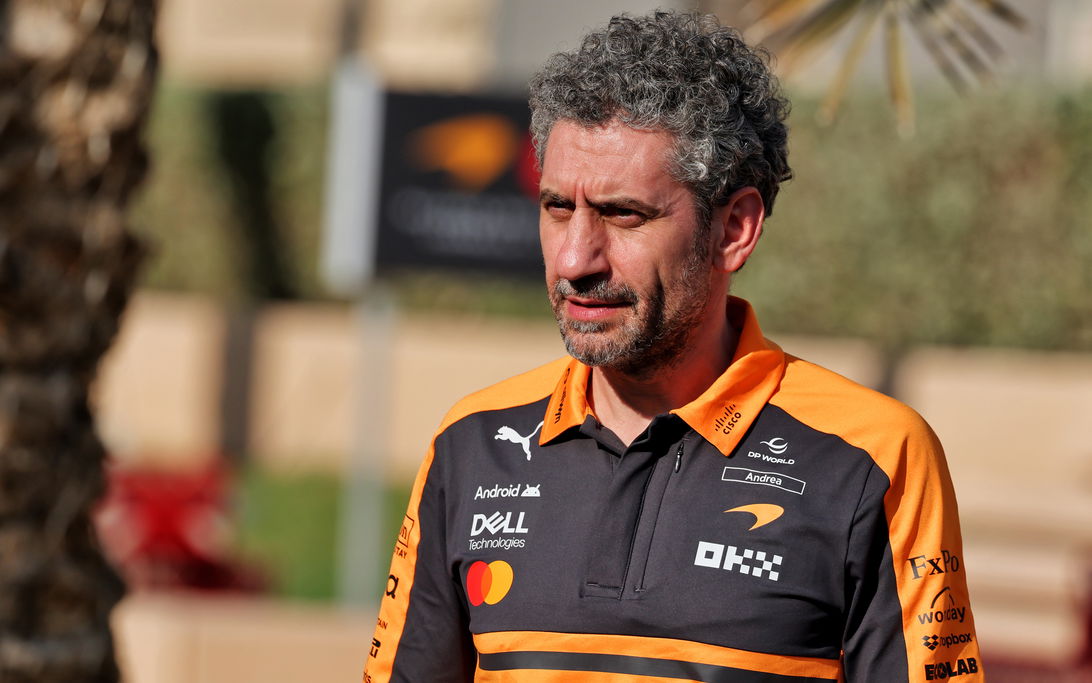
McLaren team principal Andrea Stella has warned against F1 relying on lift and coasting as an energy management strategy under the new regulations, instead advocating for amendments to the rules surrounding super clipping.
F1 has entered a brave new power unit era with a near-equal split between electric and conventional combustion power, but in doing so, the need to harvest energy has grown significantly.
This poses energy management and deployment headaches for teams and drivers, and one particular area of the rulebook has come under scrutiny during pre-season testing.
Of the four methods in which a driver can recharge the battery of the power unit, lift and coasting, and super clipping are garnering significant attention, and the requirement for both is linked.
Lift and coast (LiCo) has traditionally been used as a fuel-saving technique, and is where a driver deliberately takes their foot off the throttle and coasts into the braking zone of a corner. Under the 2026 rules, doing this will also aid energy recovery at up to 350kW, which is the full capacity of the MGU-K.
Super clipping, on the other hand, is when the battery starts to harvest power even though a driver is still at full throttle. This sees top speeds taper off and reduce.
Clipping itself is nothing new; previously, when the power unit was out of electric energy, the car would slow towards the end of a straight. But this year, it is also a method to recover energy, hence adding 'super' to the name.
The regulations specify that recharge using this approach must be limited to 250kW to prevent excessive and sudden reductions in speed.
Therefore, despite super clipping naturally being a more effective way to harvest energy, it will likely push drivers towards LiCo, as it is more efficient.
Whilst the FIA's rationale for the former limit is predicated on safety grounds, the F1 teams also have similar concerns about the latter.
Stella pointed out that the Bahrain International Circuit is also not necessarily representative of other tracks on the F1 calendar and their potential LiCo demands.
"When it comes to lift and cost, like I said before, we need to be a little bit careful as an F1 community, because Bahrain does not necessarily expose the need to do lift and cost, because it's a harvest-rich circuit," he told media, including RacingNews365, after testing concluded.
"You can harvest in braking, and you don't need to do these special manoeuvres that can surprise the car that follows you."
When the F1 Commission — which is comprised of the FIA, Formula One Management (FOM) and the teams — met on Wednesday in Sakhir, the motorsport governing body agreed to teams testing super clipping up to 350kW, which McLaren did on the final day of running.
Stella endorsed a change to the rules, adding: "We tested the possibility of increasing the super clip to 350kW... There are all the conditions to make this a 350kW harvest while the driver is at full throttle, which means that the driver doesn't have to lift the cost to harvest 350kW.
"We discussed this with the FIA and in the F1 Commission. It will ultimately be up to the FIA to decide whether they introduce it or not. We successfully tested it, and we are happy."
Also interesting:
Join RacingNews365’s Ian Parkes, Sam Coop and Nick Golding as they look back on last week’s first test in Bahrain and this week’s second test at the same venue. The trio debate Max Verstappen’s criticism of the regulations and whether Formula 1 is facing an identity crisis.
Rather watch the podcast? Then click here!


Most read



In this article
Never miss a thing from the Formula 1 season! Add the 2026 F1 schedule to your calendar at the touch of a button. Subscribe below and put the dates and times of every race directly on your PC or smartphone, so you don't miss a second from the new season.
Download the F1 calendar Download the F1 calendar
A variant with just the race and qualifying is also available.
Click here to download it..





Join the conversation!