


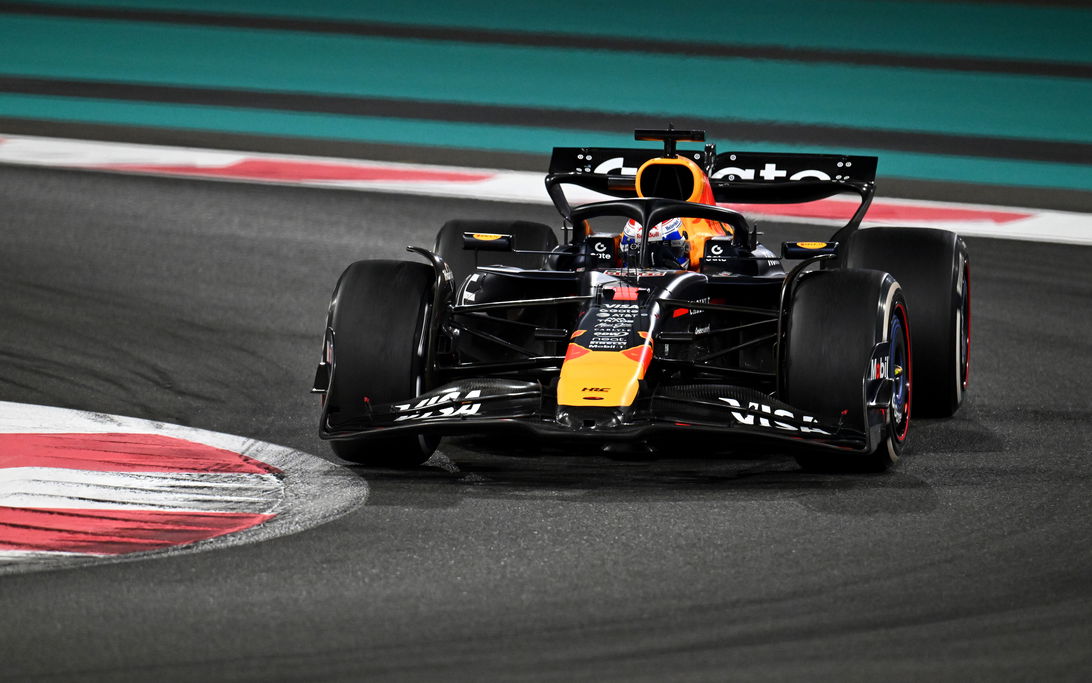
Ford Motorsport global director Mark Rushbrook has issued an update on Red Bull’s power unit for the 2026 F1 regulations, providing an important boost for Max Verstappen.
For the first time in its F1 history, Red Bull is producing its own engines rather than relying on a manufacturer such as Honda. Ford is on hand to offer technical support, a partnership that appears to be making positive progress.
With Red Bull having never powered an F1 car itself before, this represents an extraordinary step into the unknown – one that carries risk for Verstappen.
The Dutchman faces the possibility of a season in an uncompetitive package unless Red Bull has mastered the art of F1 power unit development at its first attempt.
Next month’s private test in Barcelona will give Red Bull and Ford its first serious look at the power unit, which Rushbrook insists is progressing as planned.
"Things are going according to plan and we are where we need to be, but of course it doesn’t really all come together until the car is on the track," Rushbrook told Motorsport.com.
"That will be an important day and an important week. Only then will we see if all the work of the past three years pays off."
Despite progress being made, natural nerves remain within Ford, with Rushbrook acknowledging that simulation data can only reveal so much.
"Well, there is always some nervousness when a new car or engine goes out on the track for the first time," Rushbrook conceded.
"Our computer tools are good for designing things, and our labs are good for developing and calibrating the hardware, but you haven’t seen it all until it really comes together on the track.
"We can simulate a lot in our virtual environment, but the question remains whether you’re going to see things on the track that you haven’t been able to see in the labs."
Red Bull-Ford goals 'met'
According to Rushbrook, the goals that Ford and Red Bull set out for its F1 engine at the beginning of the development process have been "met".
The key focus now remains on drivability, one of the areas Rushbrook has highlighted as being particularly important for F1’s new power units.
Asked which features of the new power unit will be most important, Rushbrook explained: "It’s about power, performance, reliability and then drivability.
"In terms of the timeline and the goals we set at the beginning of our programme, we met them. In the last few months, the work has mostly gone into drivability and calibration.
"Some of it you can do with computer models, some of it in the lab, and some of it is done with drivers in the simulator. That’s where the focus is now."
Much remains unknown for every F1 engine manufacturer when it comes to the 2026 regulations, which represent the biggest regulatory change in the history of the sport.
This has made setting goals and targets difficult, with Rushbrook believing everyone is broadly aiming for the same outcomes.
Discussing Ford’s objectives, Rushbrook said: "Basically, it’s all based on the rules that everyone has to stay within.
"From that, you can calculate what is theoretically possible, and that forms your ultimate goal. As a result, I think everyone has been aiming for about the same thing.
"All the engineers probably came to similar estimates, since everyone is dealing with the same laws of physics. You look at what is theoretically possible, and then it’s about how efficiently you get there, including power transfer in practice."
Also interesting:
Join RacingNews365's Ian Parkes, Sam Coop, and Nick Golding as they continue to review the 2025 Formula 1 season. The trio answer crucial questions such as who was the best driver this year, who was the most improved, the biggest disappointment, and much more!
Rather watch the podcast? Then click here!


Most read
In this article
Never miss a thing from the Formula 1 season! Add the 2026 F1 schedule to your calendar at the touch of a button. Subscribe below and put the dates and times of every race directly on your PC or smartphone, so you don't miss a second from the new season.
Download the F1 calendar Download the F1 calendar
A variant with just the race and qualifying is also available.
Click here to download it..





Join the conversation!