


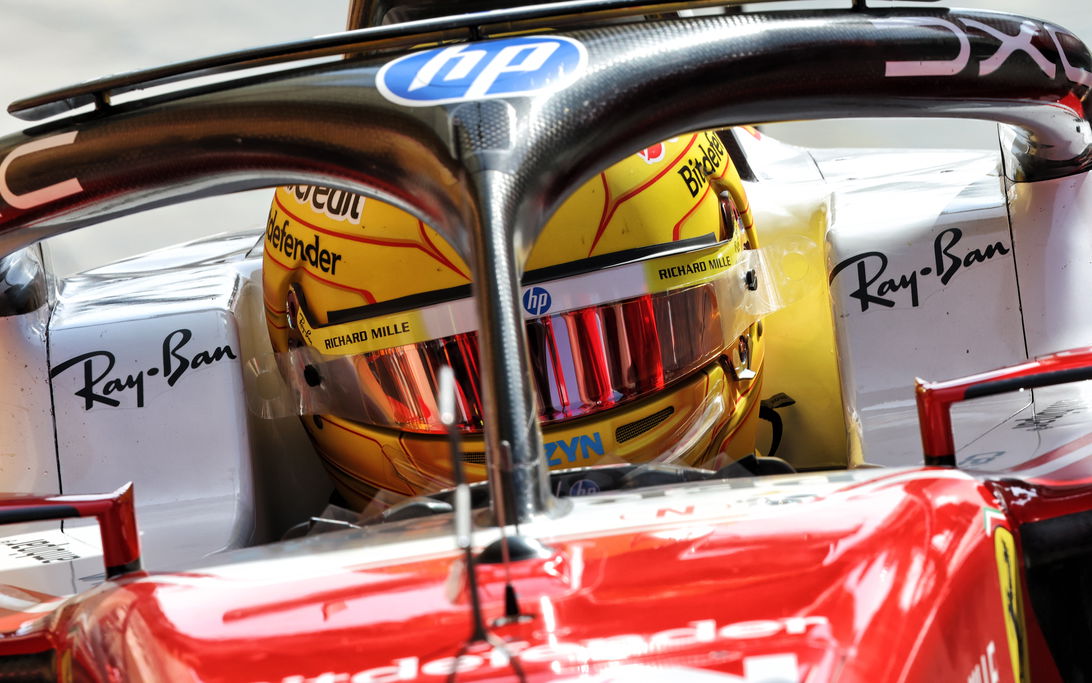
Lewis Hamilton does not believe F1 fans will be able to understand the complexities of energy management under the new power unit regulations, arguing people will "need a degree" to fully comprehend them.
The Ferrari driver labelled the situation "ridiculously complex" when speaking to media, including RacingNews365, after his four hours of running on the first morning of the first official F1 pre-season test at the Bahrain International Circuit.
Broadly happy with the new cars, the seven-time F1 drivers' champion maintains they are more "fun" to drive, but has commented on how they "feel" slower than F2 machinery.
With electrical and traditional combustion power at an even split in the new engines, finding lap time and energy management is a more involved process than during the original turbo-hybrid era, which began in 2014.
When it was put to Hamilton how difficult it is to understand how much of that is up to the driver and how much is down to software within the car, he replied: "None of the fans are gonna understand it, I don't think; it's so complex - it's ridiculously complex.
"I was sat in a meeting the other day, and they were taking us through it, and it's like you need a degree to fully understand it all."
Nonetheless, the 41-year-old added: "And in terms of managing it, it's pretty straightforward, I would say.
Expanding on his answer, Hamilton highlighted where the systems in place are an advantage, but also where they can be undone.
"Maybe in race trim is going to be different, we will see," the 105-time grand prix winner continued.
"But then there also is a system that can automatically, once you finish your lap, it learns the way that you're driving...
"But, say for example, you lock up and go wide and cover more distance, it affects that algorithm.
"So we're just trying to get on top of it and understand it - but everyone's in the same boat."
Also interesting:
In this video, we explore a fascinating Mercedes engine theory that is engulfing the F1 paddock. We break down how it works, why it matters, and why this advantage — if real — may be brilliant, legal… but only temporary.
Most read

In this article
Never miss a thing from the Formula 1 season! Add the 2026 F1 schedule to your calendar at the touch of a button. Subscribe below and put the dates and times of every race directly on your PC or smartphone, so you don't miss a second from the new season.
Download the F1 calendar Download the F1 calendar
A variant with just the race and qualifying is also available.
Click here to download it..





Join the conversation!