


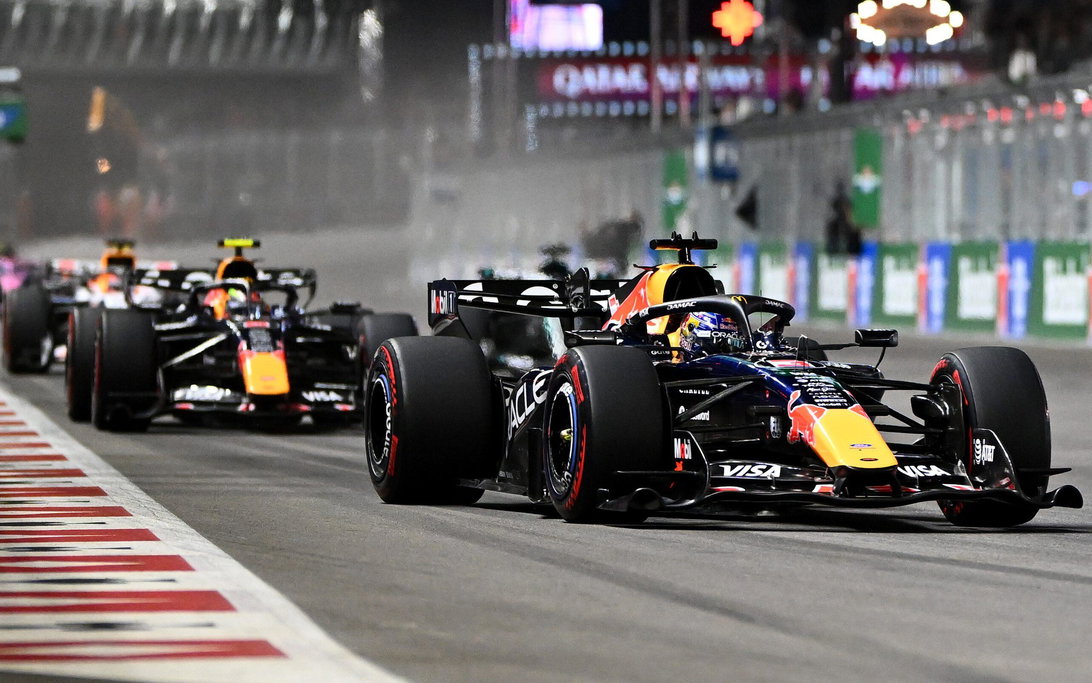
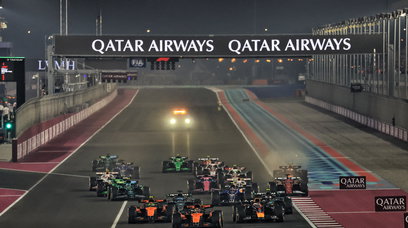
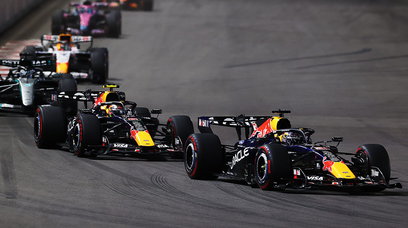
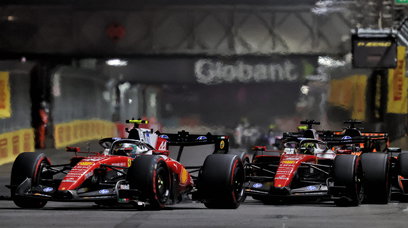
The Las Vegas Grand Prix was defined by something rarely seen in F1: cars running nose to tail not just in the opening laps, but for all 50 laps of the race.
It made for a genuinely unpredictable contest, with position changes rippling through the field from start to finish and keeping the outcome in doubt until the chequered flag.
In many ways, the race felt like a throwback to the start of the 2026 season, before teams had fully refined their energy deployment strategies on the new generation of power units.
But Las Vegas also carried a twist of its own. The slipstream effect on The Strip proved even stronger than at other high-speed venues such as Monza, handing any car following closely a genuine chance of a substantial advantage under braking, and with it, the chance to complete a pass.
The layout of the Las Vegas Strip Circuit, with few genuine braking zones to recharge energy and one long straight running the length of the famous boulevard it is named after, meant each team could tailor a precise deployment strategy to suit its own power unit.
[Article continues below]
 Las Vegas GP
Verstappen's late-race request
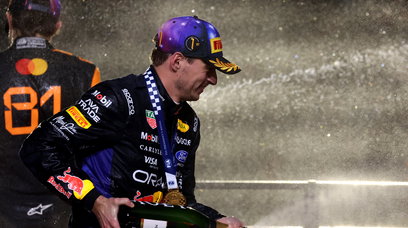
Notably, in the closing ten laps of the race, Max Verstappen asked his pit wall whether his power unit's energy deployment could be adjusted for the final straight, in search of an advantage over his closest pursuers heading into the last lap.
Red Bull's engineers, however, judged that the existing strategy was already the best available, with the point of maximum energy availability positioned just before the final corner.
In effect, what Verstappen was asking for was already built into the deployment mode chosen for the race.
Simulations and data gathered in practice had given every team a clear picture of which mode to run, based on both starting grid position and the specific characteristics and efficiency of each power unit and chassis.
The proof that this picture was broadly shared across the grid came in the sheer closeness of the field throughout the race, with the top ten cars covered by just three seconds for virtually the entire distance.
It is little surprise, either, that the RB22's performance proved closely matched to that of the Mercedes power unit in terms of raw output.
Mercedes retained a marginal edge in energy recovery, but the Red Bull-Ford unit was able to claw much of that back just past the midpoint of The Strip straight on pure internal combustion power alone.
The Las Vegas Grand Prix laid bare just how closely matched the 2026-specification power units have become, despite each manufacturer taking a different design philosophy to get there.
It is a pattern Formula 1 will hope to see repeated, and even sharpened, across more circuits next season, including those where energy deployment will carry far less weight than it did under the lights on The Strip.
Most read
In this article
Never miss a thing from the Formula 1 season! Add the 2026 F1 schedule to your calendar at the touch of a button. Subscribe below and put the dates and times of every race directly on your PC or smartphone, so you don't miss a second from the new season.
Download the F1 calendar Download the F1 calendar
A variant with just the race and qualifying is also available.
Click here to download it..


Join the conversation!