


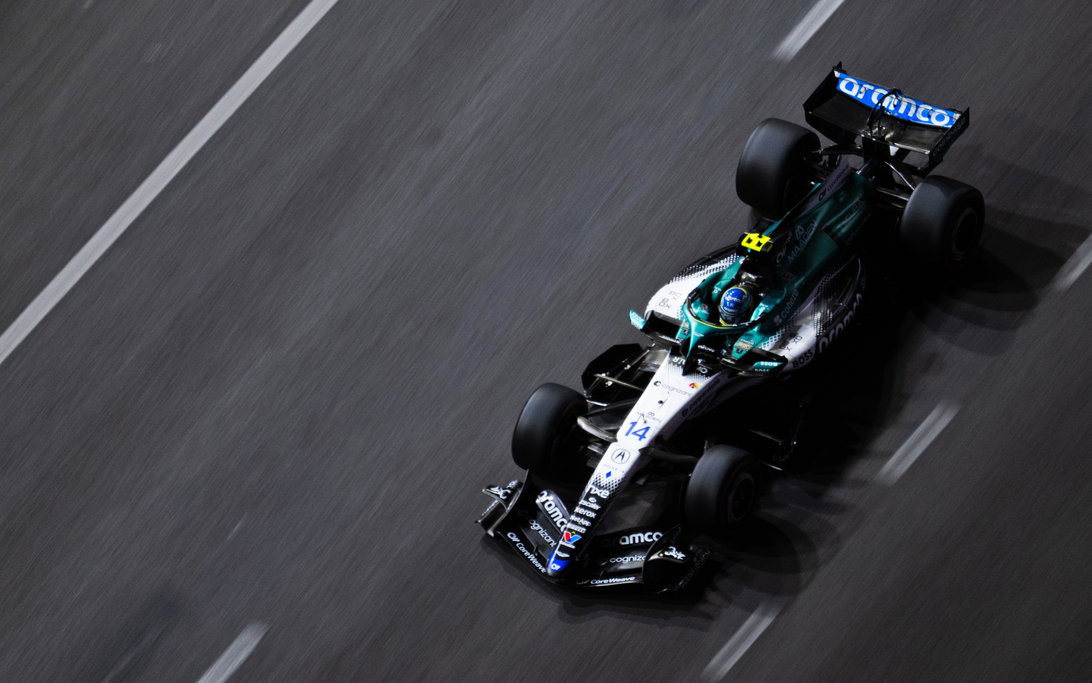
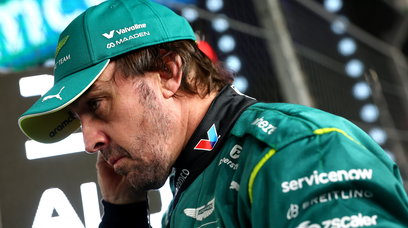
Honda has been unable to identify any problems with the power unit in Fernando Alonso's Aston Martin after he retired from the Las Vegas Grand Prix at the final corner.
Alonso pulled into the pit lane at the end of the 50-lap race in Sin City instead of taking the chequered flag, bemoaning an issue with his engine.
However, in the days since, the Japanese marque has still not been able to detect anything wrong with the unit, as it stated shortly after the race.
"We have checked all the data we have now, and during maintenance, we also checked the engine physically," said Shintaro Orihara, Honda's trackside general manager and chief engineer, to media, including RacingNews365.
"At this moment, we haven't found any issues with the engine from the data or from the maintenance. But we will check on Friday how the engine works on this track."
Alonso, who is missing media day at the Qatar Grand Prix as he recovers from a viral infection, is due to be back in his AMR26 for FP2 at the Lusail International Circuit, with Jak Crawford deputising in FP1.
Despite their accounts being at odds, Orihara was keen to express how much Honda "respect" the feedback provided by Alonso.
"We carefully analysed his comments, and we also respect his comments. That's why we checked all the data, and we also checked the engine condition," he said.
"But from the data, at the moment we haven't seen any issues. But as I mentioned, we should check again on Friday to get some feedback from Fernando."
[Article continues below]



What might be causing the disparity in accounts?
The Las Vegas Strip Circuit is an outlier on the F1 calendar and, due to the energy-poor, high-speed nature of the track, it is not a happy hunting ground for the underpowered Honda engine.
That paucity was exacerbated by the slipstream-fest that was experienced in Nevada, amplifying the shortcomings of the power unit.
"In Las Vegas, it's difficult to analyse how engine performance affects car speed; there is a lot of the tow effect, and also different energy management across two cars," Orihara added. "So our metrics say power itself is okay, but probably we should check carefully on these tracks again...
"Probably, this year, our engine performance is not enough to satisfy or give confidence to the drivers, and then probably they feel the engine performance is not great."
Mike Krack, Aston Martin's chief trackside officer, also defended the situation, stressing caution about jumping to conclusions over the disparity from the information and contradictory accounts from Alonso and Honda.
He detailed how the increased energy usage under the 2026 F1 power unit regulations can make it confusing for a driver to work out what is combustion power and what is from the battery.
"We need to be careful because the K [MGU-K] power is so much higher that as soon as you have even a small variation in K, it could feel like the ICE [internal combustion engine] — and you have different K power in different places," said Krack.
"So very often, for the drivers, it's much more difficult to judge than it used to be in the past. And I think some of it is coming from there."
Most read
In this article
Never miss a thing from the Formula 1 season! Add the 2026 F1 schedule to your calendar at the touch of a button. Subscribe below and put the dates and times of every race directly on your PC or smartphone, so you don't miss a second from the new season.
Download the F1 calendar Download the F1 calendar
A variant with just the race and qualifying is also available.
Click here to download it..



Join the conversation!