


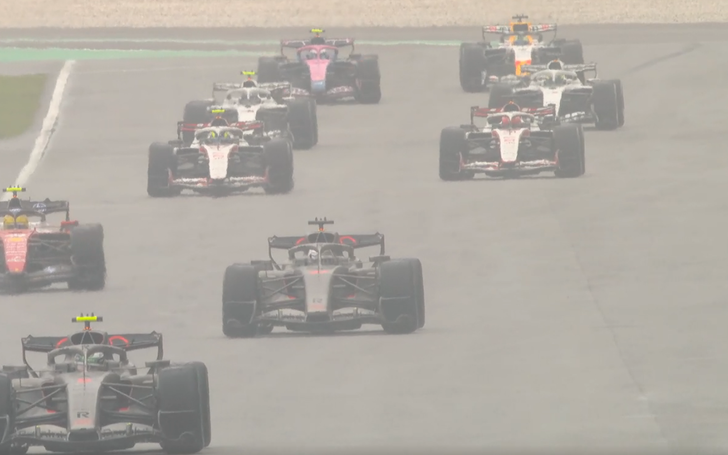
FIA single-seater director Nikolas Tombazis has issued an apology to F1 fans after a startling series of on-track stoppages caused a delay to the start of the Bahrain Grand Prix in Malaysia.
Following a postponement due to adverse weather conditions, the cars finally emerged from the pit lane behind the safety car in wet conditions some 40 minutes after the scheduled race start.
However, as they rounded the track, some cars began to slow down, with Max Verstappen at the head of the field highlighting that he felt as though he had no power.
Three cars were spotted stopping on the racetrack - Lewis Hamilton, Esteban Ocon and Valtteri Bottas - before they fired back up and got going again.
With the field running at such a slow pace behind Verstappen, who streaked into the distance, the four-time champion amazingly came around to lap the field, with the safety car now running behind some cars.
It caused the FIA to abort the start and, after all of the cars returned to the pit lane, the power units were diagnosed with a bug, which required a software update to fix.
Explaining the situation, Tombazis said: "There was a bit of a concertina effect between cars and some cars almost stopped completely.
"That bug prevented the power from being redeployed and for the cars to start again.
"If we had had a bit more testing, we probably would have managed to catch it in time and not to have such a situation.
"Once the problem happened, our guys realised very quickly what was happening and had to work under a lot of time pressure for an update to the software, which was issued to the teams, and the teams had to install it on their cars.
"So all of that took about 20 minutes. It may have felt like five hours for spectators waiting for a race and for everybody else, which is understandable.
"We are sorry about that, but I think it was quite a fast reaction given the problem."
[Article continues below]
 Bahrain GP
Tombazis: Software not tested in such slow conditions
The opening stages of the race around the Sepang International Circuit marked the first time this year the cars had run extensively in wet conditions.
With the wet surface under a formation lap naturally causing a lower-than-normal speed, the power units were effectively unable to keep firing.
Tombazis has acknowledged that the FIA missed putting the software through such tests at low speed when preparing it for its debut as part of the new cycle of regulations.
"The software was tested, it just wasn't tested in those specific conditions," Tombazis said.
"What caught us out was the fact that cars went at that very, very low speed, which was not normally contemplated.
"When problems happen, people learn. Everything you do, from the phone you're holding, everything is based on learning things and improving.
"I'm not saying that no error happened, the bug is, by definition, an error.
"Testing stuff better avoids errors. That's obviously what people try to do.
"Sometimes things fall through the net, and people learn, and you do a better job next time."
Most read

In this article
Never miss a thing from the Formula 1 season! Add the 2026 F1 schedule to your calendar at the touch of a button. Subscribe below and put the dates and times of every race directly on your PC or smartphone, so you don't miss a second from the new season.
Download the F1 calendar Download the F1 calendar
A variant with just the race and qualifying is also available.
Click here to download it..





Join the conversation!