


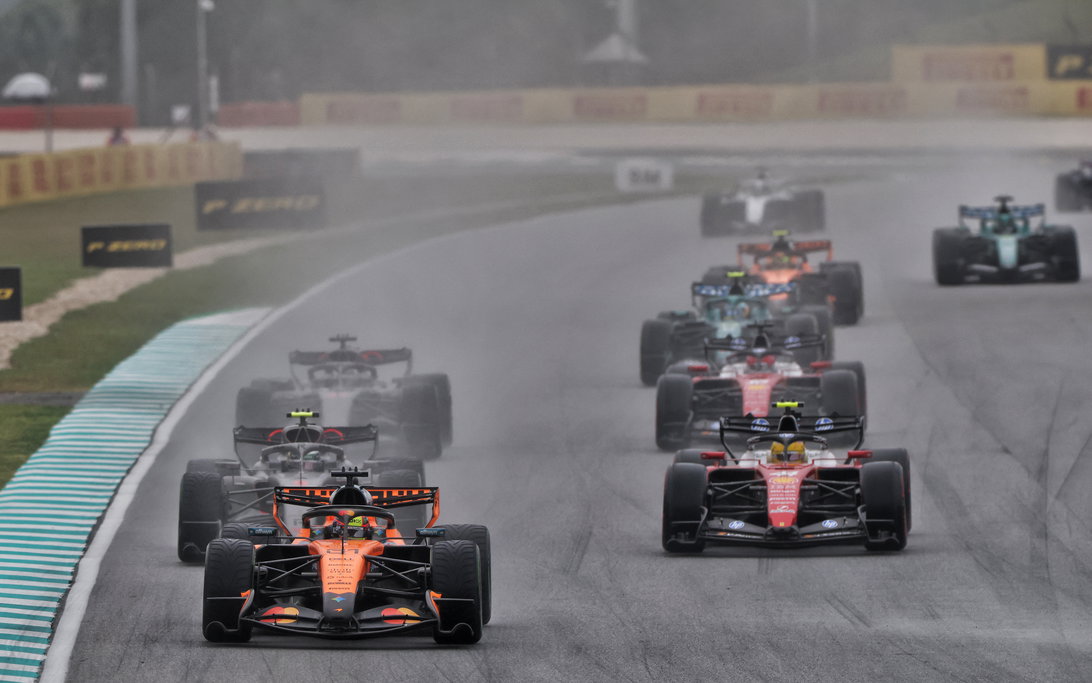
The FIA has explained why the software bug which affected F1 cars on the formation lap of the Bahrain Grand Prix was not previously detected.
Owing to the wet weather conditions at Sepang, the field was set for two laps behind the safety car to sight the track ahead of the race, but on the first of these, pole-sitter Max Verstappen's Red Bull slowed to a crawl, as he reported in that he could not accelerate.
Verstappen eventually got going again, but second-place starter Lewis Hamilton also slowed down and stopped on the track, with Ferrari telling him a software fix was being worked on as Esteban Ocon and Valtteri Bottas also stopped.
The starting sequence was then suspended and the red flags brought out as the cars returned to the pit-lane, with the race then starting without further incident after FIA technicians on-site worked out a software fix and patched this to all 22 cars.
The issues arose from a wet-weather mode in the software, which is used by all teams and power unit manufacturers, that trim the power available from the full, dry-weather 350kw to 250kw in the rain in certain areas of the track.
Only when the cars were going slowly on approach to the slow, uphill left-hander of Turn 9 behind the safety car did the problems begin - with cars not having run their power units in wet-weather modes in competition in 2026.
There has been some wet weather running, including at Suzuka for Racing Bulls and Fiorano for Ferrari, but this has been in Pirelli tyre testing, with some brief instances also during pre-season testing.
Explaining why the bug had not been caught, single-seater technical director Nikolas Tombazis explained that the "combination of events" on the formation lap was not something that had been foreseen.
"I think it was a combination of the very low speeds that were far lower than you would do in testing that caused it," Tombazis told media, including RacingNews365.
"I don't believe those tests were in any way representative of the situation in order to help us catch it in time.
"Software has to be tested in more detail, and I don't know whether unfortunately or not, but this year we've had, generally speaking, very good weather, and that's the reason why it happened so late.
"Any bug is a product of a mistake. I don't know any software that doesn't have bugs and updates.
"Of course, anticipating these things is what one hopes to do, but sometimes, a combination of events isn't properly anticipated and causes the problem."
The article continues below.
'This problem will never happen again'
Reflecting, Tombazis declared that whilst any similar problems in future could not be ruled out, the specific bug which had caused the issues in Sepang would not happen again.
"I mean, cars are complicated when you have electrical energy and combustion energy all working together," Tombazis added.
"Obviously, when you want to ensure sporting fairness between the teams, that is complicated. So we would all like it to be simpler, but the fact is, when you have as much electrical energy, it does make it more complicated.
"After every race, we have a long debrief afterwards, where we identify criticalities.
"Obviously, that was a major criticality, and we need to make sure we avoid it.
"But can I guarantee it will never happen again? This specific problem, yes.
"A problem, no. But we will do our best to avoid it, of course."
Also interesting:
Join RacingNews365's Ian Parkes, Sam Coop and Nick Golding as they look back on the Bahrain GP in Malaysia, but also look ahead to this weekend's race in Singapore. The confusing and shocking start is a major talking point as is Red Bull's rise.
Rather watch the podcast? Click here!


Most read




Never miss a thing from the Formula 1 season! Add the 2026 F1 schedule to your calendar at the touch of a button. Subscribe below and put the dates and times of every race directly on your PC or smartphone, so you don't miss a second from the new season.
Download the F1 calendar Download the F1 calendar
A variant with just the race and qualifying is also available.
Click here to download it..





Join the conversation!