


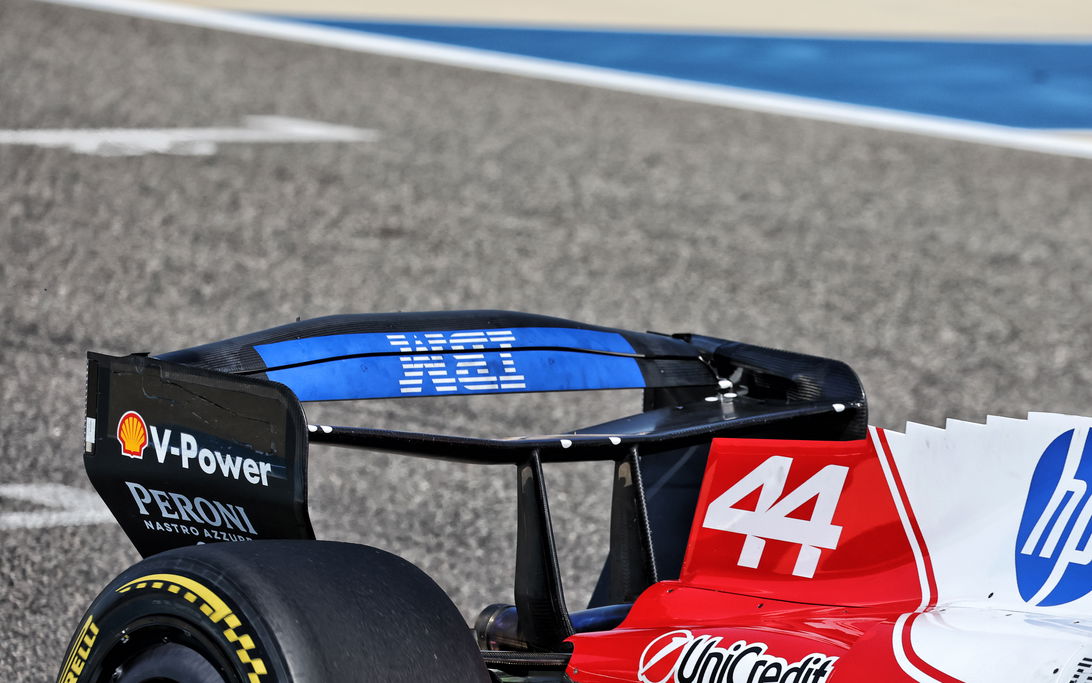
As the new F1 season ticks ever closer, it is Ferrari who has got the F1 world talking after a unique innovation was spotted at Bahrain testing on Thursday.
The entire Sakhir paddock was captivated by the rear wing flap opening mechanism on Day 2, the penultimate day of pre-season testing.
In a rather astonishing manoeuvre, the rear wing now appears to open 'upside down' when passing through the straight mode zones.
The engineers at Maranello have found an innovative solution by rotating the flap clockwise by 270°, with the flap assuming a position that is effectively opposite to its natural one, with the convex side at the top and the concave side at the bottom.
Through this, it assumes the same configuration as an aircraft wing.
The mechanism creates a drastic reduction in drag, much greater than that obtained by more conventional flap openings.
Article continues below the image
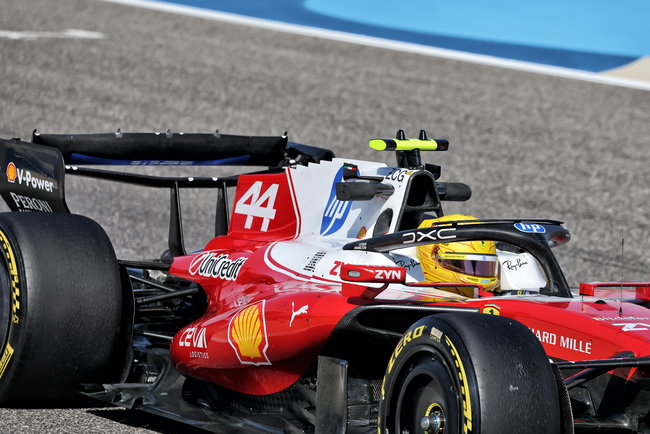
The function of the new Ferrari rear wing
While other openings only exploit the reduction in the vertical section of the flap when opened in a neutral position, with a 90° opening, the Ferrari system achieves two objectives simultaneously.
On the one hand, complete reversal implies that the space between the main plane of the wing and the flap, especially in the centre, is already greater than the section of the flap itself under normal conditions, due to the centrally arched profile that all flaps possess.
Furthermore, the complete reversal of the flap places it in a position of an aircraft that is capable of generating lift. In this way, albeit imperceptibly, with the flap open, the SF-26 lifts the entire rear end, thus increasing the expansion section of the diffuser.
To be precise, what is increased is what is known as the angle of attack with respect to the flow passing underneath. The increase in the angle of attack of the diffuser profile causes the flow to detach from it, inducing diffuser stall, and dumping the drag created from it.
In essence, with the 180° rotation of the wing flap, the drag is reduced so much that it can generate a significant speed differential at the end of the straights.
But in reality, this is not the objective, as it is more accurate to measure a significant decrease in energy required to propel the car, given a certain speed.
Although the advantage is bound to vary from track to track, on fast tracks such as Monza, Spa, Las Vegas and Jeddah, it could be substantial as it will greatly reduce dependence on energy in straight-line performance and thus facilitate recovery during lift and coast phases.
But it is not known whether this will represent an absolute competitive advantage for Ferrari and, above all, for how long - but it is fair to point out that it highlights an extremely accurate reading of the regulations, exploiting an area that has never been identified in this way before.
Also interesting:
Join RacingNews365’s Ian Parkes, Sam Coop and Nick Golding as they look back on last week’s first test in Bahrain and this week’s second test at the same venue. The trio debate Max Verstappen’s criticism of the regulations and whether Formula 1 is facing an identity crisis.
Rather watch the podcast? Then click here!


Most read









Never miss a thing from the Formula 1 season! Add the 2026 F1 schedule to your calendar at the touch of a button. Subscribe below and put the dates and times of every race directly on your PC or smartphone, so you don't miss a second from the new season.
Download the F1 calendar Download the F1 calendar
A variant with just the race and qualifying is also available.
Click here to download it..





Join the conversation!