


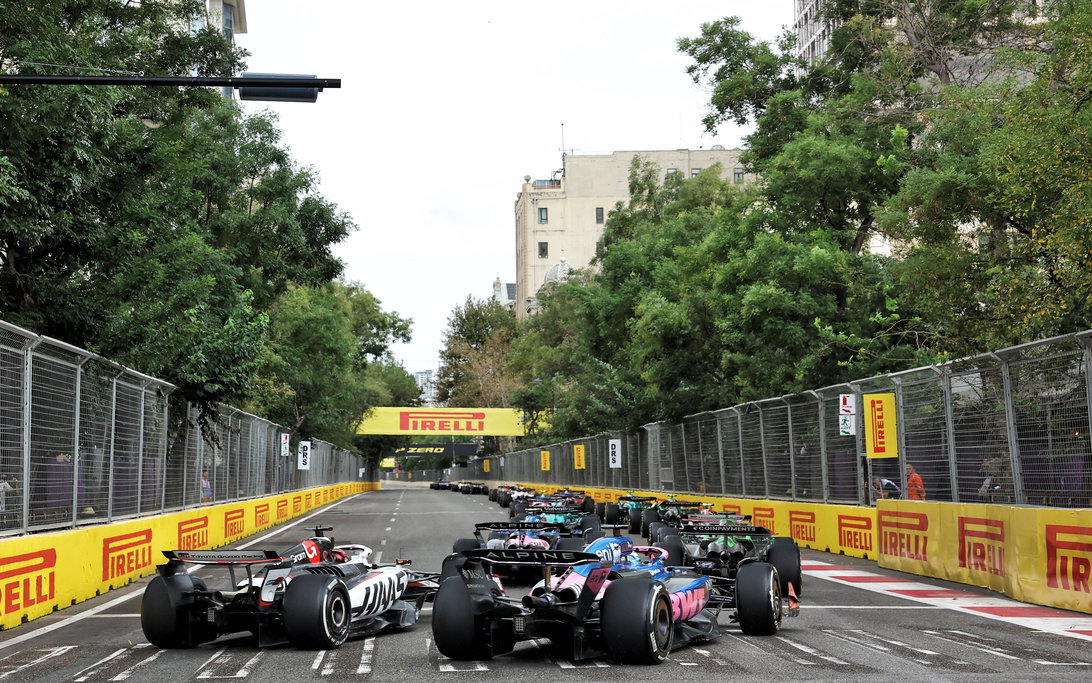
The Baku circuit represents an interesting challenge in terms of power unit recharging, specifically because of its layout, which includes a very long straight of more than 2,200 metres.
It is the longest straight of the entire season and raises questions among many people in the paddock about which recharging strategies will be adopted to optimise the performance of the cars.
The situation most similar to Baku seen so far is obviously Monza, where there were as many as four straight-line sections in which to deploy energy, as well as to carry out part of the recharging.
Baku can quite easily be divided into two primary sectors, in which, on the one hand, energy recharging can be unproblematic, before then adopting a long deployment on the main straight.
According to information RacingNews365 has gathered in the paddock over the last few grands prix, the common trend among the teams is to adopt a very progressive deployment, so as to reserve as little time as possible for the super-clipping phase in the final section before Turn 1.
But in reality, it appears that there are two schools of thought.
[Article continues below]
 Azerbaijan GP
The conundrum facing F1 teams in Baku
Among the teams powered by Mercedes, the super-clipping would instead take place in the central section of the straight, effectively splitting it into two sections, similar to what happened in Japan at Suzuka, around 130R.
In this way, power would be partially reduced for a shorter section before nevertheless arriving at the first braking zone with a strong energy charge, allowing the car to accelerate promptly afterwards.
The second approach to be tested will be the one that sees clipping reduced mainly to the braking phase before Turn 1, but it will be necessary to understand how much energy recovered during this phase will be sufficient to cover the subsequent sections, while always concentrating the clipping at the end of each straight in the first sector of the track and in the second sector.
There is no doubt that, as far as energy recovery is concerned, the strategies adopted in terms of ICE usage will also have a significant impact and will therefore be directly proportional to the residual power available.
In this regard, it is very important to consider that having a power unit with relatively few kilometres on it, and therefore a fresher engine, could provide greater guarantees.
The suggestion that Mercedes could replace George Russell's power unit in Azerbaijan would find an additional justification precisely in this - but fresh rumours have emerged suggesting that Mercedes might even wait until the Austin race to unlock the new PU for the British driver.
The teams will certainly use the first two free practice sessions to assess the pros and cons of each solution, considering not only overall performance, but also the capability resulting from the choice of which recharging mode to adopt, allowing for better opportunities to attack and defend during the race.
Essentially, it is a real puzzle that will determine the approach to the entire weekend in Azerbaijan.
Also interesting:
Join RacingNews365's Ian Parkes, Sam Coop and Nick Golding as they look back on the Spanish GP! The Madring layout and lack of overtaking is a major talking point, as is Lando Norris' cruel victory loss.
Rather watch this podcast? Then click here!


Most read


In this article
Never miss a thing from the Formula 1 season! Add the 2026 F1 schedule to your calendar at the touch of a button. Subscribe below and put the dates and times of every race directly on your PC or smartphone, so you don't miss a second from the new season.
Download the F1 calendar Download the F1 calendar
A variant with just the race and qualifying is also available.
Click here to download it..





Join the conversation!