


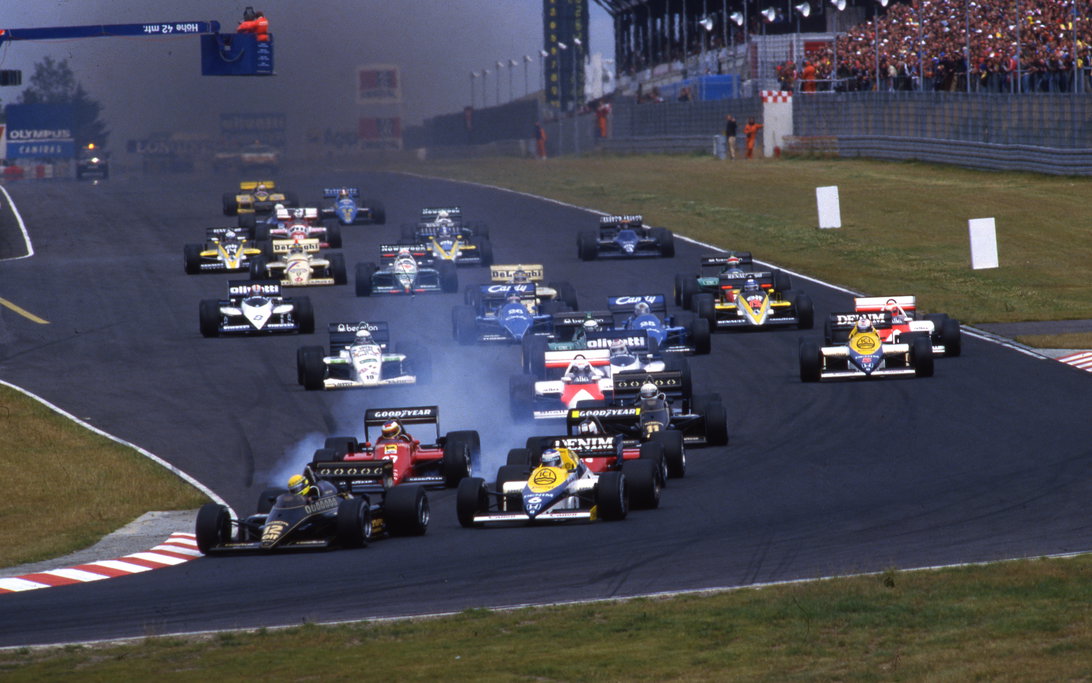
On this day, 4 August, 41 years ago, Formula 1 made a landmark return to the Nürburgring, a circuit whose very name had become synonymous with one of the championship's most terrifying moments.
The 1985 German Grand Prix, held on 4 August, was the first world championship race at the venue since Niki Lauda's horrifying, near-fatal crash in 1976, and it brought with it a piece of technology that would change the way fans watch racing forever.
Nine years earlier, Lauda's Ferrari had left the track at high speed on the Nordschleife's fearsome 22.8-kilometre loop, struck an embankment, and erupted into flames.
The Austrian suffered severe burns to his face and head and was given the last rites in hospital. The accident was the final straw.
F1 left the Nordschleife for good, its length, lack of run-off and impossibly stretched marshalling deemed incompatible with a modern grand prix.
Article continues below.
 German GP
New circuit, new era
Rather than attempt to modify the old Nordschleife, a purpose-built 4.5-kilometre GP-Strecke was constructed inside the complex and opened in 1984.
Some purists grumbled that only the Nordschleife could truly be called the Nürburgring, but for the FIA and teams, it was a modern facility fit for grand prix racing.
Equally significant was what viewers saw on their television screens. François Hesnault's Renault RE60, entered as a third car specifically for the purpose, carried a bulky camera on its right-hand side that beamed the first-ever live onboard footage during an F1 race.
Hesnault lasted only eight laps before clutch failure ended his afternoon, but in those brief minutes, a revolution in motorsport broadcasting was born. It remains the last time an F1 team entered more than two cars for a world championship event.
On track, Michele Alboreto produced a superb drive from eighth on the grid to win for Ferrari, crossing the line over 11 seconds clear of Alain Prost's McLaren.
Jacques Laffite hauled his Ligier up from P13 to complete the podium, while Niki Lauda, the man whose 1976 crash had triggered F1's departure from the Nürburgring, set the race's fastest lap and finished fifth.
Reliability proved the day's villain. Pole-sitter Teo Fabi retired his Toleman with clutch problems on lap 29, and Ayrton Senna, Nelson Piquet and Elio de Angelis all failed to see the chequered flag.
Alboreto's victory, his fifth and ultimately final win in Formula 1, extended his championship lead to 46 points over Prost's 41.
Ferrari topped the constructors' standings with 65 points to McLaren's 46. It was a high-water mark for the Italian and his team that season, as their title challenge would falter in the races that followed.
Also interesting:
Join RacingNews365's Nick Golding and Samuel Coop as they reflect on the first half of the 2026 F1 season, answering who they believe has been the best, most disappointing, surprised us and requires a huge end to the year.
Rather watch this episode? Then click here!


Most read
In this article
Never miss a thing from the Formula 1 season! Add the 2026 F1 schedule to your calendar at the touch of a button. Subscribe below and put the dates and times of every race directly on your PC or smartphone, so you don't miss a second from the new season.
Download the F1 calendar Download the F1 calendar
A variant with just the race and qualifying is also available.
Click here to download it..




Join the conversation!