


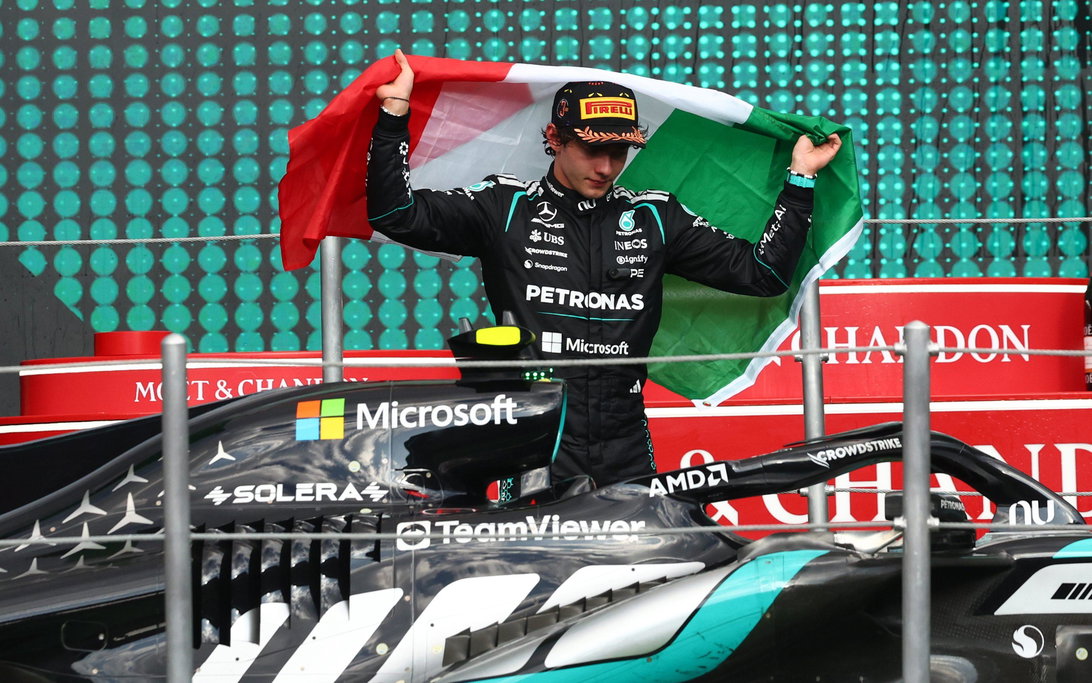
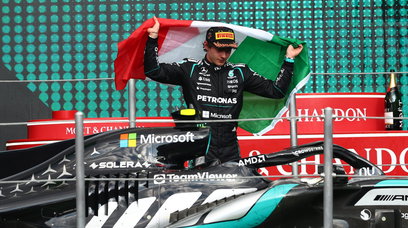
Kimi Antonelli secured the 2026 Formula 1 drivers' world championship in Mexico City, becoming the first Italian to claim the title since Alberto Ascari 73 years earlier.
That statistic alone underlines the scale of the achievement by the 20-year-old from Bologna, who found the ideal partner in his Mercedes W17.
More than simply a competitive car, it became the instrument with which Antonelli produced what can justifiably be described as a masterpiece.
But how good was the W17? Was it an overwhelmingly dominant machine, or an exceptionally strong car that was nevertheless far from perfect — and, crucially, difficult to extract the maximum performance from?
The answer lies in Mercedes' unconventional development philosophy and Antonelli's remarkable ability to exploit the car's strengths while working around its limitations.
[Article continues below]



Mercedes took a different approach to developing the W17
The W17 had already made a strong impression during pre-season testing, although much of the attention focused on the performance of the power unit developed at Mercedes' Brixworth facility rather than any particular advantage in aerodynamics, chassis design or suspension.
What was less immediately apparent was just how advanced the W17's overall concept already was.
Mercedes' technical team, led by James Allison, had approached the project with the conviction that the power unit would form the foundation around which the entire car should be designed.
That belief prompted an unusual development strategy, one that ran counter to both conventional practice and the approach Mercedes expected its rivals to adopt.
Ahead of the season, the widespread assumption throughout the paddock was that teams would introduce a steady stream of upgrades as they developed their understanding of the new generation of cars.
That proved to be the case for almost everyone — with Mercedes the notable exception.
Allison and his engineers instead chose to begin the season with a car that was already relatively mature. Its aerodynamic and mechanical solutions were not simply initial specifications awaiting substantial refinement, but designs that had effectively undergone much of their development before the opening race.
This allowed Mercedes to concentrate primarily on optimising its power unit and, importantly, establish a clearer picture of the advantage it held over the competition.
There was, of course, no absolute guarantee that the Mercedes power unit would immediately become the benchmark. However, the team wanted to eliminate potential distractions, particularly the uncertainty associated with a chassis that was difficult to set up.
It was therefore essential that the relationship between the chassis and aerodynamic package was already well understood, thoroughly validated and capable of delivering the required performance.
[Article continues below]
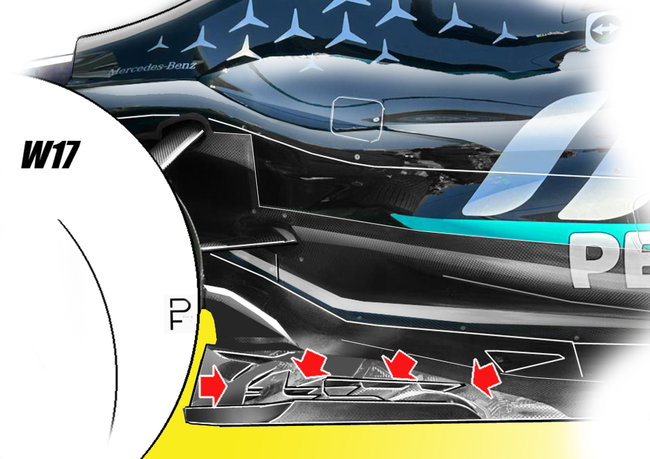
The W17's floor remained largely unchanged for much of the season, thanks to a highly refined and effective design that had already been established during pre-season testing.
Why the W17 played to Antonelli's strengths
Mercedes' development philosophy had two significant consequences for its drivers.
First, they needed to focus heavily on optimising the use of the power unit, particularly its electrical energy deployment.
Second, they had to adapt their driving styles to the car's existing aerodynamic and mechanical characteristics, knowing that major upgrades capable of fundamentally changing its behaviour were unlikely to arrive in the short term.
The combination of those demands highlighted Antonelli's exceptional qualities while also exposing some of the limitations of his team-mate, George Russell, despite the Briton's unquestionable speed and competitiveness.
With the exception of occasional standout performances from Russell, it was Antonelli who consistently transformed the W17 into a car capable of delivering lap times beyond the reach of its rivals.
A major part of that advantage came from the Mercedes power unit, which remains ahead of the competition, particularly in its management and deployment of electrical energy.
Antonelli proved remarkably adept at exploiting those characteristics.
Working closely with race engineer Peter Bonnington, better known as 'Bono', the Italian developed an almost entirely counter-intuitive driving style that allowed him to extract the maximum available performance with extraordinary consistency.
His ability to adapt to the demands of the power unit, without compromising the car's overall balance, became one of the defining factors in his championship success.
[Article continues below]
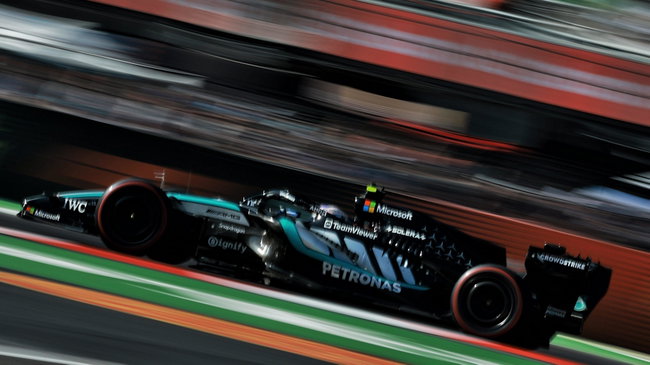
The W17's aerodynamic strengths – and hidden weaknesses
Although the Mercedes chassis and aerodynamic package were not necessarily the outright class leaders in every area, neither represented a significant weakness.
Indeed, both contributed important strengths to the W17's overall performance.
From a mechanical perspective, the chassis provided a relatively straightforward platform for establishing an effective set-up, allowing the tyres to operate within their ideal performance windows in most conditions.
Aerodynamically, the W17 combined strong efficiency with a well-balanced distribution of downforce.
It did not necessarily generate the highest absolute levels of downforce on the grid, but the way that load was distributed across the car proved particularly effective.
That balance helped make the W17 an exceptionally competitive package, even if extracting its ultimate potential required a highly specific driving approach.
The limitations of the original concept became more apparent when Mercedes introduced its first major aerodynamic upgrade package of the season at the Bahrain Grand Prix in Malaysia.
The changes centred on a revised floor and reshaped sidepods, but integrating the new components with the existing car proved more difficult than anticipated.
The upgrade package was only fully completed in Austin, where Mercedes introduced a new front wing.
That component had been set aside at the previous two events because of the difficulties encountered in making the earlier aerodynamic changes work as intended.
The experience demonstrated just how finely balanced the W17's original configuration had been, and why Mercedes had been reluctant to pursue the continuous development programme favoured by its rivals.
[Article continues below]
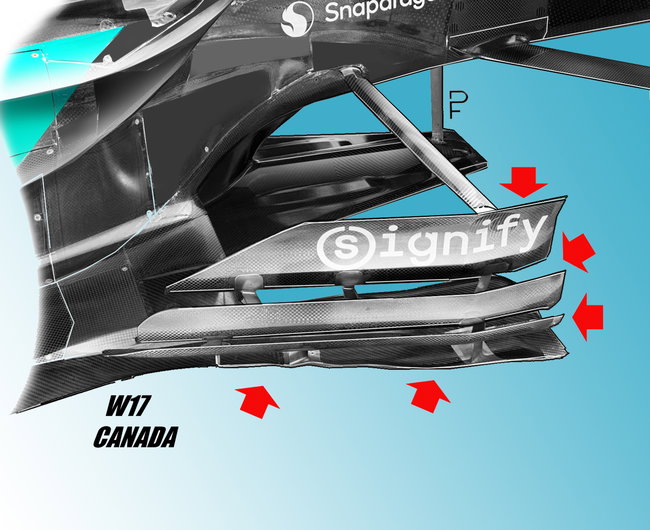
The bargeboards, the aerodynamic deflectors positioned ahead of the sidepods, were the only components to undergo substantial development before the major upgrade package introduced in Malaysia.
Mercedes introduced a revised specification in Montreal, designed to improve pressure management around the floor and optimise its aerodynamic performance.
How Antonelli unlocked the W17's full potential
Ultimately, the W17 proved to be a car with very few weaknesses, most of which were cleverly concealed by the strength of its overall package.
But that did not make it an easy car to drive at the limit.
Its performance depended on a precise combination of aerodynamic balance, mechanical set-up and, above all, intelligent management of the power unit's electrical energy.
While Russell was occasionally able to unlock that potential, Antonelli demonstrated an exceptional ability to do so consistently.
The Italian's achievement was therefore about considerably more than simply having the fastest car.
Mercedes provided him with an outstanding technical platform, but it was Antonelli's understanding of its characteristics, adaptability and unconventional driving technique that allowed him to make the difference.
The W17 may not have been a perfect Formula 1 car. In Antonelli's hands, however, it became the perfect championship-winning weapon.
And the 20-year-old mastered it.
Also interesting:
Join RacingNews365's Ian Parkes, Samuel Coop and Nick Golding as they look back on Mexico City but also look ahead to this weekend's São Paulo Grand Prix! Kimi Antonelli become world champion is a lead discussion, as is the latest Ferrari drama!
Rather watch this episode? Then click here!


Most read

In this article
Never miss a thing from the Formula 1 season! Add the 2026 F1 schedule to your calendar at the touch of a button. Subscribe below and put the dates and times of every race directly on your PC or smartphone, so you don't miss a second from the new season.
Download the F1 calendar Download the F1 calendar
A variant with just the race and qualifying is also available.
Click here to download it..


Join the conversation!