


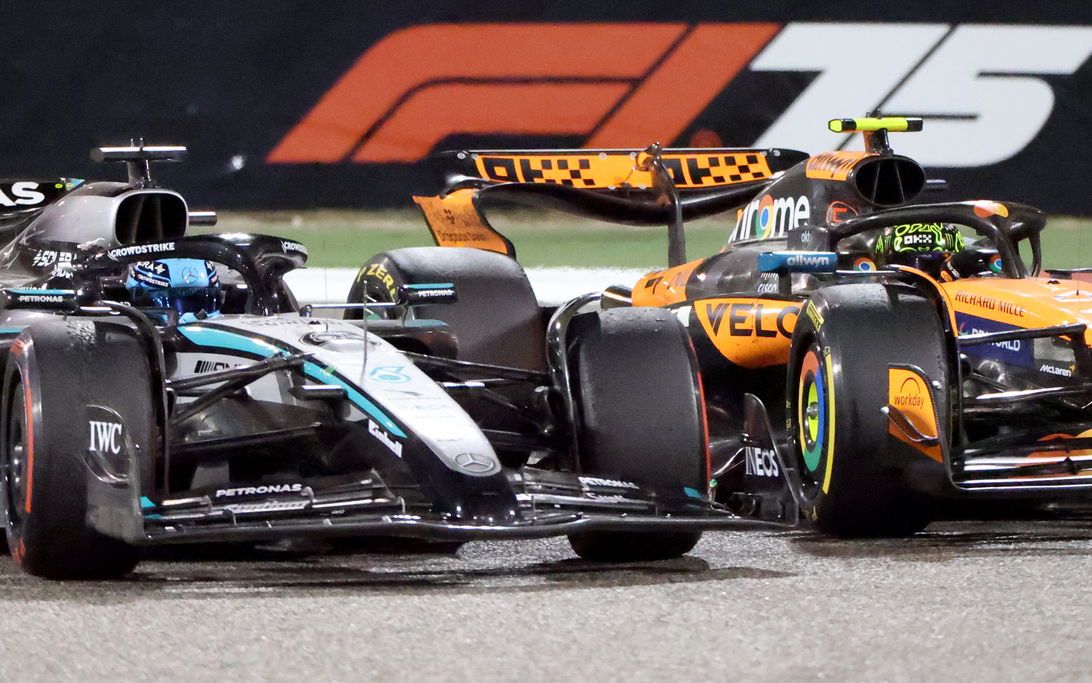
Mercedes is widely regarded as the favourite for the 2026 F1 season, but that assumption deserves closer scrutiny.
While the Silver Arrows' historical success and technical expertise are undeniable, recent seasons suggest McLaren should be considered at least an equal contender under the new regulations.
The 2026 rule reset will usher in one of the biggest technical overhauls in modern F1 history. Teams will introduce completely new cars and power units, with a far greater emphasis on electrical energy deployment and the use of active aerodynamics.
Set-ups will be adjustable on straights and ahead of corners, allowing teams to switch between optimal top speed and maximum downforce.
As ever in Formula 1, such sweeping changes reward teams that interpret regulations quickly and translate concepts into performance on track—an area where McLaren has excelled in recent years.
Naturally, speculation is rife over which teams and manufacturers have best mastered the new framework. Mercedes is frequently tipped as the benchmark, largely due to its dominance following the introduction of the V6 turbo-hybrid engines in 2014.
The Silver Arrows possess extensive expertise in electrical systems and hybrid integration, which could prove decisive under the 2026 power unit rules. Furthermore, paddock rumours suggest Mercedes may have identified an innovative approach to compression ratios, potentially delivering an early efficiency advantage.
Even so, it is striking how McLaren continues to sit firmly in Mercedes’ shadow in most 2026 discussions. Of course, the 2025 world champions are occasionally mentioned as title contenders, but rarely with the same conviction or expectation afforded to Mercedes.
Viewed by others:

The car as the benchmark
That imbalance in perception is particularly curious given recent form. Over the past few seasons, McLaren has left a far stronger impression than Mercedes on track.
The Woking-based team adapted rapidly to the ground-effect regulations, developing at remarkable speed and securing three world titles across two seasons. Crucially, McLaren achieved that success using the same Mercedes power unit as its rival.
In contrast, Mercedes endured a prolonged period of struggle between 2022 and 2025, failing to consistently extract performance from its own package.
The contrast underlines a key point ahead of F1 2026: engine strength alone does not guarantee success. Chassis quality, aerodynamic efficiency and overall integration remain decisive — and McLaren has repeatedly proven its strength in those areas.
Admittedly, the 2026 regulations will remove ground-effect aerodynamics, meaning all teams are starting afresh. But that reset does not automatically place Mercedes comfortably ahead of McLaren.
As a works team, Mercedes does enjoy certain structural advantages, including earlier access to power unit data and full control over design decisions.
Customer teams inevitably trail slightly in that regard, as they are effectively purchasing a finished product — although they are involved in the broader development process.
Still, that advantage has not prevented McLaren from outperforming Mercedes in the recent past.
Do not be surprised, therefore, if McLaren remains a leading force in F1 beyond the regulation change.
The technical department received a significant boost with the arrival of Rob Marshall, formerly one of Red Bull’s most influential engineering figures. His experience in translating major regulation shifts into competitive concepts could prove invaluable under the radically different 2026 framework.
It is also worth remembering that McLaren halted development of the MCL39 relatively early. With a sizeable performance advantage over its closest rivals, the team was able to divert resources towards the future sooner than most. The foundations for the next generation are firmly in place.
Whether McLaren can once again establish an early advantage in 2026 remains the great unknown. No team yet has a clear picture of the new competitive order—and that uncertainty is precisely what makes Formula 1 so compelling.
A rival may yet emerge with a decisive edge. But history shows that McLaren has repeatedly outperformed expectations, even against its own engine supplier. Writing them off now would be a mistake.
Also interesting:
The 2026 F1 Cars Revealed: Everything You Need to Know!
Discover how the 2026 F1 regulations will revolutionise the sport, with a shift to movable wings instead of traditional DRS, to the increased electrical power in the hybrid systems, and the introduction of 100% sustainable fuel.
Most read




Never miss a thing from the Formula 1 season! Add the 2026 F1 schedule to your calendar at the touch of a button. Subscribe below and put the dates and times of every race directly on your PC or smartphone, so you don't miss a second from the new season.
Download the F1 calendar Download the F1 calendar
A variant with just the race and qualifying is also available.
Click here to download it..





Join the conversation!